Tag Archives: nature

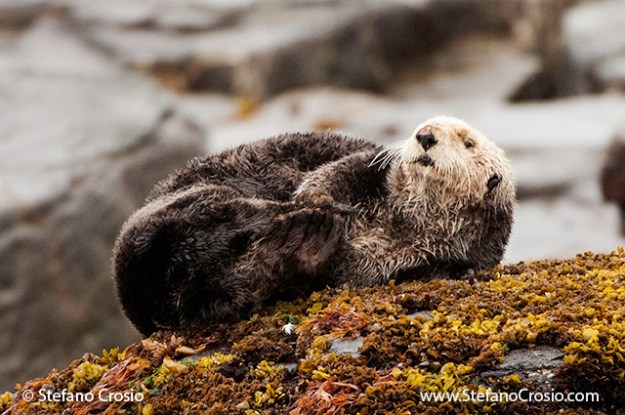
Sea Otter Resting on a Rock

USA, Afognak Island, Kodiak Archipelago (AK) Sea otter (Enhydra lutris)

Not long ago I have uploaded a new gallery to my Website showcasing images of certain Mustelids (Mustelidae), which is a family comprising some 54 species of carnivorous mammals such as otters, badgers, martens, wolverines and weasels. If you are interested, feel free to check it out.

The image on this post is of a sea otter (Enhydra lutris) in the Kodiak Archipelago, in Alaska.

Sea otters are members of the weasel family. They spend most of their time in the water (they even give birth in it!) but, in some instances such as the one recorded in the image above, they come ashore to sleep or rest.

Sea otters often float at the water’s surface, lying on their backs, often with a clam and a rock. Otters will place the rock on their chests, and repeatedly smash the shellfish against it until it breaks open so they can feed on the mussel. Otters sometimes float in forests of kelp in which they entangle themselves to provide anchorage in the swirling sea. Given all the time they spend in the water, sea otters have thick underfur that traps air to form an insulating layer against the chilly waters: this is particularly important as sea otters have no insulating fat (source: National Geographic).

If you would like to see more images of mine, feel free to browse my Galleries.

As per my copyright notice, please respect my work and do not download, reproduce or use the image above without first seeking my consent. Thank you :-)

A Snack on the Fly – Black-eared Kite

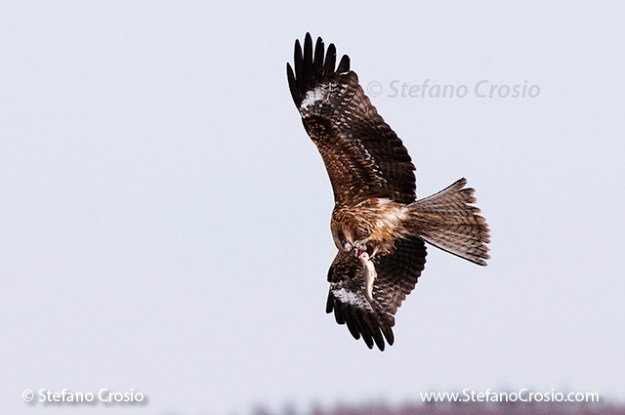
Black-eared kite (Milvus migrans lineatus) eating fish in flight

This image is of a Black-eared kite (Milvus migrans lineatus) eating a fish in flight: it is a shot that I particularly like because it shows an interesting behavior of the bird.

Black-eared kites are large birds of prey with dark brown plumage and black feathers over the ears. They have large wings (with a wingspan of about 50 to 60″/130 to 150 cm) and spend much of the time soaring and circling in the sky. Viewed from beneath, kites have prominent broad white patches under their wings, just before their dark wingtips. The end feathers often splay into “fingers” when they’re flying (source: Japan Times and Silly Reflections).

If you would like to see more images of mine, feel free to browse my Galleries.

As per my copyright notice, please respect my work and do not download, reproduce or use the image above without first seeking my consent. Thank you :-)

Alaskan Teddy Bear

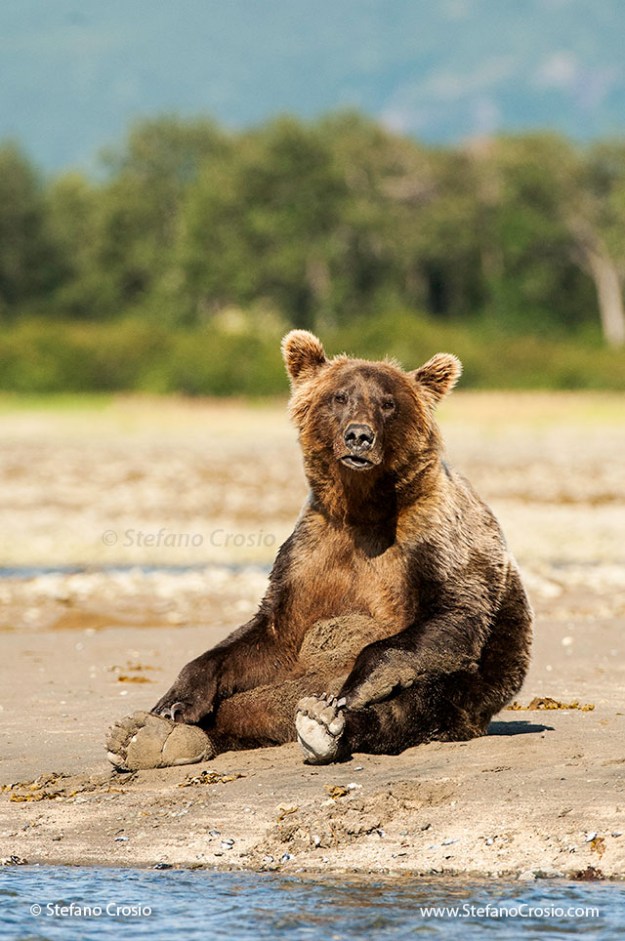
Coastal brown bear (Ursus arctos) sitting up

In the summer, Alaskan coastal brown bears (Ursus arctos) congregate near the shores of the sea and other bodies of water waiting for wild salmon to come back to the very streams they were born in and swim upstream to reach the headwater gravel beds of their birth and lay their eggs. Clearly, this offers the bears a wonderful opportunity to hunt salmon and feed off of their flesh and especially their eggs, of which they are particularly fond.

The salmon run is particularly important to the bears because the hibernation period is fast approaching and brown bears enter a phase known as hyperphagia where they maximize their food intake (they can eat up to 90 pounds of food per day!) to build up sufficient fat reserves to survive the hibernation months.

However, sometimes the salmon are a little late on their spawning schedule… or the bears are a little early for the party, which means that the bears have some time to kill while they wait for their favorite prey to arrive. So bears go into “energy saving” mode and they just lazily hang out near the water waiting for their lunch to be served.

The coastal brown bear in the image above was just sitting in the sun near a river in Alaska’s Katmai National Park, probably daydreaming of the hordes of sockeye salmon it will soon start chasing all over the place…

To me, it looked just like a teddy bear neatly arranged in a sitting position by a toy store salesperson! 😉

If you would like to see more images of mine, feel free to browse my Galleries.

As per my copyright notice, please respect my work and do not download, reproduce or use the image above without first seeking my consent. Thank you :-)

Yoga Meditation (or Balanced Rock at Twilight)

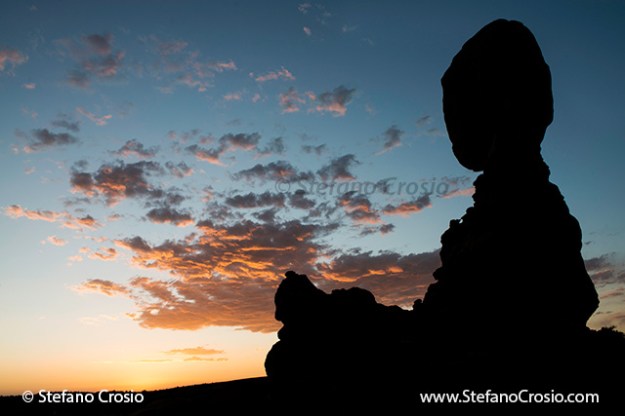
Balanced Rock at twilight

Shooting famous, over-photographed landmarks such as balanced rock in Utah’s Arches National Park challenges the photographer to come up with images that are not cliche, that portray such landmarks in a different light, from a different perspective or in a fresher way.

Silhouetting your subject may be a way to reinterpret such well-known scenes. Silhouetting essentially transposes your 3D subject into a 2D world, so shape becomes key for a successful silhouette. Thus, moving around your subject, changing your angle of view may radically  alter your final image, the 2D rendition of your subject.

When I saw a sunset with potential (because of some lingering clouds) behind me, I quickly hiked to the other side of balanced rock and moved around until that impressive rock formation took on the shape (at least in my eyes) of a person sitting before a beautiful sunset in a yoga meditation position. Click, click, and there we go: a symbolic rendition of balanced rock! 😉

If you would like to see more images of mine, feel free to browse my Galleries.

As per my copyright notice, please respect my work and do not download, reproduce or use the image above without first seeking my consent. Thank you :-)

Raw Moves: Three Reasons for Shooting RAW Instead of Jpeg

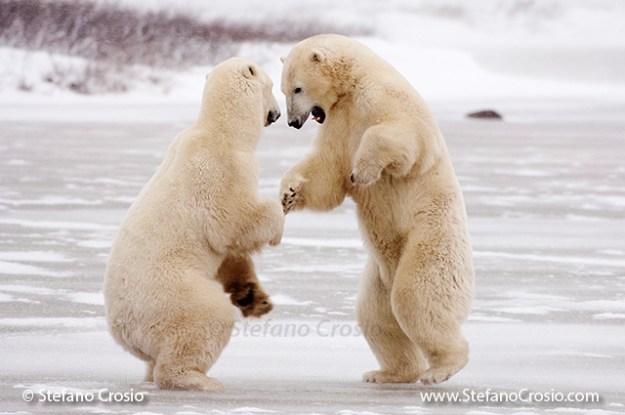
Polar bears (Ursus maritimus) play-fightingCaption: Canada, Hudson Bay – Polar bears (Ursus maritimus) play-fighting

A while ago, the exquisite Fairy of the North, Dina (who so elegantly authors the blog The World According to Dina, masterfully combining her beautiful images with perfectly selected quotes to complement them) asked me if I would write a post about why I think anyone who shoots digital and takes his or her photography seriously should shoot RAW as opposed to straight off the camera Jpegs.

By the way, before we even get to the point, what is a RAW file, just in case you were wondering? A RAW file is essentially the equivalent of a film negative in the digital age. Every camera manufacturer has their own proprietary formats of files containing the raw (hence the name), unprocessed input captured by the sensor. In fact, RAW files are called in several different ways and have different extensions, depending on the various camera makers: for instance, Nikon’s are called NEF and Canon’s are called either CRW or CR2, depending on the models.

Unlike straight out of the camera Jpegs (which are the result of the camera’s computer processing the sensor data, making arbitrary choices that you as the photographer cannot control and producing a file format that is immediately viewable by anyone), RAW files need to be processed through specialized software such as the camera manufacturer’s proprietary processing software or third-party software such as Adobe PhotoShop or Lightroom or Apple Aperture and then converted to a usable file format, such as TIFF, PSD or Jpeg.

In essence, processing a RAW file requires more of the photographer’s time because he or she has choices to make (in terms of optimizing white balance, exposure, contrast, color balance/saturation, etc.) but puts the photographer back in control of his or her creative decisions and what’s best, in a totally non-destructive, reversible way (more on this later).

Having said that, here are the three main reasons why I think you should set your camera to shoot RAW instead of Jpeg:

1. Unlimited White Balance Adjustments: This is one of the most powerful reasons for choosing a RAW file over an in-camera Jpeg. In short: if for any reason you shoot an image using a white balance setting that is not optimal for the scene you are shooting and you have your camera set to produce a Jpeg file, then you are stuck with that suboptimal white balance and changing it (or at least improving it) will be a difficult and time-consuming task to be performed in your image processing software. If instead you shoot RAW, you can easily correct your white balance with just one click in your processing software. Done!

2. Lossless Process: Jpegs are image files that are considerably smaller than other formats. This is because they utilize a compression algorithm that is lossy, meaning that it discards a bunch of color information from the image to make the file smaller. The more you compress, the more subtle color transitions and image sharpness you lose. In addition, image data loss is cumulative, meaning that every time you save or re-save a Jpeg file, you lose information that cannot be recovered later on. If you shoot RAW instead, you retain all of the information captured by your camera’s sensor, forever. This means not only that, should you need to perform some intensive editing of your image you will have more information to work on, but also and more importantly that you will forever retain full access to all the information that the sensor originally captured.

3. Non-Destructive, Reversible Editing: If you shoot Jpeg and then edit your file in post processing you can then either keep it as a Jpeg when you save it (in which case, all your edits will become permanent AND you will experience image data loss when you save your processed Jpeg) or work using layers (if available in your processing software). The latter is definitely the way to go, because layers can always be discarded later on, should you wish to process your image differently. However, Jpegs do not support layers, so if you use them and want to retain them, you will have to save your processed file in a format that supports layers, such as TIFF or PSD which are both lossless formats but end up in bigger file sizes. Instead, if you shoot RAW and process your RAW file, all your edits will be stored in a so-called “sidecar file”, meaning a small text file that goes hand in hand with your RAW file and contains all the information about the edits that you performed. This means that your RAW file will never be altered and you will always be able to change any of your edits at any time in the future with no damage to your image file or information loss. Pretty cool, huh?

As a final note, even if after reading these compelling reasons for shooting RAW 😉 you were to choose to continue shooting in-camera Jpegs, at the very least make sure that as soon as you download them to your computer you immediately save them to a lossless image format: as we said earlier on, not only will this let you retain your adjustment layers if you so choose, but it will avoid image degradation every time you re-save that Jpeg.
Standing Tall

Brown bear (Ursus arctos) and fireweed

I took this image of a standing European brown bear (Ursus arctos) with a backdrop of colorful fireweed in the summer in Finland, near the Russian border.  That area is known to have a fairly high concentration of bears and the very long summer days contribute to keep you shooting. This particular bear stood momentarily to watch out for a big male that was in the vicinities and I managed to take a couple of shots before the action was over.

You all have a great weekend!

If you would like to see more images of mine, feel free to browse my Galleries.

As per my copyright notice, please respect my work and do not download, reproduce or use the image above without first seeking my consent. Thank you :-)

Juvenile White-Tailed Sea Eagle in Flight… and The World According to Dina!

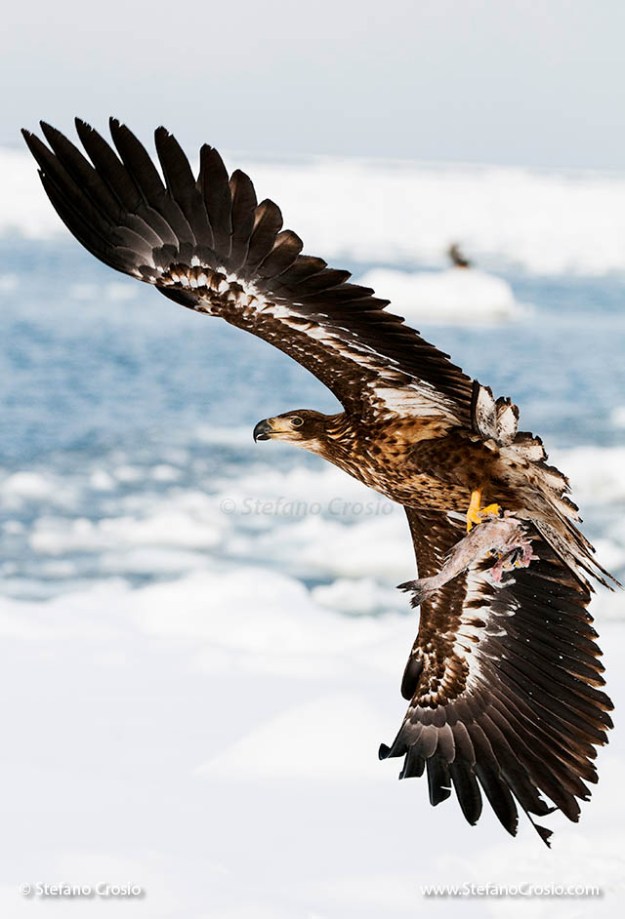
Juvenile white-tailed sea eagle (Haliaeetus albicilla) in flight

A new gallery with a selection of my bird images is now available on my Web site (feel free to go check it out, if you feel like it!): among other bird shots, it includes several images from my trip to Hokkaido, the northernmost of Japan’s largest island, where in the winter numerous white-tailed sea eagles, Steller’s sea eagles and red-crowned cranes congregate to hunt for fish.

This image of a juvenile white-tailed sea eagle (Haliaeetus albicilla) in flight is one of those rare moments that make the day of a wildlife photographer, when everything comes together just the way you wanted/hoped for! The sea eagle is tack sharp, it has got the fish in its claws, the entire wingspan (which, at over 2 mt/6.5 ft, makes them the fourth largest eagles in the world!) fits just perfectly within the vertical shot with no clipped feathers, and the eagle looked back at just the perfect time: man, what do you want more? 🙂

Also, a selection of Arctic and Subarctic images of mine has been published in the wonderful, inspirational, educational blog The World According to Dina, that revolves around pretty much everything having to do with the North of the world and her beautiful home country, Norway: please do yourselves a favor and pay my gracious hostess Dina (whom I wholeheartedly thank for inviting me as a guest author!) a visit and check out for yourselves how magical a place her blog is and how masterfully she juxtaposes her beautiful photographs with just the perfect quotes to go with them!

If you would like to see more images of mine, feel free to browse my Galleries.

As per my copyright notice, please respect my work and do not download, reproduce or use the image above without first seeking my consent. Thank you :-)

Landscape Arch at Night and a Few Night Photography Tips

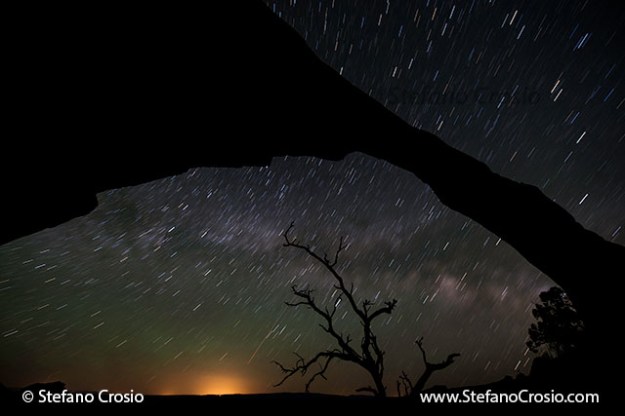
Landscape Arch at night

I took this image of Landscape Arch at Arches National Park at night (which you actually can see much better on my Web site), with the lights of the town of Moab in the background. With certain over photographed subjects, sometimes you need to be creative to come up with images that are not cliché and that still represent those towering creations of nature in their beauty and wildness. Night photography can be an option to resort to, if you are prepared to adjust your meal schedule around it and if you master the technique to get the shot.

A few tips on night photography:

1. Scout your spot earlier in the day to previsualize your shot and identify where precisely you will want to set up later in the day

2. Get to your spot before sunset so, if suitable, you can squeeze in some bonus sunset shots but most importantly you can set up your gear, frame your shot and focus when you can still see something!

3. If you shoot digital, (i) make sure the long exposure noise reduction function of your camera and, if it has one, its mirror lock up feature are activated; (ii) secure your camera to a sturdy tripod; (iii) with your camera in M exposure mode, set your aperture to a low f/stop (say anywhere between f/2.8 and f/4.0 or thereabouts) and set your shutter speed and ISO to a base exposure (of course, you will have to slow down your shutter speed as the night progresses); (iv) if you have a cable release (which you definitely should), connect it to your camera

4. Shoot a series of images, starting from twilight (when the sky will still be tinged with delicate orange, pink, magenta and violet hues) going forward to when the sky will turn pitch black, adjusting your exposure accordingly

5. Decide whether you want the stars to record as dots or streaks of light (star trails) and set your shutter speed/ISO accordingly (for best results, try to keep your ISO as low as possible, but you may have to compromise a bit): as a rule of thumb, bear in mind that anything slower than say 15/20 sec will cause at least some of the stars to streak noticeably – for pleasing star trails you will need exposures north of 30 seconds up to several minutes or even hours (the longer the exposure, the longer the trails – remember, every time you double the time the shutter stays open, with the others parameters staying the same, you add one extra stop of light to your exposure): this means that on your camera your shutter speed dial shall be set to Bulb and you will have to use a cable release and to experiment timing your exposure yourself (an illuminated digital watch may come in handy)

6. Be aware that the longer your exposure, the greater the chances that orbiting satellites and commercial airplanes will ruin your shot leaving all sorts of dotted luminous trails across it…

And by the way, today in the US is Nature Photography Day, a day that in the last 8 years has been designated by NANPA (the North American Nature Photography Association) “to promote the enjoyment of nature photography, and to explain how images have been used to advance the cause of conservation and protect plants, wildlife, and landscapes locally and worldwide”. So, if you are game, you might as well be inspired by the night photography tips on this post and go out with your camera and tripod tonight to give it a shot!  🙂

If you would like to see more images of mine, feel free to browse my Galleries.

As per my copyright notice, please respect my work and do not download, reproduce or use the image above without first seeking my consent. Thank you :-)

Great Basin Bristlecone Pine at Sunset

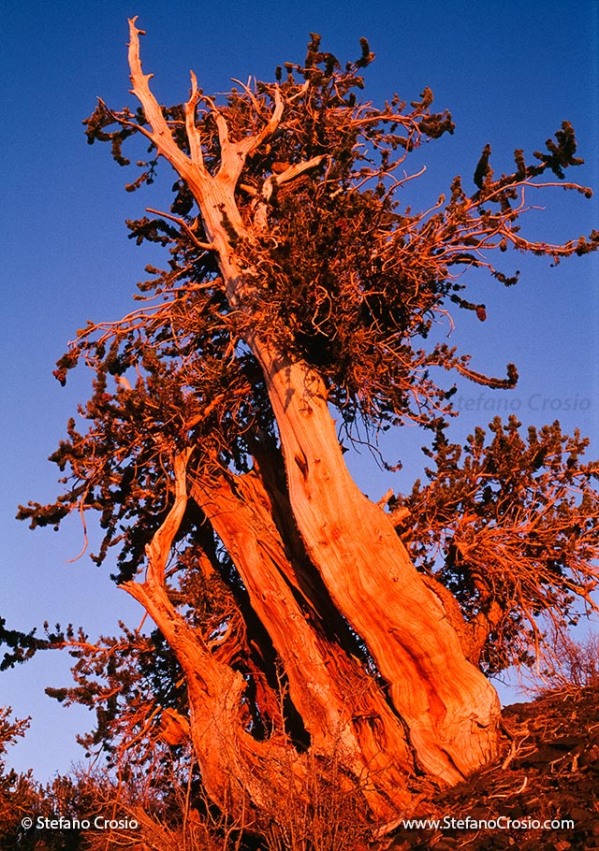
Great Basin Bristlecone Pine (Pinus longaeva) at sunset

This image is of a Great Basin Bristlecone Pine (Pinus longaeva) and it was made at sunset in the Inyo National Forest (CA): these trees can only be found in certain mountainous areas of California, Nevada and Utah and are really remarkable in that, with some of them being almost 5000 years old, they are the oldest living tree on earth.

Bristlecone pines have adapted to survive in extremely harsh and challenging environments. Typically, they live in high elevation habitats in areas with rocky soil, low rainfall and long winters.

They grow extremely slowly (a 40 year old bristlecone pine may not reach 6 inches!) and, at high elevations, they grow to 60 feet tall. Also, their needles can remain green for over 45 years. At low elevations, bristlecone pines grow straight, while at high elevations their trunks become twisted. Their root system is very shallow so as to allow maximum water uptake in arid environments.

For more information about these incredible trees, you may check out the relevant pages on the Websites of the National Wildlife Federation, the BBC, and the National Park Service.

If you would like to see more images of mine, feel free to browse my Galleries.

As per my copyright notice, please respect my work and do not download, reproduce or use the image above without first seeking my consent. Thank you :-)

Windows Arch and Turret Arch Before Dawn

Windows Arch and Turret Arch at twilight

Utah’s Arches National Park is a special place that rewards visitors with stunning red rock desert views and over 2000 natural sandstone arches and giant balanced rocks.

I captured the above image of Windows Arch, with Turret Arch in the background, at twilight, just before dawn, from a slightly elevated vantage point. Given the bright desert sunlight and the crowds that generally assemble around the most iconic features of the Park, photographing at the fringes of the day or at night are among the best options available to those who do not simply seek to bring home a snapshot from Arches.

Immediately before dawn, contrast is low and manageable but the sky is already lit and takes on delicate pastel tones that subtly complement the warm hues of the ubiquitous rocks and sand. Add a pleasing composition (especially if you are at one of those over photographed spots) et les jeux sont faits 🙂

Oh, and by the way, Happy Memorial Day! 🙂

If you would like to see more images of mine, feel free to browse my Galleries.

As per my copyright notice, please respect my work and do not download, reproduce or use the image above without first seeking my consent. Thank you :-)

Ever Heard of a Sik-Sik?…

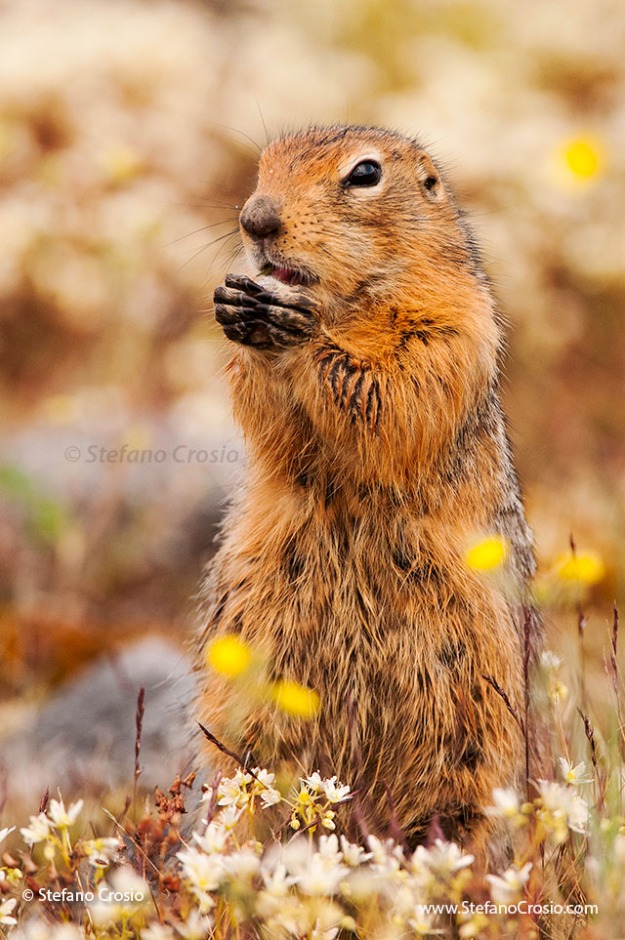
Arctic ground squirrel, or sik-sik (Spermophilus parryii)

Thought so. Quite honestly, neither had I – at least before I traveled to Canada’s arctic territory of Nunavut (I have published more photographs from that trip on thisthis and this previous posts). Up there, beyond Inuit, caribou, wolves, arctic hare, the occasional polar bear and billions of mosquitoes and black flies you can find… sik-siks, which is the kind of cute sounding way Inuit call arctic ground squirrels because of the sound they make.

Arctic ground squirrels (Spermophilus parryii) are the largest and northernest among North American ground squirrels. They seek shelter from the frigid tundra temperatures by building a maze of burrows in areas where the permafrost does not prevent digging.

Throughout the long acrtic winters sik-siks hibernate for 7 to 8 months a year. Now get ready for a super cool fact: “Researchers at the University of Alaska at Fairbanks have shown that during hibernation, arctic ground squirrels adopt the lowest body temperature ever measured in a mammal. [Their] body temperature […] drops below freezing, a condition referred to as supercooling. At intervals of two to three weeks, still in a state of sleep, hibernating squirrels shiver and shake for 12 to 15 hours to create heat that warms them back to a normal body temperature of about 98 degrees Fahrenheit [(about 36.5 degrees Celsius)]. When the shivering and shaking stops, body temperature drops back to the minimal temperature” (quoted from the Denali page of the National Park Service’s Web site).

By the way, I have uploaded a new gallery to my Web site with a selection of my images of rodents and lagomorphs (i.e., rabbits and hares – no pikas, sorry): feel free to go take a look if you feel like it!

If you would like to see more images of mine, feel free to browse my Galleries.

As per my copyright notice, please respect my work and do not download, reproduce or use the image above without first seeking my consent. Thank you :-)

Happy Mother’s Day!

In a rare (at least for this blog!) multi-image post, here’s to all the Mothers who enjoy reading Clicks & Corks and to the Mothers of all of our readers!

Which of these mommies do you, or your Mom, relate more to?  😉

Happy Mother’s Day!

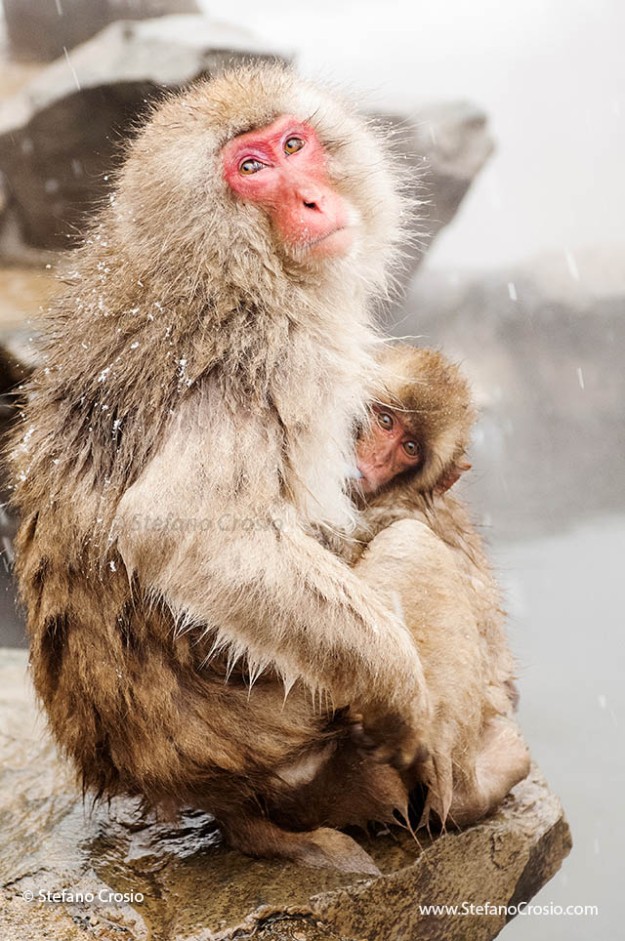
Snow monkey (Macaca fuscata) nursing her baby

Protective?

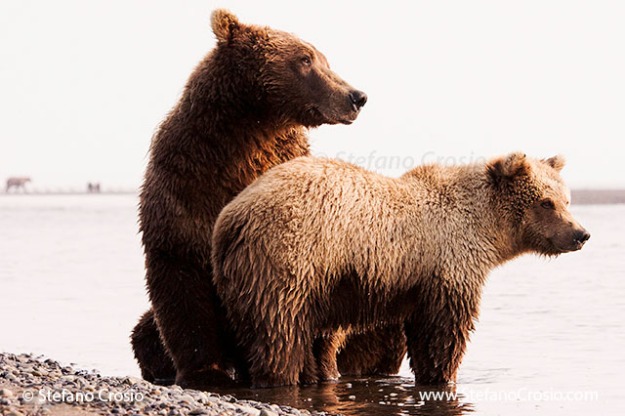
Coastal brown bear (Ursus arctos) sow with cub

Romantic?

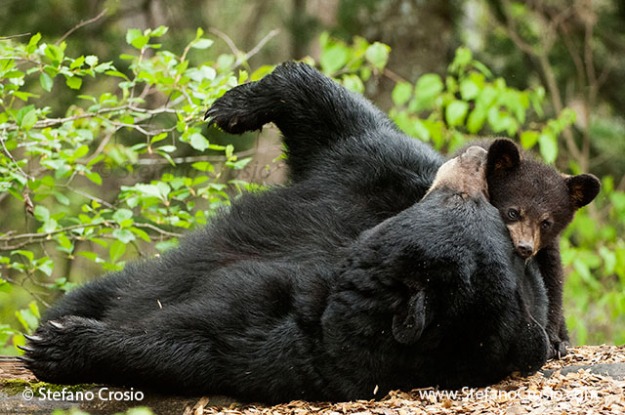
Black bear (Ursus americanus) sow play-fighting with cub

Playful?

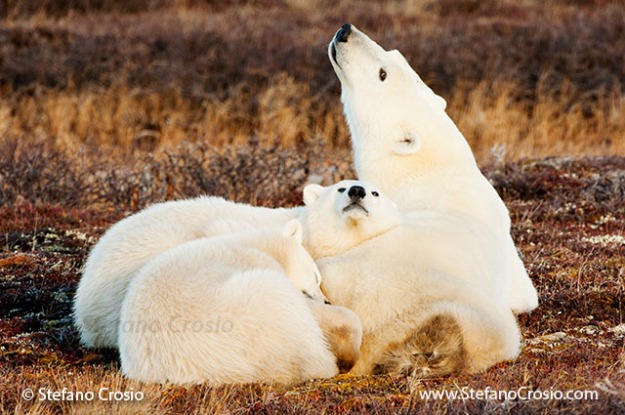
Polar bear (Ursus maritimus) sow with cubs

Cuddly?

The River

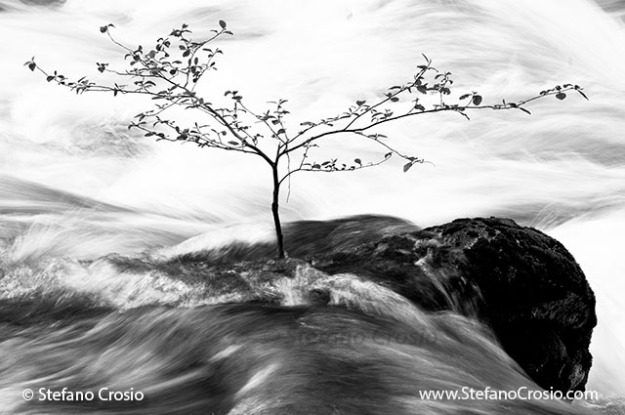
Stubborn dogwood (Cornus nuttallii Audubon)

Readers who have been following this blog since the inception may recall that I very much like dogwood, of which I have already published a close-up of a blossom in a previous post.

This photograph of a small dogwood tree, stubbornly clinging to a rock in the middle of an impetuous river is another image that I hold dear because I think it clearly conveys a message of resilience and will to survive against all odds. Two very positive messages, if you ask me.

The black & white rendition simplifies the image to its graphic elements and amplifies the yin-yang contrast between the dark and the light portions of the image, that balance each other out nicely, as if divided by an imaginary diagonal line.

Oh yeah, the title for this post pays homage to my favorite Springsteen song 🙂

If you would like to see more images of mine, feel free to browse my Galleries.

As per my copyright notice, please respect my work and do not download, reproduce or use the image above without first seeking my consent. Thank you :-)

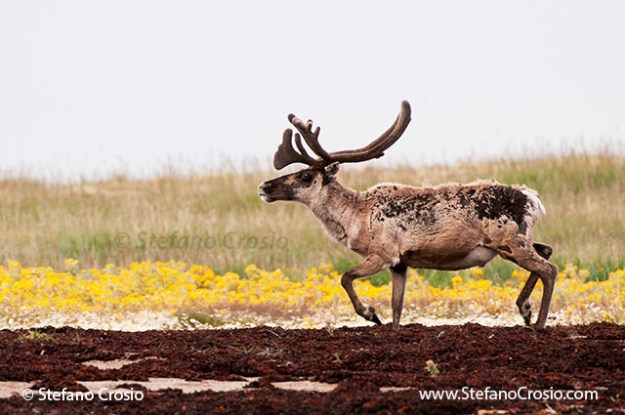
Barren-Ground Caribou Bull

Barren-ground caribou bull (Rangifer tarandus groenlandicus)

I took this image of a barren-ground caribou bull (Rangifer tarandus groenlandicus) during my trip to Canada’s arctic territory of Nunavut (by the way, I have published other photographs from that trip on this and this previous posts).

This bull was strutting on a Nunavut beach, stomping its hooves on a layer of dried sea weed that the high tide had left behind and in so doing the animal was making literally hundreds of black flies come out of those sea weed for the joy of both the caribou and… the photographer! Whenever the wind dies down in the tundra, black flies and mosquitoes fill the air and become a major nuisance. This image was taken in the summer, when caribou shed their winter fur and leave patches of skin exposed to mosquito or black fly bites.

Anyway, to me the key points in this image are the position of the caribou, with two raised legs to convey a sense of motion, and the graphic four-layer background, which appears to be interestingly divided into four bands of brown, yellow, green and cyan.

If you would like to see more images of mine, feel free to browse my Galleries.

As per my copyright notice, please respect my work and do not download, reproduce or use the image above without first seeking my consent. Thank you :-)

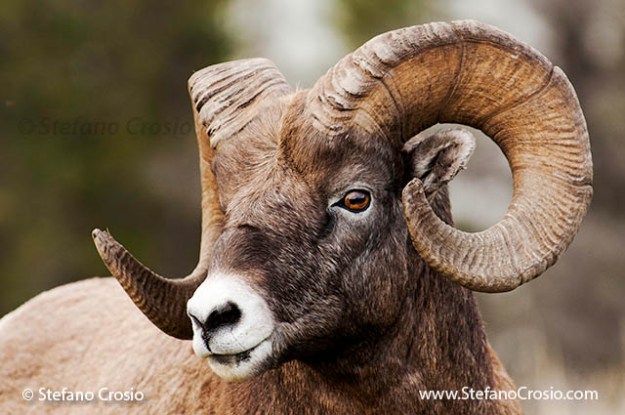
Bighorn Sheep Portrait

Bighorn sheep (Ovis canadensis)

I have uploaded a new gallery to my Web site with a selection of my bighorn sheep (Ovis canadensis) images taken in Canada’s Jasper National Park: feel free to go take a look if you feel like it.

The image above is a sample from that gallery: a few hours “invested” following a herd of bighorn sheep during their grazing rewarded me with a few photographs that I am happy with. This one is a head shot of a beautiful individual who let me approach at a safe but relatively close distance. I am fond of this image because I think it shows the character of these animals, highlighting their most distinctive feature: those majestic, weathered, curled horns in a graphic way, while the soft, diffused light of an overcast day limits contrast and allows viewers to see every detail of the subject’s face.

The gallery contains a collection of different images, some of which will be the subjects of future posts because they are interesting behavioral shots of these animals.

if you have the opportunity to check them out, let me know what your favorite ones are!

If you would like to see more images of mine, feel free to browse my Galleries.

As per my copyright notice, please respect my work and do not download, reproduce or use the image above without first seeking my consent. Thank you :-)

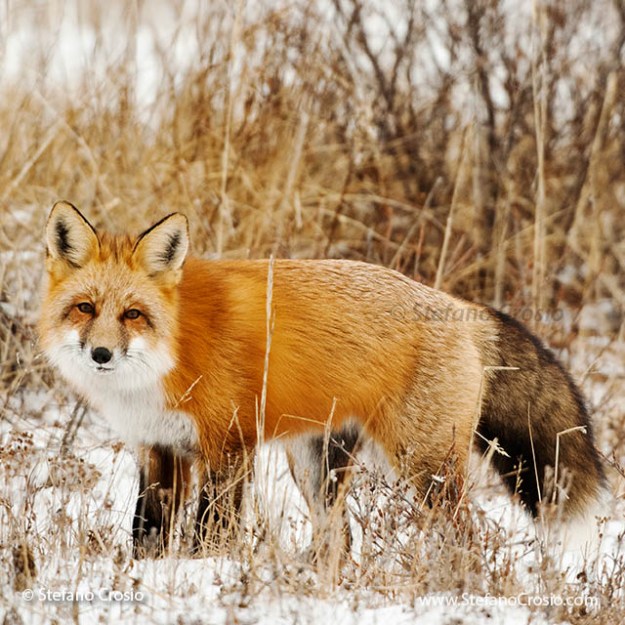
Portrait of a Red Fox

Red fox (Vulpes vulpes)

I like foxes: I took this photograph of a red fox (Vulpes vulpes) in Manitoba, Canada, not far from where I photographed the arctic fox that I posted about a while ago. This red fox stuck around for a little while, looking at me and my tripod with some curiosity, before moving on in search of prey in those barren, wintry grounds. I love how it really looks in its prime, with that wonderful fur and tail, in the soft, diffused light of a nice overcast day, just perfect for a portrait!

If you would like to see more images of mine, feel free to browse my Galleries.

As per my copyright notice, please respect my work and do not download, reproduce or use the image above without first seeking my consent. Thank you :-)

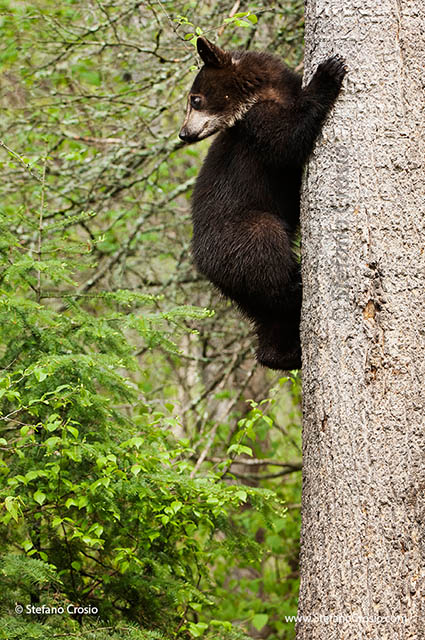
Black Bear Cub Climbing a Tree

Black bear (Ursus americanus) cub climbing a tree

Black bears (Ursus americanus) are proficient climbers. They use their curved claws to cling to the bark and quickly climb high into trees. Generally, they do it to escape danger (it is common behavior for cubs), to eat the nuts or fruit in the tree, or to rest or sleep at the juncture between branches and trunk. In this image, a young black bear is descending a tree after an excursion to the canopy. It is amazing to see how even little bears will climb quickly and with dexterity all the way to the top branches of tall trees and perch there for a nap, with no fear of heights.

By contrast, grizzlies have longer claws that are not as well suited for climbing, which makes them not as effective a tree climber as black bears. This does not mean, however, that grizzly bears cannot or will not climb a tree. They certainly can, they are only clumsier than black bears (given also their heavier structure) so to climb a tree they often resort to hugging the tree and pulling themselves up, using branches as if they were the steps of a ladder.

Anyway, should you experience a close encounter with a bear in the wild, follow sensible bear safety procedures and avoid climbing a tree because chances are that either species of bears will climb it at the very least as well as you can!

Some useful online resources about bears and their behavior can be found at:  

Bear Aware

Bear Country USA

Denali National Park and Preserve

National Geographic Magazine

North American Bear Center

If you would like to see more images of mine, feel free to browse my Galleries.

As per my copyright notice, please respect my work and do not download, reproduce or use the image above without first seeking my consent. Thank you :-)

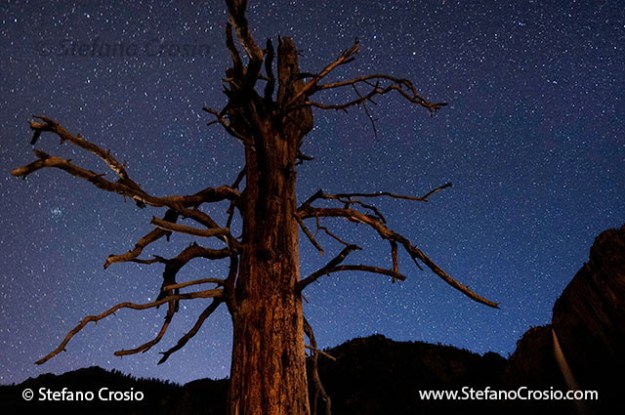
Painting with Light: Incense Cedar Tree at Night

Incense cedar tree at night in Yosemite Valley, CA

This image was taken at night in Yosemite Valley, CA, where I set up my tripod before dark, focused my wide angle lens on this gnarled incense tree in the background, set a base exposure, composed my shot paying attention that no branches of the tree intersected the top of the surrounding mountains and waited for darkness to descend. Then it was just a question of taking several shots at different times at night, with the sky taking on different hues, and sometimes experimenting with “light painting”, as in this image.

Painting with light is a hit and miss technique that may be performed in night photography situations, and that is achieved by shining a flashlight on the foreground subject, or anyway a foreground element, to accentuate it and give it some texture in the final image. There are no hard and fast rules for how long to light your subject, and the photographer is best advised to take several shots with different intensities of lighting, as there is no way of telling which one will turn out to be the most pleasant one. On those circumstances I always take a few shots in full darkness too, with the tree that is completely silhouetted against the lighter sky, because sometimes those may turn out to be the best option.

In this case, however, I think the moderate amount of “light painting” on the incense tree works to the benefit of the image as it gives kind of an eerie feel to the gnarled tree, accentuating its tortured limbs that stretch out in all directions and one of which points to Yosemite Falls.

If you would like to see more images of mine, feel free to browse my Galleries.

As per my copyright notice, please respect my work and do not download, reproduce or use the image above without first seeking my consent. Thank you :-)

Bugling Elk

CANADA, Jasper National Park - Bugling elk (Cervus elaphus)

The image above shows a bugling elk in Jasper National Park, Canada, with traces of fresh wounds that it probably suffered in a fight with another bull.

During the mating season in the Fall, bull elk (Cervus elaphus) are used to bugling, that is sending out long, high-pitched rutting calls that can be heard for miles to attract cows or threaten other bulls. Bugling is often associated with the opening of the elk’s preorbital gland to release a scent that should further attract cows.

At that time of the year (September/October), bulls are nervous and aggressive, and this often reflects in their behavior, such as when they stick the tips of their antlers into the ground to dig holes, spray urine or even engage in battles with other bulls over cows or to establish dominance.

Especially during mating season, it is important to be cautious approaching elk because getting too close may (and often will) result in becoming victims of an elk charge or even worse being gored by elk. Photographers and wildlife enthusiasts should not invade the animal’s comfort zone and be watchful for body signs that may signal stress in the animal and the risk of an imminent attack, such as stomping the hooves on the ground, lowering the ears, strutting, etc.

If you would like to see more images of mine, feel free to browse my Galleries.

As per my copyright notice, please respect my work and do not download, reproduce or use the image above without first seeking my consent. Thank you :-)

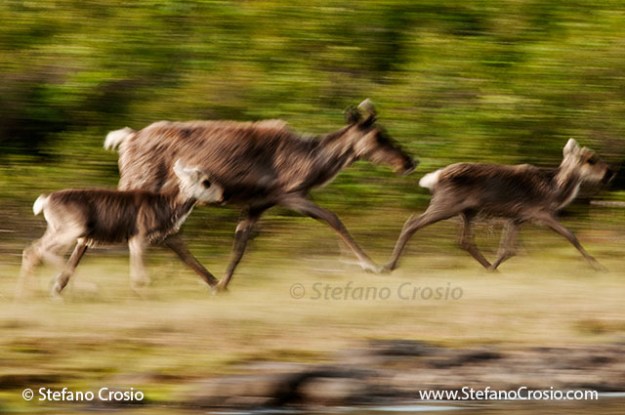
Pan Blur Technique and Barren-Ground Caribou

Pan blur of barren-ground caribou (Rangifer tarandus groenlandicus)

Before getting to the point of this post, let me just quickly say thank you to all of you who have been reading and following Clicks & Corks so far: this new blog was officially launched on February 10 and less than a month later it has had over 1,000 views, 210 comments and 71 followers. Your support and your active contributions to C&C are nothing short of exceptional and they are a phenomenal reward to the effort that goes into trying to publish quality content that hopefully many of you may find interesting and worth reading or viewing. Once again, thank you.

But let’s move on to today’s subject: pan blurs. Pan blurs are fun to do and sometimes they may offer a solution when freezing an action shot either is not an option or would not yield an interesting enough visual result (as would have been the case with the running barren-ground caribou cow and calves (Rangifer tarandus groenlandicus) that are portrayed in the image above).

Successful pan blurs convey a sense of motion in a painterly, sort of impressionistic way, as if the “light painter” behind the lens (all photographers are essentially painters who rely on the qualities of light instead of paint and paintbrushes!) had chosen a quick, thick and essential brushstroke style.

The situations in which I find myself using the pan blur technique the most are those when my subject is in motion and either light levels are so low that attaining a fast enough shutter speed to freeze the action would be impossible or impractical (as is often the case when photographing at the fringes of the day in the outdoors or in dark indoor contexts, such as a poorly lit gym or ice rink) or the subject and the context the subject is in are not interesting enough to be captured in a crisp, detailed shot that freezes the action. In these instances, instead of not taking any shot at all, I switch to pan blur gear and see what I come up with. A desire to convey a strong, visual sense of speed when photographing a fast living thing or object in motion may be another very good reason to resort to a pan blur.

Should you be wondering how to make a pan blur, just follow these steps:

  • Stick a telephoto lens on your camera;
  • Set your exposure using the M or S modes and pick a fairly slow shutter speed (how slow depends on how fast your subject is and how “streaky” you want your background to be, but somewhere between 1/8 and 1/60 sec should get you in the ballpark most of the times);
  • Set your AF system to an active tracking mode;
  • Position yourself such that your moving subject will be in front of you and its trajectory will run from one side to the other (left to right or right to left);
  • Stand still and, by rotating your torso/arms, aim your camera to the side your subject is supposed to come from;
  • As soon as your subject is in sight, lock focus on it and start tracking it by panning your camera in a fluid motion in sync with your subject and keeping it in the frame;
  • When your subject is by and large in front of you, without stopping your fluid panning motion, trip the shutter to expose one or more frames;
  • Keep tracking your subject for a few more moments just to make sure not to interrupt your panning when the shutter is still open.

The whole point of this technique is to blur the background and the moving parts of your subject (e.g., the limbs of a living thing, the wheels of a vehicle…) while retaining some key part of your subject relatively in focus (such as the head of a living thing or some distinctive feature in a vehicle).

Variants of this technique include the use of a flash set to rear curtain sync, which accentuates the sharpness of the subject while retaining the streaky background, or extreme pan blurs. Extreme pan blurs call for even slower shutter speeds so that not only the background but also the subject is blurred, although to some lesser extent than the background: when successfully performed, these shots may yield even more artistic, painterly abstract results, which can be equally rewarding.

Pan blurs are kind of hit and miss by definition, especially with fast moving subjects, so be prepared to take several practice shots to master this technique before using it in any important situation.

If you would like to see more images of mine, feel free to browse my Galleries.

As per my copyright notice, please respect my work and do not download, reproduce or use the image above without first seeking my consent. Thank you :-)

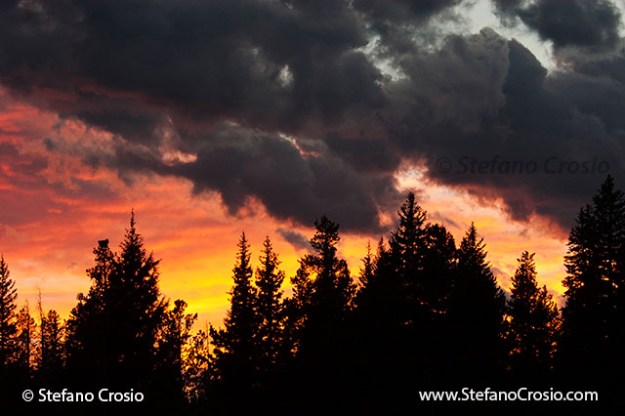
The Sky on Fire

The Sky on Fire

After one day of shooting in Yellowstone National Park, I was heading back to the car when I noticed that some nice sunset color was starting peeking out from a rip in the thick cloak of dark clouds that had been lingering for the entire afternoon.

I quickly looked for a nice way to frame that sunset just in case things were about to get even better when the sun would be lower in the sky. I knew I had to act quickly because there would likely be only a very limited time window to photograph it and I needed to set up my camera and tripod and then expose, focus and compose my image. Fortunately, there was no shortage of trees where I was, so I decided to go tight to  really accentuate the color in the sky while silhouetting the trees: hopefully this would create  a nice framing for the main subject of my image (the warm sunset hues) and a pleasing color contrast between that and the blackness of the trees and the ominous clouds above.

A few minutes later magic did happen and the sliver of sky that was unobstructed by the darkest clouds suddenly became painted in incredibly intense reds and yellows, as if the sky had caught on fire. It only lasted maybe a minute or two, but fortunately enough to take a few frames of that raw beauty.

If you would like to see more images of mine, feel free to browse my Galleries.

As per my copyright notice, please respect my work and do not download, reproduce or use the image above without first seeking my consent. Thank you :-)

Environmental Portraits and Arctic Fox

Arctic fox (Alopex lagopus) in its environment

Up until a while ago, the dominating trend in wildlife photography was shooting tight, delivering images that showed the animal up close, whether they were portraits or action shots. While tight shots are by all means still relevant and utilized by photo editors, a more recent trend has been that of the so-called environmental portraits, that is photographs that show the animal not in isolation but in the broader context of the ecosystem it is a part of.

There certainly is merit in this trend, in that through such images viewers take in much more about the animal than they could from a tight shot. Viewers have a better and more visual idea of the conditions and the geography the animal lives in: in other words, they get a more complete story about the subject.

The above image of an arctic fox (Alopex lagopus) in the barren lands in proximity to the shores of the Hudson Bay (Canada) exemplifies the notion of an environmental shot. I will post in the future closer images of the same species that show the animal’s body features from up close (if you are interested, you can view a selection of them right away on my Web site), but this photograph immediately tells you what animal we are talking about as well as something about the environment it lives in and its camouflage ability.

So, if you are pulling together your wildlife photography portfolio, it is a good idea to include both tight shots and environmental portraits, so as to add some variety and tell a more compelling story about your subjects.

If you would like to see more images of mine, feel free to browse my Galleries.

As per my copyright notice, please respect my work and do not download, reproduce or use the image above without first seeking my consent. Thank you :-)

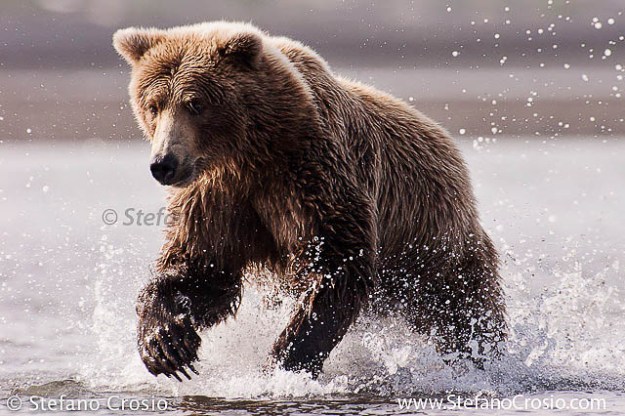
Sprinting Coastal Brown Bear

Sprinting Coastal Brown Bear (Ursus arctos)

Beside loving bears, which I find truly fascinating animals, I love Alaska: such beautiful country, most of which is still wild and pristine, notwithstanding human efforts to drill more oil out of it (will we ever get rid of so dirty an energy source?…)

I visited Alaska twice, and I hope I will be able to go back in not too long a time. The first time I went to Katmai National Park, and the second time back to Katmai (although in a different area) and then on to the Kodiak archipelago. Alaska and Katmai in particular are among the best places you may be at to observe and photograph coastal brown bears. These are often interchangeably called “grizzlies” but, although they both belong to the species Ursus arctos, coastal brown bears (as the name implies) prevalently live in coastal areas and tend to be bigger than grizzlies who are considered a distinct subspecies (Ursus arctos horribilis) and live inland, away from major bodies of water.

If you travel to Katmai in the Summer, chances are that you are going to witness one of the most exciting phenomena in the life cycle of a coastal brown bear: the salmon run. Around that time of the year, wild sockeye salmon enter their spawning phase, during which they somehow find their way back from the ocean to the very same river where they were born so that they can work their way upstream, reach the headwater gravel beds of their birth, lay their eggs and generally die within a couple of weeks (because when they return to their original freshwater environment, they stop eating and live off their fat reserves).

Clearly, brown bears are not indifferent to nature’s call that brings the salmon back to accessible waterways to reproduce. Since fall and then winter are fast approaching (and with them a long period of hibernation), brown bears enter a phase known as hyperphagia where they maximize their food intake (they can eat up to 90 pounds of food per day!) to build up sufficient fat reserves to survive the hibernation months. In this period, coastal brown bears congregate by the shore or next to river banks anxiously waiting for one of their favorite prey to arrive in huge numbers.

When salmon eventually comes, all hell breaks loose and bears start chasing salmon in shallow waters to catch them and eat them. Bears are especially fond of salmon eggs, so much so that, after a bear has eaten enough fish for a day, sometimes it keeps catching more salmon just to eat the eggs while discarding the rest (for the seagulls’ happiness).

While I was observing a group of about six bears chasing salmon in the estuary of a river in Katmai, this young bear started sprinting in my general direction in pursuit of a salmon (that eventually proved to be faster than the bear) and gave me a great opportunity to freeze the motion of the bear at the peak of the action. The low angle of the image (that I shot kneeling in the sand) accentuates the majestic nature of the bear and creates an eye-level connection with the animal. Hope you like it!

If you would like to see more images of mine, feel free to browse my Galleries.

As per my copyright notice, please respect my work and do not download, reproduce or use the image above without first seeking my consent. Thank you :-)

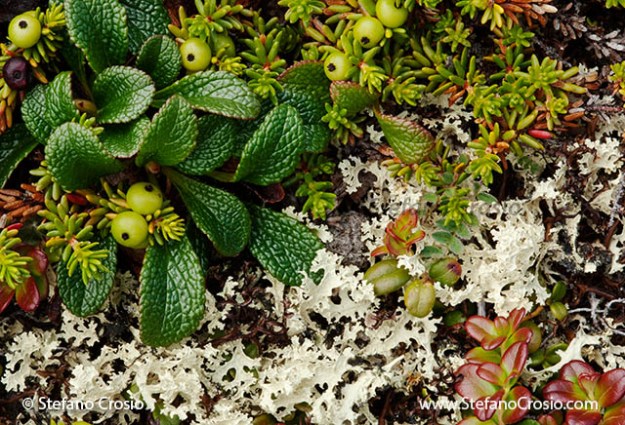
Tundra Lichens and the Sacred Geometry of Chance

Tundra lichens: the sacred geometry of chance

On an expedition to the beautiful and extreme barren lands of Nunavut (Canada), at some point I have become fascinated by the endless patterns, colors and texture of tundra lichens. So, an afternoon with overcast weather, perfect for macro photography, I set out on a journey to capture an image of the lichens that would hopefully do them justice and that would convey my aesthetics.

To me, macro photography can be spectacular and challenging at the same time. Spectacular because, if you succeed both technically and artistically in capturing the “right shot”, the results are extremely rewarding and lead the viewer to a trip to a mysterious and often overlooked miniature world. Challenging because macro photography confronts the photographer with several difficulties, from technical ones (e.g., attaining pleasing lighting as well as sufficient magnification while retaining enough sharpness and depth of field) to artistic ones (e.g., framing the subject so as to obtain a balanced and pleasing composition as well as convey a message that is immediately evident to viewers).

The answer to these challenges is patience, observation, method and experimentation. With my camera and macro lens on my tripod, I tried several different compositions and moved around to find just the right patch of lichens that would realize my vision. After several attempts, I found what I was looking for: a patch of lichens that were pristine in appearance, covered the entire field of view of my lens, leaving no empty spots, and conveyed a Zen-like “Yin & Yang” kind of message. In the above image, a slightly curved, strong diagonal line of neutral-toned white lichens visually separates the super-textured green plants and berries in the top left portion of the frame from a smaller reprise of colored and textured lichens in the bottom right corner of the frame.

In my view, quoting Mr Sting, this image reminds me of “the sacred geometry of chance“.  😉

If you would like to see more images of mine, feel free to browse my Galleries.

As per my copyright notice, please respect my work and do not download, reproduce or use the image above without first seeking my consent. Thank you :-)

Snow Monkey Business

Japanese Snow Monkey (Macaca fuscata) in thermal pool

When I traveled to Japan on a wildlife photography trip, one of the highlights was photographing the Japanese snow monkeys.

These monkeys (which are actually macaques – Macaca fuscata) are a species that is indigenous to Japan. On Japan’s big island (Honshu), they live in two main areas, one of which is a mountainous region in the center of the island, by the town of Nagano, at an elevation of about 850 mt/2,750 ft.

There, whoever is interested in observing or photographing the snow monkeys needs to hike to Jigokudani Yaenkoen National Park (which supposedly means “Hell’s Valley”) and then to the thermal pool, which is one of the monkeys’ favorite places to congregate in winter. This is because this region of Japan gets very cold in the winter, with temperatures that drop to -15 C/5 F, and therefore the monkeys seek comfort from the warm waters coming from natural hot springs that are heated by the underground activity of the Shiga Kogen volcano.

Actually, the whole use of the thermal pool by the snow monkeys started relatively recently and marked a discovery in the monkeys’ adaptive skills. While beforehand no snow monkey had been observed in the thermal pool, in the Sixties one monkey ventured into the hot spring waters to collect seeds that had been thrown in by the Park’s keepers. The monkey evidently enjoyed not only the free meal, but also the warm water and this led to imitation by the other monkeys in its troop and eventually by virtually the entire population of that area, that took on the habit.

If you happen to travel to Japan, I wholeheartedly recommend you pay a visit to the snow monkeys, as they are very interesting (and often times downright funny) to observe, with their human-like behavior. Plus, they make for great photo subjects! The one captured in this image reminded me of Planet of the apes, as if it were crawling out of the pool thinking “I’m coming to get you!”

If you want to learn more about the Japanese snow monkeys, I suggest you start by checking this Web site out.

If you would like to see more images of mine, feel free to browse my Galleries.

As per my copyright notice, please respect my work and do not download, reproduce or use the image above without first seeking my consent. Thank you :-)