A Horizontal Tasting of Eight 2008 French Pinot Noirs

In January I was in Milan and I attended another wine tasting event organized by the local chapter of the Italian Sommelier Association: whenever I can, I participate in these events because they are very well organized and the association often signs up producers or interesting personalities in the wine world, which make these gatherings entertaining and always educational.

This time the event revolved around an international grape variety and a wine that is the bread and butter of fellow wine blogger Jeff, AKA the drunken cyclist: if you know Jeff and follow his excellent and entertaining wine blog (and if you do not, I think you should) you know that I refer to Pinot Noir, a wine/grape variety of which Jeff is definitely an expert. On the contrary, I am no expert of Pinot Noir, although I like good Pinot Noirs from Burgundy, the US and Italy (Alto Adige) and I particularly like the grape variety in the context of a good Champagne or Classic Method sparkling wine such as a good Franciacorta. If Jeff reads this post, he may weigh in and share his thoughts on the subject.

Anyway, the guest of the event was Prof. Moio, an Italian agronomy professor who spent a few years in Burgundy (admittedly the “purest” region in the world for growing Pinot Noir) to research Pinot Noir and particularly its varietal (or primary) aromas and its fermentation and aging (AKA secondary and tertiary) aromas as well as their perception by the human brain from a chemical standpoint. It goes without saying that, considering the area in which it was performed, no research would ever be complete without a fair share of practical testing in the field! 😉

Jokes aside, he presented the findings of his chemical research which, leaving aside some very technical stuff, were pretty interesting. I will pass on just a few points that I found noteworthy (you will notice a few technical wine terms – if in doubt, please check out our Wine Glossary):

  • As you may know, the main part in a grape berry where primary aromas reside is the skin (hence some white wine producers nowadays make their whites undergo a short maceration phase so as to maximize the extraction of terpenes, the molecules that are mainly responsible for the varietal aromas of wine)
  • The research conducted by Prof. Moio isolated four molecules that are present in the skins of Pinot Noir grape berries and are responsible for the main varietal aromas of Pinot Noir: these molecules release scents reminiscent of cherries and red berries
  • The release of the aromatic molecules of wine (a specific type of esters is one of the main carriers of aromas) is faster in wines with lesser structure and conversely slower in more structured wines that have a greater dry extract: this is the chemical reason why Grands Crus (which tend to be more structured and therefore release aromas at a slower pace) tend to have a longer finish than generally less concentrated Appellations Communales
  • The human brain categorizes those molecules that carry one single scent (for instance, pineapple) associating them with a sort of “image” to be able to recognize that same scent on future occasions; however, when different molecules carrying different scents (for instance, pineapple and peach) are present at the same time (as is often the case in wine) then one of two things may happen: either the brain tells the two different scents apart correctly and associates them to the correct “mental images” or it combines the two scents together generating a third and different “mental image” (say, apricot) – according to Prof. Moio, this is why different people who sniff the same glass of wine may have different perceptions of its aromas.

But enough chemistry now, and let’s move on to the best part of the event, that was obviously the wine tasting part! What we did was a horizontal tasting of eight different Pinot Noirs of the 2008 vintage, all of which came from the Cote d’Or (the best area in Burgundy for growing Pinot Noir) and specifically four of them came from Cote de Nuits (the northern part of Cote d’Or) and the other four from Cote de Beaune (the southern part of Cote d’Or).

Clearly, this tasting had no scientific meaning, especially because different winemaking styles (and therefore the secondary and tertiary aromas that derive from the winemakers’ choices) influenced the final bouquets of the wines that we got to sample. However, it was a nice way to introduce us to certain producers and appellations and to show us a sample of Pinot Noirs coming from the two subzones of the best area in France (and admittedly the world) for that kind of wine.

Jumping to the, like I said, non-scientific conclusions of our tasting experience, it was apparent from the limited sample we got to try that, among the eight wines that we tasted, Pinot Noirs made in Cote de Beaune tended to retain more distinctly the varietal aromas of Pinot Noir compared to the wines made in Cote de Nuits where secondary/tertiary aromas of fur tended to be more evident and sometimes to overwhelm the delicate red berry varietal aromas. My personal ratings of the eight wines I tasted that night seem to by and large confirm that conclusion as the Cote de Beaune wines generally fared a little better than the Cote de Nuits ones.

Just for clarity, I am by no means implying that therefore Cote de Beaune Pinot Noirs are better than Cote de Nuits Pinot Noirs (where 24 out of 25 of the Grands Crus can be found): all I am saying is that, among those 8 wines that I tasted, I happened to personally like the Cote de Beaune Pinot Noirs a little better than their Cote de Nuits counterparts (although, as you will see, I liked the Gevrey-Chambertin Pinot Noir of the Cote de Nuits quite a bit).

To finish up this long post, these are my favorite wines among the eight 2008 Pinot Noirs that we tasted (along with their approximate prices in the US):

1. Volnay, Domaine Marquis d’Angerville (Cote de Beaune) ~ $70

By far the best of the eight, at least to me, with aromas of blackcurrant, red berries, cherry, and hints of tobacco and fur. In the mouth it had good structure and it was smooth and tannic, perfectly balanced and with a long finish. Outstanding Outstanding

2. Aloxe-Corton, Domaine Tollot-Beaut “Les Vercots” Premier Cru (Cote de Beaune) ~$50

Nice bouquet of blackcurrant, red berries, licorice, hints of menthol. In the mouth it had good structure and concentration and it was noticeably tannic. Very Good Very Good

3. Gevrey-Chambertin, Domaine Trapet Pere et Fils (Cote de Nuits) ~$55

Nose of blackcurrant, redcurrant, fur, soil, tobacco, violet. Tannic and balanced in the mouth. Very Good Very Good

4. Chambolle-Musigny, Domaine Bruno Clair “Les Veroilles” (Cote de Nuits) ~$90

In the nose this wine started very subdued and it took a while for it to open up nicely into a bouquet of blackcurrant, red berries, violet, slight hint of fur. In the mouth it had plenty of structure and concentration, along with tannins that still felt quite aggressive, suggesting that it would be best left aging a while longer. Good Good

5. Chassagne-Montrachet, Domaine Bruno Colin “La Maltroie” Premier Cru (Cote de Beaune) ~$75

The nose of this wine did not convince me completely, as tertiary aromas of oak and tobacco were predominant and tended to overwhelm the primary aromas of red berries. In the mouth, however, it proved to be a solid wine, smooth, tannic and with a long finish. Good Good

I will not mention the remaining three wines we tasted as honestly I was unimpressed and I would not recommend buying them.

Have you had a chance to try any of the Pinot Noirs mentioned above? If you did, what do you think about them?


Gambero Rosso’s Tre Bicchieri NYC 2013: The Top of the Crop

With some delay, I finally got to sit down and write my report about the Gambero Rosso Tre Bicchieri 2013 Italian wine fair that took place in New York City on February 15.

As was the case for the Vinitaly/Slow Wine NYC 2013 event, I have attended the Tre Bicchieri event with fellow wine blogger and friend Anatoli who authors the excellent Talk-A-Vino wine blog, a blog that you should definitely follow if you don’t already and are into wine. Doing the walk around with Anatoli was as usual a lot of fun and very helpful and stimulating in terms of sharing views and comparing notes about the wines we tried out. Anatoli has tons of knowledge about wine and is a pleasure to talk to and learn from. You can (and in my view you should) read Anatoli’s take of the Tre Bicchieri NYC event on his blog, where he published an excellent and very thorough post about it, complete with pictures of the fair!

Regarding the logistics of the event, the check in process was smooth and quick, thanks to the mandatory online pre-registration. The premises where the event took place (the Metropolitan Pavillion in Chelsea, NYC) were perfectly adequate for the fair which, with over 170 producers showcasing their wines, was a pretty big one. While it was helpful that the organizers provided everyone with a booklet with the names of each producer and exhibited wine and a progressive number for each, the layout of the event was unfortunately quite messy.

The wineries were not organized on a region-by-region basis, as would seem to make the most sense. Rather, they were organized by importer, which in my view is not helpful as importers may (and most of the time do) represent several different producers from completely different regions and with different styles. To make things worse, the physical layout of the tasting tables was such that, even by following the numerical progression of the booklet, from 1 to 173, whenever a row ended, it proved very difficult to understand where the next table number would be, which made our navigation of the event quite frustrating. The logistics of the Slow Wine part of the Vinitaly/Slow Wine NYC 2013 event were vastly preferable.

But let’s now get down the actual wine tasting experience. As was the case for the Vinitaly/Slow Wine NYC 2013 event, I will list below what in my view was the absolute top of the crop among the many great wines that I got to taste and, in an effort not to drive you insane, I will group them by region contrary to what the organizers did! 😉 It goes without saying that the list below is far from being complete, because (i) clearly we did not get to try out all of the 173 wines on display; (ii) certain of the wines that Anatoli and I were targeting were no longer available by the time we got to the relevant tasting table; and (iii) I made an effort to be extremely selective in my choices below in order to keep this post to a manageable length, so by all means there were many more very good wines that I tasted but did not “make the cut” to be mentioned on this post.

1. ALTO ADIGE

Abbazia di Novacella, Alto Adige Valle Isarco Sylvaner “Praepositus” 2011: an elegant bouquet of pear, apple, peach and citrus graces this pleasant and tasty medium-bodied white: Very Good Very Good

2. TRENTINO

Ferrari, Trento Extra Brut Perle’ Nero 2006: this fabulous, creamy Classic Method Blanc de Noirs is 100% Pinot Noir, ages 72 months on its lees and displays complex aromas of red berries, pineapple, citrus, toast and hazelnut: Outstanding Outstanding

Ferrari, Trento Brut “Giulio Ferrari Riserva del Fondatore” 2002: just the opposite of the previous one, this phenomenal Classic Method Blanc de Blancs is 100% Chardonnay, ages 10 years (!) on its lees and blesses the taster with complex aromas of butter, vanilla, toast, citrus, apple, pineapple… WOW: Spectacular Spectacular (the only problem is its astronomical price tag!)

3. FRIULI

La Tunella, Colli Orientali del Friuli Ribolla Gialla “RJgialla” 2011: a wonderful, super-pleasant, fresh medium-bodied white made of 100% Ribolla Gialla (a grape variety indigenous to Friuli) with an elegant bouquet of apple, Mirabelle plum, peach and white flowers: Outstanding Outstanding

Livon, Collio Friulano “Manditocai” 2010: a solid 100% Friulano (AKA Tocai) white wine with nice aromas of butter, tropical fruit, citrus and minerals: Very Good Very Good

4. PIEMONTE

Chiarlo, Barbera d’Asti Superiore “Nizza La Court” 2009: a very good, smooth Barbera with aromas of raspberry, spirited cherry and rose: Very Good Very Good

Elvio Cogno, Barolo “Vigna Elena” Riserva 2006: an excellent Barolo with a complex bouquet of violet, cherry, raspberry and licorice: Very Good Very Good but will benefit from a few extra years of aging to finish taming its tannic strength

Le Piane, Boca 2008: a great 85% Nebbiolo, 15% Vespolina full-bodied red, smooth and yet with tannic strength, offering complex aromas of berries, plum, violet, black pepper and minerals: Very Good Very Good

Baudana/Vajra, Barolo “Baudana” 2004: OMG, this was a fabulous treat “off the list”, that the very kind representative of the producer treated Anatoli and me to – it was the typical example of the reason why you want to buy a good Barolo and then forget about it for many years and eventually enjoy it in all its divine expressiveness: a complex nose of cherry, plum, blackberry and coffee complements supple tannins and plenty of structure: Spectacular Spectacular

Baudana/Vajra, Barolo “Cerretta” 2008: this younger vintage from a different “clos” presented a relatively subdued nose of licorice, leather and black pepper, while in the mouth it was smooth and had already fairly gentle tannins: Very Good Very Good but will need more years of aging to be at its top

5. LOMBARDIA

Berlucchi, Franciacorta “Cellarius” Brut 2008: with 80% Chardonnay, 20% Pinot Noir and 30 months of aging on its lees, this Classic Method sparkler is one of my favorite Franciacorta’s for its QPR, although I have to say the 2008 vintage appears more constrained compared to the excellent 2006 and 2007, but still plenty good – the only problem is that for some reason this wine is not imported in the US yet, but I will give you a tip: if you happen to travel to the US from the Milan Malpensa airport, you can buy the Cellarius in the duty free zone right after clearing the security check area: definitely worth a stop if you ask me! – Anyway, the Cellarius has elegant aromas of citrus, apple, bread crust and minerals, a lively acidity and a fine and long-lasting perlage: Very Good Very Good

Ca’ del Bosco, Franciacorta Extra Brut Rose’ Cuvee “Annamaria Clementi” 2004: WOW, if at the Vinitaly/Slow Wine NYC 2013 event Anatoli and I had already enjoyed (and let me add fallen in love with) the fabulous white version of this top of the line Classic Method sparkling wine label of the Ca’ del Bosco winery (which in Italy retails at about €80 a pop), the Tre Bicchieri event gave us the opportunity to also taste the Rose’ version of it, which moves up the price tag of this phenomenal sparkler to a whopping €140 a bottle! With 100% Pinot Noir and 7 years on its lees, this wonderful wine exhibits a complex bouquet of pastry, hazelnuts, chocolate, coffee and minerals complemented by a fresh, tasty and structured mouth feel: Spectacular Spectacular

Mamete Prevostini, Valtellina Superiore Riserva 2009: there is very good value in this 100% Chiavennasca (AKA Nebbiolo) red, with a nice nose of cherry, raspberry, coffee and cocoa, as well as already gentle tannins: Very Good Very Good

6. VENETO

Masi, Amarone della Valpolicella Classico “Mazzano” 2006: definitely not an inexpensive Amarone, but in my view Masi never lets down with an excellent top of the line label with a complex bouquet of black cherry, blackberry, vanilla, leather, licorice and chocolate as well as plenty of structure and warmth in the mouth and noticeable but supple tannins: Outstanding Outstanding

Viticoltori Speri, Amarone della Valpolicella Classico “Vigneto Monte Sant’Urbano” 2008: a very good Amarone with a decent QPR and subtle aromas of wild berries, soil and coffee; in the mouth, plenty of structure coupled with gentle but noticeable tannins and a long finish: Very Good Very Good

7. LIGURIA

Cantine Lunae, Colli di Luni Vermentino “Cavagino” 2011: a very good Vermentino that is partly fermented in barrique casks  and has pleasant aromas of apricot, peach, hazelnut and mint: Outstanding Outstanding

8. TOSCANA

Poggio di Sotto, Brunello di Montalcino 2007: a wonderful Brunello with a hefty price tag, but an elegant bouquet of red berries, plum, herbs, soil and licorice, for a wine that feels warm and with noticeable but already gentle tannins in the mouth: Spectacular Spectacular

Tenuta dell’Ornellaia, Bolgheri Superiore Ornellaia 2009: a typical Bordeaux-style blend for this vintage of one of the archetypical Super Tuscans, with 52% Cabernet Sauvignon, 22% Merlot, 21% Cabernet Franc and 5% Petit Verdot – in spite of its elegant nose of wild berries, herbs, black pepper and minerals, I think opening a bottle of so fantastic a wine so early in its life is almost a sin, as it is somewhat like driving a Ferrari only in first gear… The tannins are still young and need time to harmoniously integrate: should you spend the small fortune necessary to buy a bottle of this great wine, store it properly in your cellar and leave it there for several years before drinking it, it will pay you back big time: Outstanding Outstanding

9. MARCHE 

Fazi BattagliaVerdicchio dei Castelli di Jesi Classico “San Sisto” Riserva 2009: an excellent Verdicchio with a complex bouquet of citrus, peach, pineapple, almond and minerals, smooth and tasty in the mouth and with a long finish: Outstanding Outstanding

10. UMBRIA

Castello della Sala“Cervaro della Sala” 2010: a blend of 90% Chardonnay and 10% Grechetto aged in barrique casks for 6 months for this excellent, smooth wine with fine aromas of citrus, pineapple, butter, honey and hazelnut: Outstanding Outstanding

Tabarrini, Sagrantino di Montefalco “Campo alla Cerqua” 2008: a wonderful Sagrantino with fine aromas of rose, violet, plum, soil, licorice and black pepper, which in the mouth is full-bodied, warm and with noticeable but supple tannins: Outstanding Outstanding

11. ABRUZZO

Torre dei Beati, Montepulciano d’Abruzzo “Cocciapazza” 2009: an excellent Montepulciano with aromas of cherry, wild berries, chocolate and licorice, which in the mouth is warm and has substantial but smooth tannins and plenty of structure: Very Good Very Good

12. CAMPANIA

Marisa Cuomo, Costa d’Amalfi Furore Bianco Fiorduva 2010: well, I think I have said enough about the Fiorduva in my recent wine review – with a fine bouquet of peach, apricot and Mirabelle plum, it is balanced and has a long finish, although it would benefit from one or two more years of aging before enjoying it: Outstanding Outstanding

Mastroberardino, Taurasi “Radici” 2008: a great 100% Aglianico wine with an excellent QPR and fine aromas of blackberry, blueberry, soil and black pepper; it is warm in the mouth and has abundant yet gentle tannins: Outstanding Outstanding

13. BASILICATA

Basilisco, Aglianico del Vulture “Basilisco” 2009: a fantastic Aglianico del Vulture  with a fine bouquet of cherry, herbs, soil, minerals and oaky notes, along with noticeable but gentle tannins in a full-bodied structure: Outstanding Outstanding

14. SICILIA

Cusumano, “Noa'” 2010: a blend of 40% Nero d’Avola, 30% Cabernet Sauvignon and 30% Merlot for an immediately enjoyable wine with aromas of rose, blackberry, black cherry, blueberry, graphite and cocoa, good structure and supple tannins: Very Good Very Good

Donnafugata, Contessa Entellina Rosso “Mille e Una Notte” 2008: a wonderful blend of 80% Nero d’Avola, 20% Cabernet Sauvignon, Merlot and Syrah that results in an inky wine with a fine nose of plum, spirited cherry, sweet tobacco and vanilla, plenty of structure and gentle tannins: Very Good Very Good

Donnafugata, Passito di Pantelleria “Ben Rye'” 2010: WOW, this 100% Zibibbo (AKA Moscato d’Alessandria) gem is one of my favorite dessert wines (I plan to post a full review of it later this year), always dependable and seducing, with a bouquet that goes beyond your wildest dreams with aromas of dried apricot, honey, herbs and saffron, plenty of acidity and tastiness to counter its sweetness in an enviable balance that will keep you sipping and sipping and sipping…: Spectacular Spectacular

Firriato, “Ribeca” 2010: a solid 100% Perricone (an indigenous black-berried variety) full-bodied red wine with fine aromas of cherries, red berries, herbs, soil and chocolate, as well as gentle tannins: Very Good Very Good

Graci, Etna Bianco “Quota 600” 2010: a fine 70% Carricante, 30% Catarratto volcanic white wine with a pleasant bouquet of apricot, herbs and minerals complementing a fresh, smooth and tasty mouth feel: Very Good Very Good

15. SARDEGNA

Cantina di Santadi, Carignano del Sulcis “Rocca Rubia” Riserva 2009: a fine 100% Carignano red wine with interesting aromas of raspberry, cocoa, graphite and fur that is warm, mineral and tannic in the mouth: Very Good Very Good

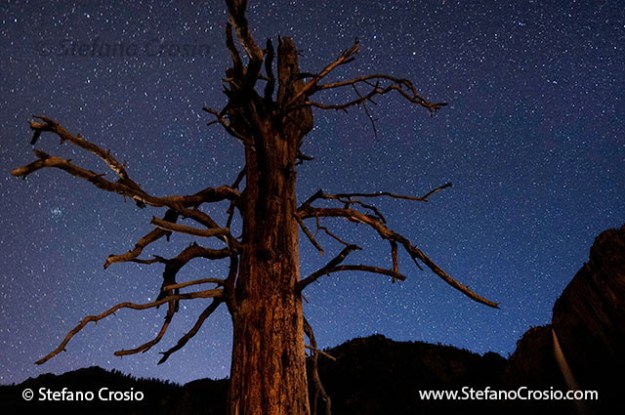
Painting with Light: Incense Cedar Tree at Night

Incense cedar tree at night in Yosemite Valley, CA

This image was taken at night in Yosemite Valley, CA, where I set up my tripod before dark, focused my wide angle lens on this gnarled incense tree in the background, set a base exposure, composed my shot paying attention that no branches of the tree intersected the top of the surrounding mountains and waited for darkness to descend. Then it was just a question of taking several shots at different times at night, with the sky taking on different hues, and sometimes experimenting with “light painting”, as in this image.

Painting with light is a hit and miss technique that may be performed in night photography situations, and that is achieved by shining a flashlight on the foreground subject, or anyway a foreground element, to accentuate it and give it some texture in the final image. There are no hard and fast rules for how long to light your subject, and the photographer is best advised to take several shots with different intensities of lighting, as there is no way of telling which one will turn out to be the most pleasant one. On those circumstances I always take a few shots in full darkness too, with the tree that is completely silhouetted against the lighter sky, because sometimes those may turn out to be the best option.

In this case, however, I think the moderate amount of “light painting” on the incense tree works to the benefit of the image as it gives kind of an eerie feel to the gnarled tree, accentuating its tortured limbs that stretch out in all directions and one of which points to Yosemite Falls.

If you would like to see more images of mine, feel free to browse my Galleries.

As per my copyright notice, please respect my work and do not download, reproduce or use the image above without first seeking my consent. Thank you :-)

Bugling Elk

CANADA, Jasper National Park - Bugling elk (Cervus elaphus)

The image above shows a bugling elk in Jasper National Park, Canada, with traces of fresh wounds that it probably suffered in a fight with another bull.

During the mating season in the Fall, bull elk (Cervus elaphus) are used to bugling, that is sending out long, high-pitched rutting calls that can be heard for miles to attract cows or threaten other bulls. Bugling is often associated with the opening of the elk’s preorbital gland to release a scent that should further attract cows.

At that time of the year (September/October), bulls are nervous and aggressive, and this often reflects in their behavior, such as when they stick the tips of their antlers into the ground to dig holes, spray urine or even engage in battles with other bulls over cows or to establish dominance.

Especially during mating season, it is important to be cautious approaching elk because getting too close may (and often will) result in becoming victims of an elk charge or even worse being gored by elk. Photographers and wildlife enthusiasts should not invade the animal’s comfort zone and be watchful for body signs that may signal stress in the animal and the risk of an imminent attack, such as stomping the hooves on the ground, lowering the ears, strutting, etc.

If you would like to see more images of mine, feel free to browse my Galleries.

As per my copyright notice, please respect my work and do not download, reproduce or use the image above without first seeking my consent. Thank you :-)

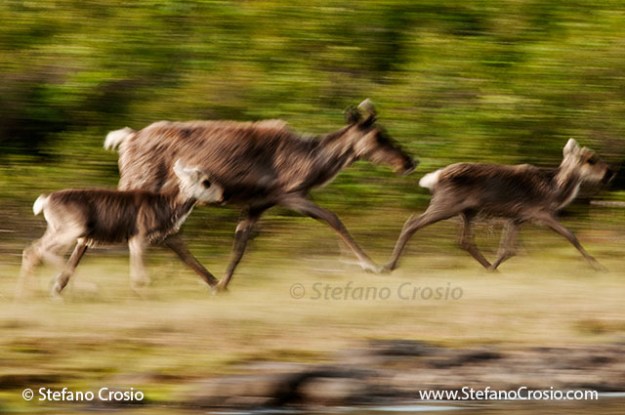
Pan Blur Technique and Barren-Ground Caribou

Pan blur of barren-ground caribou (Rangifer tarandus groenlandicus)

Before getting to the point of this post, let me just quickly say thank you to all of you who have been reading and following Clicks & Corks so far: this new blog was officially launched on February 10 and less than a month later it has had over 1,000 views, 210 comments and 71 followers. Your support and your active contributions to C&C are nothing short of exceptional and they are a phenomenal reward to the effort that goes into trying to publish quality content that hopefully many of you may find interesting and worth reading or viewing. Once again, thank you.

But let’s move on to today’s subject: pan blurs. Pan blurs are fun to do and sometimes they may offer a solution when freezing an action shot either is not an option or would not yield an interesting enough visual result (as would have been the case with the running barren-ground caribou cow and calves (Rangifer tarandus groenlandicus) that are portrayed in the image above).

Successful pan blurs convey a sense of motion in a painterly, sort of impressionistic way, as if the “light painter” behind the lens (all photographers are essentially painters who rely on the qualities of light instead of paint and paintbrushes!) had chosen a quick, thick and essential brushstroke style.

The situations in which I find myself using the pan blur technique the most are those when my subject is in motion and either light levels are so low that attaining a fast enough shutter speed to freeze the action would be impossible or impractical (as is often the case when photographing at the fringes of the day in the outdoors or in dark indoor contexts, such as a poorly lit gym or ice rink) or the subject and the context the subject is in are not interesting enough to be captured in a crisp, detailed shot that freezes the action. In these instances, instead of not taking any shot at all, I switch to pan blur gear and see what I come up with. A desire to convey a strong, visual sense of speed when photographing a fast living thing or object in motion may be another very good reason to resort to a pan blur.

Should you be wondering how to make a pan blur, just follow these steps:

  • Stick a telephoto lens on your camera;
  • Set your exposure using the M or S modes and pick a fairly slow shutter speed (how slow depends on how fast your subject is and how “streaky” you want your background to be, but somewhere between 1/8 and 1/60 sec should get you in the ballpark most of the times);
  • Set your AF system to an active tracking mode;
  • Position yourself such that your moving subject will be in front of you and its trajectory will run from one side to the other (left to right or right to left);
  • Stand still and, by rotating your torso/arms, aim your camera to the side your subject is supposed to come from;
  • As soon as your subject is in sight, lock focus on it and start tracking it by panning your camera in a fluid motion in sync with your subject and keeping it in the frame;
  • When your subject is by and large in front of you, without stopping your fluid panning motion, trip the shutter to expose one or more frames;
  • Keep tracking your subject for a few more moments just to make sure not to interrupt your panning when the shutter is still open.

The whole point of this technique is to blur the background and the moving parts of your subject (e.g., the limbs of a living thing, the wheels of a vehicle…) while retaining some key part of your subject relatively in focus (such as the head of a living thing or some distinctive feature in a vehicle).

Variants of this technique include the use of a flash set to rear curtain sync, which accentuates the sharpness of the subject while retaining the streaky background, or extreme pan blurs. Extreme pan blurs call for even slower shutter speeds so that not only the background but also the subject is blurred, although to some lesser extent than the background: when successfully performed, these shots may yield even more artistic, painterly abstract results, which can be equally rewarding.

Pan blurs are kind of hit and miss by definition, especially with fast moving subjects, so be prepared to take several practice shots to master this technique before using it in any important situation.

If you would like to see more images of mine, feel free to browse my Galleries.

As per my copyright notice, please respect my work and do not download, reproduce or use the image above without first seeking my consent. Thank you :-)

Wine Review: Oasi degli Angeli, “Kurni” Marche Rosso IGT 2008

Oasi degli Angeli, "Kurni" Marche Rosso IGTA few nights ago, I was in Milan (Italy) and I went to dinner with a friend of mine to an excellent restaurant that I will review in a future post.

Beside eating wonderfully, my friend and I decided to treat ourselves to a very special Italian red wine that I had noticed on the wine list, had never had before but had heard and read excellent things about: the fabled, divisive, extremely rare to find Oasi degli Angeli, “Kurni” Marche Rosso IGT ($100) from the Marche region.

The Bottom Line

Overall, the Kurni is a great wine and a very special one, one which in my view does not leave whoever is fortunate enough to get to taste it indifferent: it is a wine that forces you to pick a side, either you like its style or you do not. Personally, I liked it a lot, I am glad I got to enjoy it and I found it a pleasure to drink, worth seeking out if you come across it and want to treat yourself to something really special.

Rating: Spectacular and Special Spectacular – $$$$$

(Explanation of our Rating and Pricing Systems)

About the Estate

A few words about Kurni and the vineyards it comes from: it is a wine made of 100% Montepulciano grapes harvested from about 10 hectares only of Montepulciano grapevines trained as free-standing plants (according to the bush vine training or “alberello” style) with an average age of 65 years and an astounding density of up to 22,000 vines/HA(!) which allow an annual production of just about 6,000 bottles. The Kurni ages for 20 months in new oak barrique barrels.

About the Grape

Before we continue, let’s focus for a moment on the Montepulciano grape variety. First off, let’s dispel a possible source of confusion: although the name refers to the Montepulciano area near Siena (Tuscany), the Montepulciano grape variety is an Italian indigenous variety that originates from the Abruzzo region.  Consequently, it is important NOT to confuse Vino Nobile di Montepulciano DOCG (which is a Tuscan appellation whose wines must be made of 70% or more Sangiovese grapes) with Montepulciano d’Abruzzo DOC or Montepulciano d’Abruzzo Colline Teramane DOCG (which are two appellations from Abruzzo whose wines are required to be made out of at least, respectively, 85% or 90% Montepulciano grapes).

Montepulciano is a grape variety that is widely planted across central Italy (about 30,000 HA), especially in the regions of Abruzzo, Marche and Molise. Beside Italy, it is also grown in California, Australia and New Zealand. It is a grape variety that results in deeply colored wines with robust tannins, that are often used in blends. On account of the wide diffusion of Montepulciano grapes, the quality levels of the wines made out of them varies considerably – hence, caveat emptor: you need to know which producers to trust and buy from. (Note: information on the grape variety taken from Wine Grapes, by Robinson-Harding-Vouillamoz, Allen Lane 2012)

Our Detailed Review

But let’s get back to the wine that we are going to review in this post. Retailing in the US at about $100 a pop, the Kurni is by no means an inexpensive wine, nor is it an easy to find one, but let me say it up front in my view it is one that is worth the investment if you come across it and have the inclination to “invest” that kind of money in a bottle of wine. But let’s get down to it using a simplified version of the ISA wine tasting protocol that we described in a previous post: should you have doubts as to any of the terms used below please refer to that post for a refresher.

First off, the bottle of Kurni we had was a 2008 vintage with a whopping 15% VOL ABV, so it is no wine for the faint of heart. 😉

In the glass, the wine was ruby red and (as you may expect) thick.

The nose was intense and fine, with complex aromas of ripe cherries, raspberries, plums, roses, vanilla, sweet tobacco, licorice and cocoa.

In the mouth the wine is between dry and medium-dry (see more on this below), definitely warm and super silky smooth; fresh, with tame but very present tannins and quite tasty. The wine is full-bodied and balanced (although certainly leaning toward the “softness” side), intense in the mouth (you truly have to taste it to believe this: its concentration is incredible, it is just like an explosion of ripe, sweet red fruits and cherry jam in your mouth!), fine with corresponding mouth flavors and a long finish; its evolutionary state is ready (which means that you can certainly drink it now, but it will get even better with a few more years under the belt – if you can wait!)

As a side note to the tasting, I think it is important to underscore that a notable characteristic of a relatively young vintage of this wine (such as 2008) is the discernible mouth feel of latent sweetness of the Kurni, which (as indicated in the tasting notes) places it somewhere in between a dry a semi-dry wine. In the Italian wine aficionado world, there have been endless discussions as to whether this latent sweetness is due to fairly high residual sugar levels or instead the significant extent of smoothness and explosive fruit flavors of the wine.

In an interview, Kurni’s enologist defined his wine as a dry wine, therefore supporting the latter of the above two theories. Also, vertical tastings of several vintages of Kurni have reportedly confirmed this interpretation in that older vintages would taste drier than younger vintages (which would not be possible if the wine’s latent sweetness were due to higher residual sugars). Having said that, I think it would be helpful if Oasi degli Angeli made the official residual sugar level of the Kurni publicly available (I have not been able to find this information anywhere online), as this could put an end to the debate.

Oh and by the way: should you not trust my opinion – would you? really? 😉 the Kurni 2008 was awarded the top rating by both the ISA Duemila Vini wine guide (5 bunches) and the Gambero Rosso wine guide (3 glasses).

If you have had a bottle of Kurni before, let me know which side you are on! 🙂

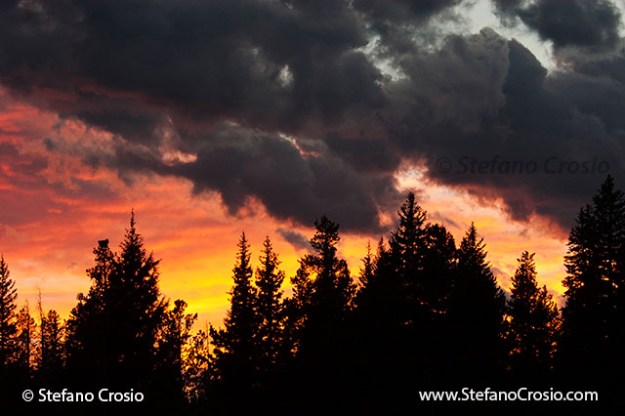
The Sky on Fire

The Sky on Fire

After one day of shooting in Yellowstone National Park, I was heading back to the car when I noticed that some nice sunset color was starting peeking out from a rip in the thick cloak of dark clouds that had been lingering for the entire afternoon.

I quickly looked for a nice way to frame that sunset just in case things were about to get even better when the sun would be lower in the sky. I knew I had to act quickly because there would likely be only a very limited time window to photograph it and I needed to set up my camera and tripod and then expose, focus and compose my image. Fortunately, there was no shortage of trees where I was, so I decided to go tight to  really accentuate the color in the sky while silhouetting the trees: hopefully this would create  a nice framing for the main subject of my image (the warm sunset hues) and a pleasing color contrast between that and the blackness of the trees and the ominous clouds above.

A few minutes later magic did happen and the sliver of sky that was unobstructed by the darkest clouds suddenly became painted in incredibly intense reds and yellows, as if the sky had caught on fire. It only lasted maybe a minute or two, but fortunately enough to take a few frames of that raw beauty.

If you would like to see more images of mine, feel free to browse my Galleries.

As per my copyright notice, please respect my work and do not download, reproduce or use the image above without first seeking my consent. Thank you :-)

Environmental Portraits and Arctic Fox

Arctic fox (Alopex lagopus) in its environment

Up until a while ago, the dominating trend in wildlife photography was shooting tight, delivering images that showed the animal up close, whether they were portraits or action shots. While tight shots are by all means still relevant and utilized by photo editors, a more recent trend has been that of the so-called environmental portraits, that is photographs that show the animal not in isolation but in the broader context of the ecosystem it is a part of.

There certainly is merit in this trend, in that through such images viewers take in much more about the animal than they could from a tight shot. Viewers have a better and more visual idea of the conditions and the geography the animal lives in: in other words, they get a more complete story about the subject.

The above image of an arctic fox (Alopex lagopus) in the barren lands in proximity to the shores of the Hudson Bay (Canada) exemplifies the notion of an environmental shot. I will post in the future closer images of the same species that show the animal’s body features from up close (if you are interested, you can view a selection of them right away on my Web site), but this photograph immediately tells you what animal we are talking about as well as something about the environment it lives in and its camouflage ability.

So, if you are pulling together your wildlife photography portfolio, it is a good idea to include both tight shots and environmental portraits, so as to add some variety and tell a more compelling story about your subjects.

If you would like to see more images of mine, feel free to browse my Galleries.

As per my copyright notice, please respect my work and do not download, reproduce or use the image above without first seeking my consent. Thank you :-)

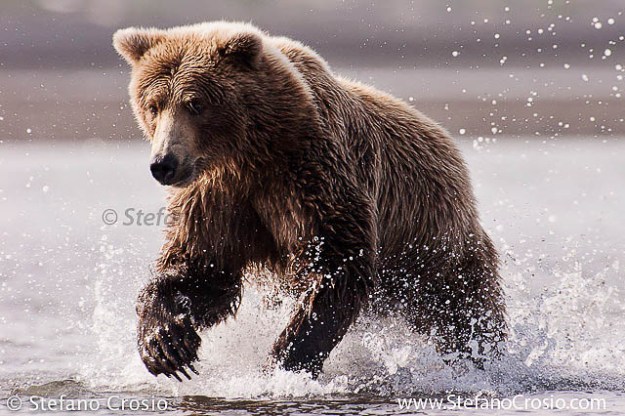
Sprinting Coastal Brown Bear

Sprinting Coastal Brown Bear (Ursus arctos)

Beside loving bears, which I find truly fascinating animals, I love Alaska: such beautiful country, most of which is still wild and pristine, notwithstanding human efforts to drill more oil out of it (will we ever get rid of so dirty an energy source?…)

I visited Alaska twice, and I hope I will be able to go back in not too long a time. The first time I went to Katmai National Park, and the second time back to Katmai (although in a different area) and then on to the Kodiak archipelago. Alaska and Katmai in particular are among the best places you may be at to observe and photograph coastal brown bears. These are often interchangeably called “grizzlies” but, although they both belong to the species Ursus arctos, coastal brown bears (as the name implies) prevalently live in coastal areas and tend to be bigger than grizzlies who are considered a distinct subspecies (Ursus arctos horribilis) and live inland, away from major bodies of water.

If you travel to Katmai in the Summer, chances are that you are going to witness one of the most exciting phenomena in the life cycle of a coastal brown bear: the salmon run. Around that time of the year, wild sockeye salmon enter their spawning phase, during which they somehow find their way back from the ocean to the very same river where they were born so that they can work their way upstream, reach the headwater gravel beds of their birth, lay their eggs and generally die within a couple of weeks (because when they return to their original freshwater environment, they stop eating and live off their fat reserves).

Clearly, brown bears are not indifferent to nature’s call that brings the salmon back to accessible waterways to reproduce. Since fall and then winter are fast approaching (and with them a long period of hibernation), brown bears enter a phase known as hyperphagia where they maximize their food intake (they can eat up to 90 pounds of food per day!) to build up sufficient fat reserves to survive the hibernation months. In this period, coastal brown bears congregate by the shore or next to river banks anxiously waiting for one of their favorite prey to arrive in huge numbers.

When salmon eventually comes, all hell breaks loose and bears start chasing salmon in shallow waters to catch them and eat them. Bears are especially fond of salmon eggs, so much so that, after a bear has eaten enough fish for a day, sometimes it keeps catching more salmon just to eat the eggs while discarding the rest (for the seagulls’ happiness).

While I was observing a group of about six bears chasing salmon in the estuary of a river in Katmai, this young bear started sprinting in my general direction in pursuit of a salmon (that eventually proved to be faster than the bear) and gave me a great opportunity to freeze the motion of the bear at the peak of the action. The low angle of the image (that I shot kneeling in the sand) accentuates the majestic nature of the bear and creates an eye-level connection with the animal. Hope you like it!

If you would like to see more images of mine, feel free to browse my Galleries.

As per my copyright notice, please respect my work and do not download, reproduce or use the image above without first seeking my consent. Thank you :-)

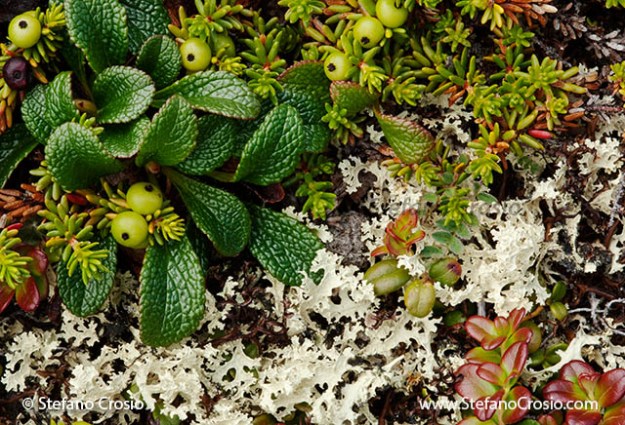
Tundra Lichens and the Sacred Geometry of Chance

Tundra lichens: the sacred geometry of chance

On an expedition to the beautiful and extreme barren lands of Nunavut (Canada), at some point I have become fascinated by the endless patterns, colors and texture of tundra lichens. So, an afternoon with overcast weather, perfect for macro photography, I set out on a journey to capture an image of the lichens that would hopefully do them justice and that would convey my aesthetics.

To me, macro photography can be spectacular and challenging at the same time. Spectacular because, if you succeed both technically and artistically in capturing the “right shot”, the results are extremely rewarding and lead the viewer to a trip to a mysterious and often overlooked miniature world. Challenging because macro photography confronts the photographer with several difficulties, from technical ones (e.g., attaining pleasing lighting as well as sufficient magnification while retaining enough sharpness and depth of field) to artistic ones (e.g., framing the subject so as to obtain a balanced and pleasing composition as well as convey a message that is immediately evident to viewers).

The answer to these challenges is patience, observation, method and experimentation. With my camera and macro lens on my tripod, I tried several different compositions and moved around to find just the right patch of lichens that would realize my vision. After several attempts, I found what I was looking for: a patch of lichens that were pristine in appearance, covered the entire field of view of my lens, leaving no empty spots, and conveyed a Zen-like “Yin & Yang” kind of message. In the above image, a slightly curved, strong diagonal line of neutral-toned white lichens visually separates the super-textured green plants and berries in the top left portion of the frame from a smaller reprise of colored and textured lichens in the bottom right corner of the frame.

In my view, quoting Mr Sting, this image reminds me of “the sacred geometry of chance“.  😉

If you would like to see more images of mine, feel free to browse my Galleries.

As per my copyright notice, please respect my work and do not download, reproduce or use the image above without first seeking my consent. Thank you :-)

An Overview of the ISA Wine Pairing Criteria

As promised a while ago to Suzanne, the gracious author of food and cooking blog apuginthekitchen, in this post I will briefly go through the core foundations of food-wine pairing, providing an overview of the main criteria conceived and recommended by the Italian Sommelier Association (ISA). This should hopefully offer readers a few guidelines that they may consider trying out the next time they will need to pair a wine with food.

Our discussion about wine pairing will utilize certain of the concepts and terminology that we have gone through in the context of our overview of the ISA wine tasting protocol: if you are not familiar with it, consider reading that post before continuing on with this one.

The first step in the wine pairing process is to assess the food you intend to pair a wine with: in so doing, you should consider (and ideally write down) which of the following characteristics are present to a noticeable extent in your food:

  • Latent sweetness (this is that sweetish feel that you perceive eating such foods as bread, pasta, rice, potatoes, carrots, certain seafood such as shrimps or prawns, most ham, bacon, etc. – note, this is NOT the full-blown sweetness of a dessert)
  • Fatness (this refers to the presence of solid greases, such as in most cheeses, salame, hard-boiled egg yolk, etc.)
  • Tastiness (it is given by the presence of salt in a food, such as for instance in most cured meats, salame or cheeses)
  • Latent bitterness (it can be found in such foods as artichokes, raw spinach, radicchio, liver, grilled food, etc.)
  • Latent sourness (it is generally found in tomatoes, seafood marinated in lemon juice, salads with vinegar-based dressings, etc.)
  • Sweetness (typical of a dessert, honey or most fruits)
  • Aftertaste (meaning, whenever the flavor of the food tends to linger in your mouth after swallowing it – for instance, venison meat generally has a longer afterstate than veal meat)
  • Spiciness (this merely indicates the moderate use of spices in the preparation of the food, it does NOT indicate a “hot” food – examples are the use of saffron, curry, pepper, vanilla, etc. in foods like cured meats, risotto, desserts…)
  • Flavor (this indicates a noticeable, distinct flavor that is typical of a certain food or ingredient, such as in the case of blue cheese or goat cheese, salame, foods complemented by herbs, such as pesto sauce or butter and sage ravioli, coffee, cocoa…)
  • Juiciness (there are three types: (i) inherent, which is that of foods that have noticeable quantities of liquids in them, such as a fresh buffalo mozzarella or a meat cut cooked rare; (ii) due to the addition of liquids, such as a beef stew to which some kind of gravy or sauce was added, a brasato, etc.; and (iii) induced, which is that of salty or relatively dry foods, which cause abundant production of saliva in the mouth, such as in the case of a bit of aged Parmigiano Reggiano cheese)
  • Greasiness (caused by the presence of oil or other liquefied greases that is still noticeable in the mouth at the end of the preparation of the food, such as in a bruschetta, seafood salad, grilled sausage, etc.)
  • Structure (this depends on the complexity or the extent of elaboration of a food – for instance, a cracker with cheese or a bowl of white rice shall clearly be considered foods with little structure, while a dish of goulash or a Sacher torte shall be considered foods with significant structure)

Now, the core of the wine-food pairing criteria preached by the Italian Sommelier Association is that certain of the aforesaid qualities of a food (to the extent of course they are detectable to a noticeable extent in the food you want to identify a good wine pairing for) shall be paired by contrast with certain qualities of a wine (see below), while certain others of such food qualities shall instead be paired by association with the corresponding qualities in a wine.

Having said that, let’s now move on the second step and see specifically which qualities in a wine relate to the food qualities that we have listed above and how:

Food Quality


Wine Quality

(A) Pairings by Contrast

Latent sweetness ==> Acidity
     
Fatness ==> Effervescence or Minerality
     
Tastiness    

Latent bitterness

==> Smoothness

Latent sourness


Juiciness / Greasiness ==> ABV or Tannicity (by contrast)

(B) Pairings by Association

Sweetness ==> Sweetness
     
Spiciness / Flavor ==> Intensity of nose/mouth flavor
     
Aftertaste ==> Aftertaste or Finish

Wherever per the above guidelines a food quality presents an alternative in the choice of the related wine quality, structure of the food can often dictate which of the alternative wine qualities should be picked. So, for instance, in the case of the greasiness of a delicate seafood salad whose dressing is olive oil-based, the choice in the related wine quality should fall on a white wine with good ABV over a red wine with noticeable tannins, which would have a structure that would overwhelm the much simpler, more delicate structure of the seafood salad dish.

A few side notes on some “special situations“:

  • Very spicy (as in “hot”) food is very difficult to successfully pair: the best thing one can do is to pick a wine with plenty of smoothness and intensity in an effort to compensate, but if the food is too spicy, it will always overwhelm the wine
  • Particularly sour dishes are another challenge, such as in the case of salads with significant vinegar- or lemon-based dressings
  • Ice cream, gelato and sorbet are also tough pairings, because their cold nature makes taste buds even more susceptible to wine acidity, tannins or minerality – sometimes, the best bet is to pair them with a spirit (such as in the case of Granny Smith apple sorbet with Calvados or lemon sorbet with Vodka)

One last comment: the above guidelines are just that, guidelines that should offer you some pointers as to “which way to go” in your choices of which wines to pair with a certain food, but they are certainly not carved in stone, nor are they not meant to be breached now and then if you think there is good reason for it: ultimately, the bottom line is that whatever wine pairing you choose ends up being a pleasant one for your and your guests’ mouths!

Now have fun and experiment!  🙂

Snow Monkey Business

Japanese Snow Monkey (Macaca fuscata) in thermal pool

When I traveled to Japan on a wildlife photography trip, one of the highlights was photographing the Japanese snow monkeys.

These monkeys (which are actually macaques – Macaca fuscata) are a species that is indigenous to Japan. On Japan’s big island (Honshu), they live in two main areas, one of which is a mountainous region in the center of the island, by the town of Nagano, at an elevation of about 850 mt/2,750 ft.

There, whoever is interested in observing or photographing the snow monkeys needs to hike to Jigokudani Yaenkoen National Park (which supposedly means “Hell’s Valley”) and then to the thermal pool, which is one of the monkeys’ favorite places to congregate in winter. This is because this region of Japan gets very cold in the winter, with temperatures that drop to -15 C/5 F, and therefore the monkeys seek comfort from the warm waters coming from natural hot springs that are heated by the underground activity of the Shiga Kogen volcano.

Actually, the whole use of the thermal pool by the snow monkeys started relatively recently and marked a discovery in the monkeys’ adaptive skills. While beforehand no snow monkey had been observed in the thermal pool, in the Sixties one monkey ventured into the hot spring waters to collect seeds that had been thrown in by the Park’s keepers. The monkey evidently enjoyed not only the free meal, but also the warm water and this led to imitation by the other monkeys in its troop and eventually by virtually the entire population of that area, that took on the habit.

If you happen to travel to Japan, I wholeheartedly recommend you pay a visit to the snow monkeys, as they are very interesting (and often times downright funny) to observe, with their human-like behavior. Plus, they make for great photo subjects! The one captured in this image reminded me of Planet of the apes, as if it were crawling out of the pool thinking “I’m coming to get you!”

If you want to learn more about the Japanese snow monkeys, I suggest you start by checking this Web site out.

If you would like to see more images of mine, feel free to browse my Galleries.

As per my copyright notice, please respect my work and do not download, reproduce or use the image above without first seeking my consent. Thank you :-)

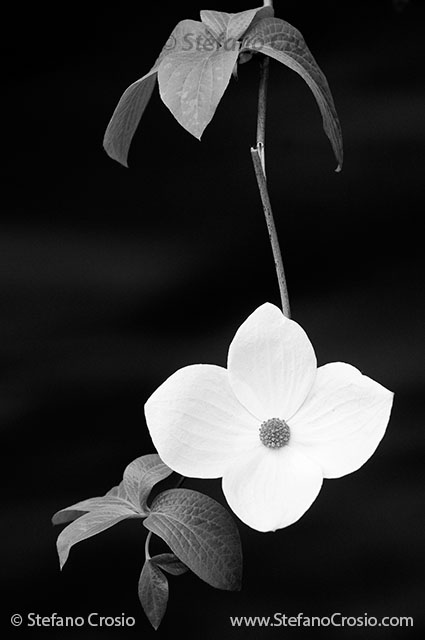
(Im)perfection

Dogwood Blossom

I just love dogwood blossoms: when they are in perfect conditions they are so beautiful and minimalist-elegant… I stumbled upon this particular blossom in Yosemite National Park and it immediately struck me, so much so that I felt I needed to stop to photograph it.

As soon as I saw it, I realized the image I would make of it would be a pretty strong metaphor. It would carry a message that beauty is fragile and transitory: the blossom appears perfect in its delicate beauty, but the twig that supports its very life is broken, like a stark premonition of the fate that is looming over the now perfect blossom. In my view, the somber mood of black & white complements well the message that this image intends to convey.

If you would like to see more images of mine, feel free to browse my Galleries.

As per my copyright notice, please respect my work and do not download, reproduce or use the image above without first seeking my consent. Thank you 🙂

Vertical Tasting of Marisa Cuomo’s Fiorduva

Marisa Cuomo, Costa d'Amalfi Furore Bianco During a recent trip to Milan, I participated in a pretty exciting (well, at least if you are into Italian wine!) event organized by the Milan chapter of the Italian Sommelier Association: a vertical tasting of six vintages of Fiorduva, the most awarded and acclaimed wine in the portfolio of coveted niche producer Marisa Cuomo.

About the Estate

Marisa Cuomo is a small winery controlling just 18 HA and producing about 109,000 bottles a year in an extreme and fascinating stretch of the Amalfi Coast in the Campania region in Southern Italy, near the towns of Furore and Ravello. Here the vines grow in narrow strips of land on the steep cliffs overlooking the Tirreno Sea, which make any kind of mechanical harvesting all but impossible. Commercially growing and harvesting vines here is an heroic challenge, with everything to be done exclusively by hand. Some of the older vines still grow horizontally instead of vertically, coming out of the stone walls that separate a strip from the one above it: this was an ancient local tradition that allowed land owners to have a vineyard and at the same time to grow vegetables in the narrow strips of land, shaded by the overhead vines. In those extreme conditions, every inch of land counts!

Marisa Cuomo, Vineyards in Winter

The team behind the winery is made up of Marisa, a strong woman who is in charge of the winemaking and bottling processes of their wines, Andrea, Marisa’s husband, who is the PR man of the winery and “Zio Luigi”, one of Marisa’s uncles who is in charge of maintaing the vineyards and harvesting the grapes.

About the Grapes and the Wine

Fiorduva is Marisa Cuomo’s flagship white wine, a blend of roughly equal proportions of three almost extinct grape varieties indigenous to the Campania region called Fenile, Ginestra and Ripoli.

Marisa and Andrea in their wine cellar

All three are white-berried grape varieties that are indigenous to and highly localized in the Amalfi Coast area in Campania. Fenile is said to derive its name from the Italian word “fieno” (hay) due to its straw yellow color. Fenile’s DNA profile is unique. It is an early ripening variety with high sugar levels. Ginestra draws its name from the homonymous Italian word which means broom, because of its dominant aroma. It is a late ripening variety with high acidity levels and with aging the wines made from these grapes may develop kerosene-like aromas similar to those that may be found in certain Riesling. Ripoli is a mid-ripening variety which is genetically close to Falanghina Flegrea and presents high sugar levels and moderate acidity (information on the grape varieties taken from Wine Grapes, by Robinson-Harding-Vouillamoz, Allen Lane 2012).

It is noteworthy to mention that the average age of the vines devoted to the Fiorduva production is 80 years: you could certainly call them “old vines”! The appellation of Fiorduva is Costa di Amalfi DOC, subzone Furore. Among its many awards, Fiorduva has won the 5 clusters top rating in the ISA wine guide and the 3 glasses top rating in the Gambero Rosso wine guide.

Zio Luigi working in the vineyard

Our Detailed Review and Vertical Tasting

Now, let’s get down to the vertical tasting of Fiorduva: as I said, we have been offered the opportunity to taste six vintages, starting from the latest (2011) all the way back to 2006. I found Fiorduva (which I had never had before, despite being aware of all the praise it received) a very special and “seducing” wine, definitely worth investing in a bottle if you come across one. Incidentally, Fiorduva is available in the U.S. where it retails for about $50, certainly not an inexpensive buy.

Among the six vintages that I tasted, in my view by far the best, most intriguing one was 2006, the oldest in the range, which vouches for the good aging potential of Fiorduva for a white wine. The vintages 2007 to 2009 were also extremely good, with 2008 perhaps having a slight edge over the other two. Finally, 2010 was good, but would certainly benefit from at least one more year in the bottle, and 2011 was pleasant, but not entirely balanced yet, with acidity and minerality tending to overwhelm the smoothness of the wine: definitely too young to be enjoyed at its fullest.

Now, to make you understand a bit more what kind of wine to expect should you lay your hands on a bottle, below is my review of my personal favorite: Marisa CuomoCosta d’Amalfi Furore “Fiorduva” DOC 2006 ($50).

My review is based on a simplified version of the ISA wine tasting sheet (for more information, see my previous post that provides a detailed overview of it).

In the glass, the wine poured a luscious golden yellow in color, and it was thick when swirled, indicating a good structure.

On the nose, its bouquet was intense, fine and complex, with aromas of apricot, peach and banana coupled with minerals and hints of petroleum and nail polish (by the way, these last two descriptors are not to be intended as negative and do not signify any flaws in the wine, they just indicate certain peculiar aromas that can be found in the Fiorduva – hints of petroleum, for instance, can often be found in certain Rieslings).

In the mouth it was dry, with high ABV and smooth; acidic and tasty: definitely a balanced wine with a full body. There was also a good correspondence between the mouth flavors and the bouquet. It had a long finish, with the wine’s intriguing flavors lingering in your mouth for a long time. In terms of its life cycle, I would call 2006 mature, meaning that I think the wine is now at its apex and would not benefit from any additional aging.

The Bottom Line

Overall, Fiorduva is an outstanding, intriguing wine which is the heroic expression of a harsh land, human tenacity and a sample of Italy’s treasure chest of indigenous grape varieties. Certainly worth a try if you come across a bottle.

Rating: Outstanding and definitely Recommended Outstanding  – $$$

(Explanation of our Rating and Pricing Systems)

A Valentine’s Day Polar Bear Hug

Polar Bear Hug (Ursus maritimus)

As some of you know, I love bears, of any species, and I love it whenever I have the opportunity to see them up close (in a safe way, of course), observe their behavior and photograph them. They make for great photo subjects.

This image was captured on a trip to the Western shores of Hudson Bay in Manitoba (Canada) where in or around late October/early November large numbers of polar bears (Ursus maritimus) congregate after hibernation waiting for the sea water to freeze so they can venture out on the ice to try and capture one of their favorite preys: seals.

While they hang out by the shore and wait for the temperatures to drop so as to make the magic happen once again, younger polar bears often kill time play-fighting. Witnessing this “boys will be boys” kind of rough game is fascinating, and if you keep your eye in the viewfinder long enough, with some luck you may photograph them while they strike poses that can look awkward, funny, dramatic or… just shweeeet like the one in this image, which two years ago these days was published as a Valentine’s Day poster insert in the Italian magazine Focus Junior.

However, appearances are sometimes deceiving because, in the “play-fight” portrayed in this image, the bear on the right was actually biting the other bear’s ear while holding its victim steady with its strong paws. You might therefore say that this image would be more appropriate to illustrate an ear piercing ritual of sort or that infamous “if you cannot beat them, bite them” Tyson vs Holyfield moment… 😉

Happy Valentine’s Day to those of you who celebrate it!

If you would like to see more images of mine, feel free to browse my Galleries.

As per my copyright notice, please respect my work and do not download, reproduce or use the image above without first seeking my consent. Thank you :-)

Spirit Bear

Spirit (or Kermode) Bear (Ursus americanus kermodei)

This image is dedicated to gracious Sarah at diary of a house elf and Kimberly at WhiskeyTangoFoxtrot4, two friends that like to hang out at Flora’s Table and two blogs that if you are not following already, you definitely should because you don’t know what you are missing: great photography, a lot of fun and… lots of wisdom too.

The reason why this image is dedicated to them is because they both live in beautiful British Columbia which, among many great things, is also home to the Spirit Bear (AKA Kermode Bear), which is the bear depicted in this image. Spirit Bears (Ursus americanus kermodei) are rare black bears that were borne white due to a recessive gene present in the blood of both their parents, but they are not albino. Being able to see, and even more to photograph, one does not happen often and when it does, it is a real treat.

If you would like to see more images of mine, feel free to browse my Galleries.

As per my copyright notice, please respect my work and do not download, reproduce or use the image above without first seeking my consent. Thank you 🙂

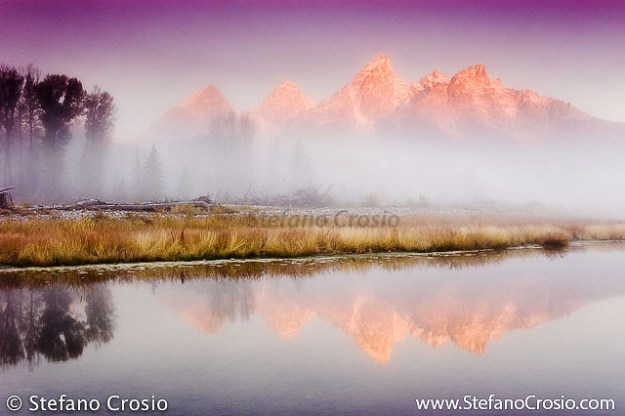
Misty Tetons

Misty Tetons

I took this photograph of the Tetons at sunrise on an Autumn day that, when I got on location, did not look very promising.

I had woken up well before daybreak and I had driven to Schwabacher Landing in Grand Teton National Park so I would be there when it was still dark, I could secure a spot and I had time to set up and compose before dawn. But, when I got there the entire range of the Tetons was concealed behind a thick veil of fog which made any attempt to photograph the mountains all but useless. I considered turning the car around and driving back to the lodge to hit the sack for some more sleep, but fought the temptation, hiked to a place I had spotted the day before and set up, hoping for the best.

And as it sometimes happens, nature did cooperate and right when the first sun rays started hitting the summit of the Tetons, the top part of the fog veil dissolved, revealing the mountain peaks bathed in sweet alpenglow with a base layer of fog lingering at the bottom, which added a touch of eerie mystery.

If you would like to see more images of mine, feel free to browse my Galleries.

As per my copyright notice, please respect my work and do not download, reproduce or use the image above without first seeking my consent. Thank you 🙂

Vinitaly International/Slow Wine NYC 2013: The Full Story

Vinitaly

Vinitaly International/Slow Wine NYC 2013 was held in New York on January 28 and I have had the opportunity to attend, with the added bonus of meeting in person Anatoli, the author of the excellent wine blog Talk-A-Vino, and doing the walk around together. Anatoli is a remarkable man with a deep and broad knowledge of wines of the world and it has been a real pleasure spending a day together enjoying the fair, sampling many good Italian wines and comparing notes. If you have never visited Anatoli’s blog, please make sure to make time to check it out and explore the wealth of quality information regarding wines and spirits that he has amassed there because it is really impressive. Also, if you are interested in reading more about this event from a different angle than mine, check out Anatoli’s three-post series on it: Vinitaly and Slow Wine Tastings – Part 1, Just Some Numbers, Vinitaly and Slow Wine Tastings – Part 2, Wine Seminars and Vinitaly and Slow Wine Tastings – Part 3, Wine, And More Wine.

Slow WineSo, you may be wondering, how was it after all? Let’s cut to the chase: I very much enjoyed my visit at Vinitaly International/Slow Wine NYC 2013 and I found the event to be well organized, with one very annoying exception that is the organization of the restricted-seating seminars focusing on specific wines.

According to the organizers’ Web site, one should have pre-registered on-line for every seminar he or she would be interested in and, provided that at the time of registration there were still seats available, a ticket would be issued to show at the entrance. Both Anatoli and I followed this process and successfully registered for two seminars, obtaining the respective admission tickets. Problem is that when we showed up with our tickets at the first seminar the person at the door tried to deny us access on the theory that the event was first come first served. This happened to a number of other people who had registered online and were being denied access as well. So, we got annoyed, pointed out the evident flaw in their system and eventually were let in, but the whole organization of the seminar was a huge flop.

Having said that, let’s take a quick look at some basic information about the event itself: the exhibitors’ area was divided into two zones: the larger one had tasting stations for the 78 wineries that were part of the Slow Wine portion of the event, while a smaller area was devoted to the Vinitaly part of the event with larger tables for 40 additional wineries as well as the representatives of 11 U.S. importers who had brought with them a selection of wines from 46 wineries that they represent. In both sections of the event many flagship bottles of the various represented wineries were available for tasting, generally coupled with a “second vin” and/or an “entry-level” wine. This worked out pretty well because in many cases it illustrated the various lines made by a certain winery and oftentimes showcased the very good quality/price ratio of certain second vins or entry-level wines even compared to the top-of-the-line wine(s) from the same producer.

Among the many very good wines that we got to sample at the fair during our wine tasting “marathon” (along with a few not-so-very-good ones), these are my personal top of the crop:

(A) PIEMONTE

  • VajraBarolo Bricco delle Viole 2008: this was my favorite Barolo among those I tried at the event. Super elegant, seducing aromas of lush red fruit and spices, with silky smooth tannins despite being still pretty young, and a very long finish. Spectacular Spectacular
  • Elvio CognoBarolo Ravera 2008: my second best among the Barolo’s: very different from Vajra’s, with a nice bouquet of red fruit, floral hints and tobacco; distinct but smooth tannins and plenty of structure. Very Good Very Good
  • DamilanoBarolo Cannubi 2008: third step of my personal podium for Barolo’s – complex in the nose with red fruit, spices and hints of soil, well defined tannins which can benefit from a few more years of aging and quite long finish. Very Good Very Good

(B) LIGURIA

  • VisAmorisRiviera Ligure di Ponente Pigato Verum 2011: without a doubt the best Pigato I have ever tasted so far – it undergoes a short phase of maceration on the skins in order to maximize the extraction of the aromas, which results in an intense and seducing bouquet of apple and herbs and a good balance in the mouth between its acidity and minerality on the one hand and its smoothness on the other. Outstanding Outstanding

(C) LOMBARDIA

  • Ca’ del BoscoFranciacorta Cuvee’ Annamaria Clementi 2004: there is only one word for this Classic Method spumante – wow! Seven years on its lees for a wine that is sleek, elegant, refined, with a wonderful superfine perlage, a complex bouquet alluding to several fascinating aromas, like peach, honey, croissant, hazelnut, minerals, and a very long finish. Spectacular Spectacular – the only problem is… its price tag!
  • Ar.Pe.Pe.Valtellina Superiore Sassella Rocce Rosse Riserva 2001: together with Fay (who was not present at the event) this is one of my favorite producers of Valtellina Superiore (a varietal wine made of 100% Nebbiolo grapes, locally known as Chiavennasca), and the Rocce Rosse was outastanding, with fine aromas of cherries, spices and tobacco, very smooth tannins and good structure with a long finish. Outstanding Outstanding

(D) VENETO

  • Trabucchi D’IllasiRecioto della Valpolicella 2006: oh man, this is a truly outstanding sweet red wine made from the same base grapes of Amarone (Corvina, Corvinone and Rondinella), perfect to be paired with chocolate or chocolate-based desserts – exquisite and intense bouquet of black fruit, black berries, licorice and vanilla, with a wonderful balance between sweetness and smooth tannins and a very long, seducing finish. Spectacular Spectacular
  • Trabucchi D’IllasiAmarone della Valpolicella Cent’Anni Riserva 2004: outstanding Amarone, with a superb bouquet of red flowers, wild cherries, plum, spices and dark chocolate; in the mouth it is warm and balanced with a great smoothness complementing good acidity and noticeable but smooth tannins, and a long finish. Spectacular Spectacular
  • PieropanSoave Classico Calvarino 2010: a very good Soave made of a blend of Garganega and Trebbiano di Soave grapes which literally hits you in the nose with an exhuberant minerality and aromas of apple, citrus and white flowers; in the mouth a lively acidity and distinct minerality are balanced by a good extent of smoothness. Very Good Very Good

(E) FRIULI VENEZIA GIULIA

  • Le Vigne di Zamo’Colli Orientali del Friuli Friulano Vigne Cinquant’anni 2010: wonderful Friulano with a pleasant and intense bouquet of citrus, apple, tropical fruit and minerals. In the mouth noticeable acidity and minerality countered by good smoothness. Spectacular Spectacular

(F) TOSCANA

  • Podere Il CarnascialeCaberlot 2002: first off, a note of gratitude to fellow blogger and wine connoisseur Laissez Fare who introduced me to the fascinating world of Caberlot. Regarding our tasting, actually the good people of Il Carnasciale made available a vertical tasting of Caberlot from vintages 2009, 2008 and 2002 – all were very good, but to me 2002 was truly outstanding, which should not come as a surprise for a wine that needs aging to be at its best (incidentally, Caberlot is not only the name of the wine, but also that of the grape, a rare cross between Cabernet Franc and Merlot). The wine offered a wonderful bouquet with aromas of berries, spices, soil, tobacco and dark chocolate, silky smooth tannins in the mouth, plenty of structure and a long finish. Caberlot is only available in magnum format, in an extremely limited production and for a hefty price tag. Spectacular Spectacular

(G) UMBRIA

  • TabarriniAdarmando 2010: an excellent white wine 100% made out of Trebbiano Spoletino grapes, with a pleasant floral and fruity bouquet, with aromas of citrus and peach, good acidity and structure. Very Good Very Good
  • TabarriniSagrantino di Montefalco Campo alla Cerqua 2008: intense aromas of red flowers, ripe plums, black pepper and licorice, noticeable tannins in the mouth that will benefit from more years of aging in the bottle and plenty of structure, with a long finish. Very Good Very Good
  • Arnaldo CapraiSagrantino di Montefalco 25 Anni 2007: my personal favorite interpretation of Sagrantino, with a complex bouquet of cherries, spices, dark chocolate and tobacco and then the quintessential sensory definition of the astringent mouth feel of tannins, with plenty of tannins that are not harsh but will be smoother with a few more years of aging and a very good smoothness to counterbalance them, and a long finish. Outstanding Outstanding

(H) MARCHE

  • Marotti CampiVerdicchio dei Castelli di Jesi Classico Salmariano 2009: nice bouquet of white flowers, peach, citrus and minerals; good acidity and a quite long finish. Very Good Very Good

(I) ABRUZZO

  • Cantina FrentanaPecorino Donna Greta 2010: a very good wine made of a blend of indigenous white-berried Pecorino grapes and Chardonnay grapes, with aromas of white flowers, citrus and vanilla, lively acidity balanced by a good smoothness, and a quite long finish. Very Good Very Good

(J) BASILICATA

  • Cantine del NotaioAglianico del Vulture Il Sigillo 2008: a wonderful Aglianico del Vulture, with a complex bouquet of plum, black berries, dark chocolate and tobacco; plenty of structure in the mouth, with smooth tannins countered by good smoothness, and a long finish. Outstanding Outstanding – in my view with a couple more years in the bottle it may become spectacular.

(K) SICILIA

  • PlanetaNoto Nero d’Avola Santa Cecilia 2008: if you have been following this blog for a while you know I love this winery, and the Santa Cecilia is one of my favorite red wines in their lineup – with fine aromas of ripe red fruit, plum, wild berries, dark chocolate, licorice and soil; in the mouth smooth tannins balanced by good smoothness and plenty of structure. Outstanding Outstanding
  • PlanetaCarricante 2011: very good white wine made out of 100% indigenous Carricante grapes, with an elegant bouquet of apple, citrus, honey and minerals; good acidity and noticeable minerality in the mouth balanced out by a good extent of smoothness. Outstanding Outstanding

Finally, one last note on my favorite seminar of the event: the Nino Negri Master Class, a vertical tasting of six vintages (2009, 2007, 2004, 2002, 2001 and 1997) of Nino Negri’s flagship wine, the Sforzato della Valtellina 5 Stelle Sfursat, a 100% Nebbiolo (AKA Chiavennasca) dry red wine from the mountainous region of Valtellina in Lombardia, made after a 3-month drying process of the grapes in small crates in ventilated premises to concentrate sugar and aromas due to the evaporation of the water present in the grapes, which leads to a 30% weight loss in the berries. This results in an extraordinary wine with plenty of structure and a jaw-dropping 15 to 16 degree ABV after regular alcoholic fermentation.

To me, the best vintage among those presented in the vertical tasting was 2001, a garnet red wine with hints of orange, with a phenomenal bouquet of ripe red fruit, spirited fruit, dark chocolate, resin, minerals, graphite. In the mouth, obviously warm, with very good smoothness balanced out by silky tannins, and finished off by plenty of structure and an endless finish. Spectacular Spectacular

Phew, that’s all! Apologies for the long post, but I hope it will tempt you to try out for yourselves some of these awesome wines. If you do, let me know how you like them.

Cheers!

A Wine Review Valentine: St Michael Eppan, Alto Adige Pinot Grigio “Sanct Valentin” 2010 DOC

St Michael Eppan, Alto Adige Pinot Grigio As a valentine to my wine enthusiast readers, in this review I will share my tasting notes for a quality Italian Pinot Grigio: St Michael EppanAlto Adige Pinot Grigio “Sanct Valentin” 2010 DOC ($30). As you may know, “Sanct Valentin” is the flagship line in St Michael Eppan’s wine offering.

The Bottom Line

Overall, a very good wine and a quality product of Pinot Grigio grapes.

Rating: Very Good and Recommended Very Good – $$

(Explanation of our Rating and Pricing Systems)

About the Grape

Let’s start with some general information about Pinot Grigio, AKA Pinot Gris, as a grape variety. Pinot Grigio is a color mutation of Pinot Noir whose origins can be traced back to the XVIII century in both Germany and France. Pinot Grigio is said to have been cultivated in Northern Italy since the XIX century. Pinot Grigio is a grey-berried grape with generally high sugar levels and moderate acidity. In Italy, for some reason, Pinot Grigio came into fashion in the late Ninenties/early two thousands, a trend that has been fueled by booming exports especially to the UK and the US of mostly inexpensive and lackluster wines made out of an overproduction of this grape variety. This phenomenon somewhat tarnished the reputation of Pinot Grigio, which was often associated with a cheap, mass-production type of wine, until in the last few years it started falling out of favor. Fortunately, some quality Italian Pinot Grigio is still made, particularly in the regions of Friuli, Alto Adige and Veneto (grape variety information taken from Wine Grapes, by Robinson-Harding-Vouillamoz, Allen Lane 2012).

Our Detailed Review

Having said that, let’s now move on to the actual review of one of such quality wines: St Michael-Eppan‘s Alto Adige Pinot Grigio “Sanct Valentin” 2010 DOC. As you may know, “Sanct Valentin” is the flagship line in the wine offering of Alto Adige’s solid winery St Michael Eppan. The Pinot Grigio Sanct Valentin is available in the US where it retails at about $30.

The Pinot Grigio Sanct Valentin is made from grapes harvested from 15 to 20 year old vines at an elevation of about 500 mt/1,640 ft in proximity to the town of Appiano (near Bolzano). One third of the wine is fermented in new barrique (small oak) casks and two thirds in used ones, where the wine rest on its lees for 11 months, then 6 months in steel vessels.

My review is based on a simplified version of the ISA wine tasting sheet (for more information, see my post that provides a detailed overview of it).

In the glass, it poured a warm straw yellow, and it was thick when swirled, indicating good structure.

On the nose, its bouquet was intense, fine and complex, with aromas of pear, white flowers and citrus coupled with hints of butter, white pepper, flint and oaky notes.

In the mouth it was dry, warm and creamy, with pretty good acidity and noticeable minerality, which made it a balanced wine with good structure. The wine had a pleasantly long finish. In terms of its evolutionary state, it was ready, meaning that it can definitely be enjoyed now and can possibly evolve even more with one or two years of additional aging.

Happy Sanct Valentin, everybody! 😉

An Overview of the ISA Wine Tasting Protocol

StefanoOne of the key building blocks of the sommelier certification course offered by the Italian Sommelier Association (ISA) is their standardized wine tasting protocol. This is a protocol that has been devised over the years by the association with a view to uniforming wine evaluations and reviews as much as possible among ISA-member sommeliers through the use of a common procedure and a common vocabulary.

A few years ago I went through all of the three levels of the ISA sommelier certification course at the Milan chapter of ISA and I thoroughly enjoyed the great learning experience that such a course offered, so I hope that many of you will find this quick overview of the ISA wine tasting protocol an interesting read. Besides, the main reason why I want to introduce these concepts is that I intend to utilize a simplified version of this evaluation process in wine reviews that I plan on publishing in future posts on this blog.

An ISA-protocol wine tasting is divided into three main phases, as follows:

  • Visual Analysis
  • Scent Analysis
  • Taste-Scent Analysis

Each phase is divided into multiple steps, each of which needs to be addressed by the taster using the ISA standardized vocabulary and the ISA wine tasting sheet. For our purposes, we will not focus on each of the 116 wine tasting terms in the ISA vocabulary or this post would grow out of proportion, but the following overview should anyhow give you a pretty good idea of what the process entails. If you have doubts as to the meanings of certain of the wine terms used below, you may want to refer to our Wine Glossary.

(A) Visual Analysis

  1. Clarity: this is an assessment whether the wine looks clear or instead presents debris or insoluble particles (as it may happen in old wines or unfiltered wines) – standard term for red wines is “clear”, standard for still white wines is “crystal clear” and standard for quality sparkling white wines is “brilliant”
  2. Color: self-explanatory, based on codified color terms for each type of wine (e.g., for white wines: greenish yellow; straw yellow; golden yellow; amber yellow). To properly assess color, one should hold the glass tilted forward (i.e., away from you) at a 45° angle against a white backdrop and assess color by looking in the middle of oval made by the surface of the wine in the glass. After assessing color, one should focus on the top part of the rim made by the wine in the glass (where the wine is shallower) to assess whether there are any perceptible color variations or “hints“: for instance, for a structured red wine with a few years of aging, the color analysis could be “ruby red with garnet hints” or vice versa a red wine that is still fairly young could be “ruby red with purple hints”
  3. Viscosity: this step entails swirling the wine in the glass and observing how fluidly or viscously it rotates and then observing the shape of the “arches” and the velocity of the “tears” that the wine leaves on the inside of the glass – two indicators of the wine’s alcohol by volume (ABV)glycerol content and structure or body (the faster the wine to stop swirling after you stop rotating the glass and the slower the tears to fall, the more ABV/structure the wine will have). Viscosity is only assessed in still wines
  4. Effervescence: as opposed to viscosity, this is a quality that is only assessed in sparkling wines. Here the taster should assess three characteristics of the perlage of the wine: the number of bubbles (the more, the better); the grain of the bubbles (the finer, the better); and the persistence of the bubble chains in the glass (the longer they last, the better)

(B) Scent Analysis

  1. Intensity: here the taster swirls the wine in the glass once again and then smells its bouquet. This first step of this phase assesses how clearly perceptible the wine aromas are in the nose of the taster
  2. Complexity: here the taster should assess how many different aromas he or she can pick up from the wine through successive inhalations: the more perceptible scents, the more complex the bouquet of the wine
  3. Description of the Aromas: here the taster indicates what kind of aromas he/she felt (or thinks that he/she felt!) in the nose, like aromas of flowers, fruit, herbs, spices, animal, soil, tobacco, minerals, etc.
  4. Quality: this is an overall evaluation of the quality of the bouquet of the wine, based on the three previous steps

(C) Taste-Scent Analysis

This phase of the ISA wine tasting protocol requires a premise: this is (finally!) the moment when the taster gets to actually taste the wine in his/her mouth.

Before getting to evaluating its quality, the taster classifies the wine in light of its essential characteristics, which are divided into two macro-categories called “softness” and “hardness“. The former category comprises sweetness, alcohol by volume and smoothness, while the latter encompasses acidity, tannins and tastiness (see more about these terms below). This analysis is important because, depending on its outcome, the taster will later decide whether the wine is balanced or not. But let’s now get to the various steps of this phase:

(i) Softness:

  1. Sweetness: here the taster classifies the wine based on its residual sugar level: dry, off-dry, medium-dry, sweet…
  2. Alcohol: here the wine is classified based on the perception in the mouth of its ABV: a wine for which a high ABV is clearly perceptible (but not disturbing) is called “warm” because of the feeling of apparent “heat” that alcohol conveys in the mouth
  3. Smoothness: this quality of the wine is that sense of “roundness” or “silkiness” in the mouth that is generally more common to red wines than whites, although there are exceptions. It is mainly given by the glycerol levels present in the wine, as a result of the alcoholic fermentation process or the action of Bortytis Cinerea in botrytized wines

(ii) Hardness:

  1. Acidity: here the wine gets classified based on the extent of perceptible acids present in the wine. A wine with crisp acidity is called “fresh”. Good acidity levels are generally desirable in white wines and particularly so in Brut sparkling wines. One of the key indicators of a wine with good acidity is increased salivation in the mouth
  2. Tannicity: this assessment is made only for red wines, because white wines have negligible amounts of tannins (because the white winemaking process lacks the maceration phase that in the red winemaking process permits the extraction of tannins). Depending on the grape variety/ies that are used to make a wine, this will be more or less tannic
  3. Sapidity: here the taster assesses the minerality of the wine, that is the extent to which mineral compounds are clearly discernible in the mouth, in the form of a vaguely salty taste

(iii) Structure:

– Body: this is an assessment of the structure or body of the wine, which is given by its dry extract and alcohol by volume: wines with a higher dry extract and ABV are called full-bodied

(iv) Assessment:

  1. Balance: this is a very important call that the taster is required to make in light of the aforesaid classifications. Generally, a wine is deemed balanced when its “softness” and “hardness” components balance each other out, but this is not a rule that is carved in stone and there are important exceptions. For instance, when tasting a white wine, it is commonly considered desirable that its “hardness” side have an edge over its “softness” side, while the opposite is often the case for structured red wines
  2. Intensity: as in the Scent Analysis phase, this is an assessment of how clearly perceptible the flavors of the wine are in the mouth of the taster
  3. Persistence or Finish: here the taster is called to classify the wine based on how long its flavors linger in his/her mouth after having swallowed a sip of wine. The finish is deemed long if the wine flavors are still perceptible after 7-10 seconds of swallowing
  4. Quality: here the taster assesses the quality of the wine flavors that he/she felt in the mouth: a quality judgment of “fine” implies that the flavors are (or include those) typical for the grape variety/ies of the wine and are pleasant in the mouth
  5. Evolutionary State or Life Cycle: here the taster classifies the wine based on its aging potential. A wine that is classified as “ready” means that it can be pleasantly drunk today but it would benefit from a few years of additional aging in order to achieve its full potential. By contrast, a wine is deemed “mature” when it is already deemed at its top and additional aging would make its quality degrade
  6. Harmony: this is the final, overall judgment about a wine, that is defined as a coherent synthesis of the three phases of the ISA wine tasting protocol resulting in a outstanding quality level. A wine that did well but not outstanding would be deemed “not quite harmonious”.

One final word regarding the recommended type of glass to perform a wine tasting exercise: it needs to be made of clear glass (ideally, a crystal glass), it needs to have a stem (that’s how one is supposed to hold the glass, by the stem), and it needs to have a bowl that is larger at the bottom (to allow wine to deposit when the color analysis is performed and to permit smooth swirls in the assessments of fluidity and bouquet) and smaller at the top (to concentrate aromas in the nose, thus facilitating bouquet assessment).

This is all: I hope you enjoyed this overview – stay tuned for a few wine reviews to come!

Psychobubbles Part IV: Some of the Best Prosecco’s

Cheers!

There we go, at last our series of posts on Italian spumante is coming to an end, with this last installment focusing on a few recommendations for quality Italian Method spumante wines.

As we said on the second post of our series, the two most renowned Italian Method sparkling wines are Prosecco and Asti Spumante. Beside being made from different grapes (Glera for the former, Moscato Bianco for the latter), Prosecco is generally produced as a dry wine (as per the applicable specifications, it can be produced in any of the variants ranging from Brut to Demisec in terms of residual sugar), while Asti Spumante is a sweet dessert wine with over 50 gr/lt of residual sugar.

On this post, we will just concentrate on Prosecco because… I have to admit it: I am not a huge fan of Asti Spumante or sweet sparkling wines in general. Should any of our readers be interested in a couple of recommendations of quality Asti Spumante wines, feel free to leave a comment on this page and I will gladly oblige 😉

Montesel, Prosecco di Conegliano Valdobbiadene Superiore "Riva dei Fiori" Brut DOCGBefore getting to the actual recommendations, let’s just say a few words about Prosecco in general: Prosecco is made prevalently or exclusively from partly-aromatic Glera (also known as Prosecco) white-berried grapes in two Italian DOCG appellations and in one more loosely regulated inter-regional DOC appellation, as follows:

  • Prosecco di Conegliano Valdobbiadene DOCG in the Veneto region;
  • Prosecco dei Colli Asolani DOCG in the Veneto region;
  • Prosecco Spumante DOC, an appellation which stretches between the regions of Veneto and Friuli.

Prosecco is one of the main examples of a sparkling wine made according to the so-called Italian Method production process, although there are a few producers who also make some very good Classic Method Prosecco’s, such as Valdo‘s Prosecco Brut Metodo Classico Numero 10 DOCG (see, our full review of this outstanding Prosecco).

Bepin De Eto, Prosecco di Conegliano Valdobbiadene Superiore Brut DOCGCompared to the Classic Method, the Charmat-Martinotti Method is a quicker and cheaper production process for sparkling wine, which is known to maximize primary (or varietal) aromas although it generally sacrifices the wine structure and the finest perlage. For more detailed information, please refer to our post on the Charmat-Martinotti Method.

Now, let’s move on to a few recommendations of quality Prosecco’s:

  • Adami, Prosecco di Valdobbiadene Superiore Brut “Bosco di Gica” DOCG (95-97% Glera grapes/3-5% Chardonnay grapes, with aromas of wisteria, pear, apple, peach, Mirabelle plum and herbs);
  • Astoria, Prosecco di Valdobbiadene Superiore “Cuvée Tenuta Val de Brun” Extra Dry DOCG (100% Glera grapes, with a bouquet of white flowers, pear, apple and citrus);
  • Bepin De Eto, Prosecco di Conegliano Valdobbiadene Superiore Brut DOCG (100% Glera grapes, with scents of rose, wisteria, apple, pear, peach, bread crust and minerals – commendable is the investment made by the owners to achieve a very good density of 4,000 vines/HA);Adami, Prosecco di Valdobbiadene Superiore Brut "Bosco di Gica" DOCG
  • Le Colture, Prosecco di Valdobbiadene Superiore di Cartizze Dry DOCG (100% Glera, with a bouquet of white flowers, peach, citrus and herbs);
  • Marsuret, Prosecco di Valdobbiadene Superiore “San Boldo” Brut DOCG (100% Glera grapes, with aromas of mint, broom, elder blossoms, apple, citrus and minerals);
  • Montesel, Prosecco di Conegliano Valdobbiadene Superiore “Riva dei Fiori” Brut DOCG (100% Glera grapes, with scents of elder blossoms, wisteria, pear, apple, lime and minerals);
  • Nino Franco, Valdobbiadene Superiore di Cartizze DOCG (100% Glera, made in the finest sub-zone of the appellation known as Cartizze and displaying fine aromas of jasmine blossoms, passion fruit, citrus, herbs and minerals);Valdo, Prosecco Brut Metodo Classico Numero 10 DOC
  • Nino Franco, Prosecco di Valdobbiadene “Grave di Stecca” Brut (100% Glera, with scents of wild flowers, almond, apricot and citrus).

Hope you have an opportunity to enjoy some of these wines and, if you do, feel free to share your opinion here.

Winevent – Gambero Rosso’s Tre Bicchieri USA Tour: February 7-15, 2013

Gambero Rosso's Tre Bicchieri USA Tour 2013

After the Vinitaly International/Slow Wine event that took place in New York on January 28 (for more information and other dates/cities, see our Winevent post on Flora’s Table), Gambero Rosso’s Tre Bicchieri World Tour will make three stops in the U.S., as follows:

  • February 7: San Francisco, CA
  • February 12: Chicago, IL
  • February 15: New York, NY

This event is open to media, trade and “Italian wine collectors” (sic) only – links to register for any of the three locations above are available on Gambero Rosso’s Web site. Tre Bicchieri USA 2013 is an event that is not to be missed for those who qualify and are into Italian wine, as the organizers will showcase a selection of only those Italian wines and producers that have been awarded the coveted top “tre bicchieri” (i.e., three glasses) recognition by reputable Gambero Rosso wine guide.

Just to give you an idea,  in an imaginary tour of Italy from North to South, the list of the wines that won the prestigious tre bicchieri includes, limiting ourselves to just one wine per region and trying to avoid the most obvious among the “usual suspects”:

  • Northern ItalyLes Crêtes‘ Chardonnay Cuvée Bois (Valle d’Aosta); Cogno‘s Barolo Vigna Elena Riserva (Piemonte); Bio Vio‘s Riviera Ligure di Ponente Vermentino Aimone (Liguria); Berlucchi‘s Franciacorta Brut Cellarius (Lombardia); Ferrari‘s Trento Extra Brut Perlé Nero (Trentino); Muri Gries‘s Alto Adige Lagrein Abtei Muri Riserva (Alto Adige); Masi‘s Amarone della Valpolicella Classico Mazzano (Veneto); Vie di Romans‘s Isonzo Sauvignon Piere (Friuli); Chiarli‘s Lambrusco di Sorbara Del Fondatore (Emilia Romagna);
  • Central ItalyFonterutoli‘s Mix 36 (Toscana); Oasi degli Angeli‘s Kurni (Marche); Caprai‘s Sagrantino di Montefalco 25 Anni (Umbria); Cataldi Madonna‘s Pecorino (Abruzzo);
  • Southern ItalyMastroberardino‘s Taurasi Radici (Campania); Basilisco‘s Aglianico del Vulture Basilisco (Basilicata); Planeta‘s Chardonnay (Sicilia); Argiolas‘s Turriga (Sardegna).

For the entire list of awarded wines, check out Gambero Rosso’s Web site.

We plan on attending the Gambero Rosso event in New York City and reporting on Clicks & Corks thereafter.

Psychobubbles Part III: Some of the Best Franciacorta and Trento Spumante’s

Cheers!

After discussing the Classic Method production process and the Charmat-Martinotti Method production process in the previous two posts, our series of posts on Italian spumante is coming to an end: today, I will pass on a few recommendations of some among the best Italian Classic Method spumante wines, at least in my view, while the next and last post will focus on recommendations specific to Charmat-Martinotti Method wines.

Before we get into the actual wines, just a few words about the best Italian appellations for Classic Method sparkling wines. In Italy there are four appellations that are exclusively reserved to the production of Méthode Champenoise wines, as follows:

  • Franciacorta DOCG, in the Lombardia region (permitted grapes: at least 50% of Chardonnay and/or Pinot Noir, along with up to 50% of Pinot Blanc – minimum aging on the lees: 18 months, with the “Riserva” version requiring a minimum of 60 months);
  • Trento DOC, in the Trentino region (permitted grapes: Chardonnay, Pinot Noir, Pinot Blanc and/or Pinot Meunier – minimum aging on the lees: 15 months, with the “Riserva” version requiring a minimum of 36 months);
  • Oltrepo Pavese Metodo Classico DOCG, in the Lombardia region (permitted grapes: at least 70% Pinot Noir, with the remaining maximum 30% coming from Chardonnay, Pinot Gris and/or Pinot Blanc – minimum aging on the lees: 15 months); and
  • Alta Langa DOCG, in the Piemonte region (permitted grapes: at least 90% of Chardonnay and/or Pinot Noir).

Berlucchi, Franciacorta Brut '61 DOCG

Beside those four appellations that are reserved to the production of Classic Method spumante wines, several other Italian appellations permit the production of Classic Method sparkling wines among other permitted wines (a few examples being Veneto‘s Prosecco di Conegliano Valdobbiadene DOCG or Piemonte‘s Cortese di Gavi DOCG or Sardinia‘s Vermentino di Gallura DOCG).

Very broadly speaking, the best Classic Method Italian spumante wines can be found in the Franciacorta DOCG and in the Trento DOC appellations. Below are a few recommendations of very good Classic Method wines with good quality/price ratio from those two appellations that, should you come across them, you should definitely consider trying out:

(A) FRANCIACORTA DOCG

  • Berlucchi, Franciacorta Brut ’61 DOCG (85% Chardonnay, 15% Pinot Noir; 18 months of aging on the lees): a solid Francicaorta with hints of citrus, pineapple and pastry.
  • Ferghettina, Franciacorta Brut DOCGBerlucchi, Cellarius Brut DOCG (80% Chardonnay, 20% Pinot Noir; 30 months of aging on the lees): this is simply delightful, one of my favorite Franciacorta ever. It is a little more expensive than the ’61, but in my view well worth the little extra for what it gives you back: freshly baked bread crust,  apple and citrus, with a mineral note, just wonderful. Unfortunately, it is not imported in the United States yet, but it sounds like the guys at Berlucchi are seriously considering whether this choice should change in the future: I sure hope it will some time soon!
  • Ferghettina, Franciacorta Brut DOCG (95% Chardonnay, 5% Pinot Noir; 24 months of aging on the lees): an excellent choice for the money, with pleasant aromas of wildflowers, citrus, bread crust and peach.
  • Ferghettina, Franciacorta Pas Dosé Riserva 33 DOCG (100% Chardonnay; 72 months of aging on the lees): magnificent and more expensive, one of Ferghettina’s top of the line wines, with scents of bread crust, pastry, citrus, pineapple, hazelnut complemented by mineral and slightly toasty hints.
    Cavit, Trento Brut Altemasi Graal Riserva DOC
  • Bellavista, Cuvée Brut DOCG (80% Chardonnay, 18% Pinot Noir, 2% Pinot Blanc, 36 months of aging on the lees): very pleasant, with aromas of citrus, bread crust and peach.
  • Bellavista, Gran Cuvée Brut DOCG (72% Chardonnay, 28% Pinot Noir; 48 months of aging on the lees): wonderful albeit quite expensive wine, with a complex bouquet of wildflowers, pastry, citrus and pineapple and lingering aftertaste.
  • Ca’ del Bosco, Franciacorta Brut Cuvée Prestige DOCG (75% Chardonnay, 15% Pinot Noir, 10% Pinot Blanc; 25 months of aging on the lees): very good choice with aromas of wildflowers, bread crust, peach and almond.
    Dorigati, Trento Brut Methius Riserva DOC
  • Ca’ del Bosco, Franciacorta Cuvée Annamaria Clementi DOCG (55% Chardonnay, 25% Pinot Blanc, 20% Pinot Noir; 84 months of aging on the lees): okay, this is really expensive, but it is also sublime: the finest perlage along with a complex bouquet of peach, honey, almond, dried nuts and subtle mineral hints of gunflint – a delightful sin.

(B) TRENTO DOC

  • Cavit, Trento Brut Altemasi Graal Riserva DOC (70% Chardonnay, 30% Pinot Noir; 72 months of aging on the lees): quite expensive, but of excellent quality, with aromas of pineapple, citrus, bread crust coupled with a touch of incense and mineral hints.
  • Maso Martis, Trento Brut Riserva DOCDorigati, Trento Brut Methius Riserva DOC (60% Chardonnay, 40% Pinot Noir; 60 months of aging on the lees): yet another great choice, with aromas of magnolia blossoms, citrus, pineapple, bread crust, vanilla.
  • Maso Martis, Trento Brut Riserva DOC (70% Pinot Noir, 30% Chardonnay; 52 months of aging on the lees): an exquisitely refined wine, with a wide bouquet of bread crust, wildflowers, apple, citrus, banana, butter and slightly oaky due to partial aging in barrique barrels. Wonderful.
  • Ferrari, Trento Brut Perlé DOC (100% Chardonnay; 60 months of aging on the lees): an excellent wine, with aromas of magnolia blossoms, citrus, apple, melon and pastry.

That’s all for now – stock up and drink good wine!  🙂

“Tasting Chateau Margaux 16 Ways”: An Excellent Post on Dr Vino’s Blog

StefanoJust a very quick note to give heads up to our wine enthusiast readers as to an in my view excellent post that got published yesterday in Tyler Colman’s wonderful wine blog, Dr Vino.

In the post, Tyler gives a full account of a one-of-a-kind wine tasting experience he had the good fortune to attend where Paul Pontallier (the man who has been the managing director and winemaker at Chateau Margaux for the last 30 years) led selected few to taste the base wines of the various grape varieties (Cabernet Sauvignon, Merlot, Cabernet Franc and Petit Verdot) that will create Chateau Margaux’s 2012 Grand Vin, pre-blending, as well as samples from the Chateau’s organic, biodynamic, and conventional test vineyards and more samples illustrating the Chateau’s experimentation with, and position on, wine fining, filtration and closure (with a very interesting perspective about the debate among cork, screwcaps and synthetic closures, especially from a Premier Cru maker’s standpoint).

As you may know, Chateau Margaux is one of the five Premiers Grands Crus Classés wines that rank at the top of the 1855 classification of the best Bordeaux wines from the West Bank that was ordered by Emperor Napoleon III of France in view of the then forthcoming Second Universal Exhibition in Paris, which still stands almost unmodified as of today (the only change in the top ranking being the addition of Chateau Mouton-Rothschild in 1973 as the fifth Premier Cru).

By the way, if you are interested and want to learn more about the fascinating history behind the 1855 classification of the Grands Crus Classés of the West Bank region of Bordeaux, I suggest you check out the excellent Official Web site of the Grands Crus Classés in 1855 and download their “History of the Classification” PDF file: it is definitely worth reading!

I found the post extremely interesting, educational and enriching, and I wholeheartedly recommend that you check out the full account on Dr Vino’s blog.

Enjoy the read!

Psychobubbles Part II: An Overview of Méthode Charmat-Martinotti (or Italian Method) Spumante

Cheers!

On our previous post we started our journey into the world of Italian spumante by covering the basics, very briefly touching upon Champagne, introducing the two main processes to make a natural sparkling wine, the Champenoise or Classic Method and the Charmat-Martinotti or Italian Method, and finally going through the main steps of the Classic Method production process. So, if you missed that post, you may want to go through it first and then dive into this second chapter of the “spumante saga” 😉

On today’s post we will briefly discuss how and when the Charmat-Martinotti Method came to be, we will then point out the main differences between the production processes for the Italian Method and the Classic Method and finally we will go through the main steps of the Charmat-Martinotti Method, including its variant used in the production of Asti Spumante.

Let’s therefore start with some history. The development of the most commonly utilized alternative process to make a sparkling wine, the so-called Martinotti Method or Charmat Method or even Italian Method, took place at the end of the XIX century, precisely in 1895 when Federico Martinotti, who was in charge of the Royal Enological Station in Asti, invented a steel pressurized and refrigerated vessel known as “autoclave” that is used to make Italian Method spumante wines. This alternative process is also known as “Charmat Method” because a French engineer by the name of Eugéne Charmat adapted the design of Martinotti’s autoclave to suit industrial production of sparkling wine and rolled out the product in 1907. Considering the contributions made by both such gentlemen to devising such alternative production process, I think the proper way to identify it would be “Charmat-Martinotti Method.”

Now, let’s get a little more into the specifics of how the Italian Method differs from the Classic Method and what this means to you if you want to buy a bottle of wine made according to one versus the other of such production processes.

First of all, let’s start by saying that two of the most renown Italian Method spumante wines are:

  • Prosecco (although there are a few producers who also make very good Classic Method Prosecco’s, such as Valdo‘s Prosecco Brut Metodo Classico Numero 10 DOCG). Prosecco is made prevalently or exclusively from partly-aromatic Glera (also known as Prosecco) grapes in either one of the following two DOCG appellations of the Veneto region: Prosecco di Conegliano Valdobbiadene DOCG or Prosecco dei Colli Asolani DOCG as well as in the more loosely regulated DOC appellation Prosecco Spumante DOC, which stretches between Veneto and Friuli; and
  • Asti Spumante, which is made exclusively from aromatic Moscato Bianco grapes in Piemonte’s DOCG appellation Asti Spumante.

Generally speaking, Prosecco is made as a dry wine: according to applicable regulations, it may be produced in all variants between Brut (less than 15 gr/lt of residual sugar) and Demi-Sec (33 to 50 gr/lt of residual sugar, which would make it fairly sweet tasting), but your best bets are in the Brut, Extra Dry (12 to 20 gr/lt of residual sugar) or Dry (17 to 35 gr/lt of residual sugar) versions.

Asti Spumante, instead, is typically a sweet dessert sparkling wine, with over 50 gr/lt of residual sugar. So, do not serve Asti Spumante with appetizers – just keep it chilled until the end of your meal and pair it with a dessert.

On our previous post, we saw how two key features of the Classic Method are its in-bottle refermentation process of the base wines and then the generally long period of time spent by Classic Method wines aging on their lees before their being shipped off to wholesalers and retailers worldwide.

What makes Italian Method sparkling wines generally less expensive than Classic Method wines and different in terms of aromas and taste is mainly their different production process. For Italian Method wines, this is much shorter because refermentation of the base wine(s) takes place in a pressurized autoclave instead of in-bottle and so does their much shorter aging time on their lees. Essentially, after the production of the base wine(s), the entire refermentation, aging and bottling phases of an Italian Method spumante all take place in an isobaric, refrigerated environment inside an autoclave, which dramatically shortens production time.

In real life, what does this mean to you? Well, for starters it means that if you buy an Italian Method spumante (like Prosecco, for instance) it will feel different both in the nose and in the mouth compared to a Classic Method sparkling wine (such as a Franciacorta or a Trento). This is because, by aging often for years on their lees, Classic Method wines develop a number of intriguing secondary and tertiary aromas, such as the quite notorious bread crust or “just baked bread” aroma.

Because of the different production process and the much shorter aging time, most Italian Method wines have fewer (or less distinct) secondary and tertiary aromas, but make up for it by being generally made from aromatic grapes (as is the case for Asti Spumante, which is made from aromatic Moscato Bianco grapes) or partly-aromatic grapes (such as Glera, also known as Prosecco) and therefore emphasizing the primary or varietal aromas of the grape(s) their base wine(s) are made out of.

In other words, chances are that if you pop a bottle of Classic Method sparkling wine you will get a broader, more complex aromatic palette and mouth feels while if you pour a few glasses of a quality Italian Method spumante you will likely get a fresher, simpler wine with quite distinct flowery and fruity aromas.

Other differences between a Classic Method wine and an Italian Method one are that the former generally has a color that is warmer in hue, a finer perlage and more structure than the latter. Regarding structure, this is a bit of a generalization as it is essentially dependent on the grape varieties that are used for making the base wines, so the point holds true especially for Classic Method wines that have Pinot Noir in their cuvée (a grape variety that is known to confer structure to the wine) and, even more so, for Blanc de Noirs.

Let’s take a little detour here: on our previous post we said that the base wines of a Classic Method sparkling wine are made from all or some of the following grape varieties: Chardonnay, Pinot Noir and Pinot Meunier (as far as Champagne is concerned), which last grape variety in Italy is generally replaced by different grapes, such as Pinot Blanc (as far as Italian Classic Method spumante is concerned). So, what we could call the “kosher” version of Champagne or Classic Method wines is made out of a cuvée produced from all three of such base grapes. However, there are two main variants from the “kosher” version, that are known as Blanc de Blancs and Blanc de Noirs.

The former is a wine made exclusively out of permitted white-berried grapes (in the case of Champagne, this means a Chardonnay-only wine), which is generally fresher, gentler and of lighter body, very suitable for instance as an appetizer or paired with delicate flavored seafood.

The latter is just the opposite, that is a wine made exclusively or prevalently out of permitted black-berried grapes (again, in the case of Champagne, this means Pinot Noir and/or Pinot Meunier), which is generally a more structured, more complex wine that is more suitable to be served with an appropriate pasta dish or even main course.

Although we will provide a more in depth overview of what a proper wine tasting should entail in a future post, I think it is important to point out certain distinctive features that everyone with an interest in wine can have fun identifying and assessing in a sparkling wine:

  1. Color: this varies depending on the grapes used in the base wines, but it is one of the characteristics that should always be appreciated, be it a warmer straw or even golden yellow color of a well-aged Classic Method wine or a paler straw yellow, sometimes with greenish hints, of an Italian Method wine;
  2. Perlage: this is the key feature to be assessed in a sparkling wine, which oftentimes either makes or breaks the wine – what you are looking for here is the three distinct characteristics of a quality perlage: (i) fine-grained bubbles; (ii) abundant bubbles forming uninterrupted chains from the bottom of the glass to the surface; and (iii) long-lasting formation of new chains of bubbles;
  3. Bouquet: although fine-nosed wine tasters can go wild identifying the slightest hints of this or that, anyone can take pleasure in picking up the scents of a good sparkling wine and trying to identify some of the more distinct aromas, such as bread crust or yeast, apple, almond or wild berries that may be present in a Classic Method wine or the flowery, fruity notes of a Prosecco, often reminiscent of white flowers and pear or again the sweet aromas of sage and peach of an Asti Spumante.

Before we get to the description of the main steps of the Charmat-Martinotti Method, a few practical pieces of advice to maximize your sparkling wine tasting experience (by the way, these apply to any sparkling wine, regardless of its being a Classic Method or an Italian Method wine):

  • The proper glass to serve a sparkling wine (except only the sweet ones, on which see below) is a flute, not a cup: this is because the elongated and narrow shape of the flute both emphasizes perlage and concentrates the fine aromas in the nose;
  • While we are at it, much to Francesca’s dismay (she just loooves her tinted glasses), all glasses you serve wine in, regardless of it being sparkling or still, red, white or rosé, must be made of clear glass or crystal: no matter how “cute” the tint of those pretty glasses you have sitting in that special cupboard, tinted glass is a no no because it kills right away one of the most important features of a wine: its own color!
  • Ideally, your flutes should not be washed with soap, you should just use hot water instead and they should be dried using a natural fiber cloth (such as cotton or linen): this is because, in order for perlage to be at its best, those chains of bubbles need to hang on to something inside the glass, so minuscule lints of cotton or linen are just perfect to maximize your favorite spumante’s perlage, while an ultra-clean, super shiny inside of the flute is going to penalize it.
  • Finally, the proper glass to enjoy an Asti Spumante or any other sweet sparkling wine is instead a cup with a wide, shallow bowl, because its larger opening tames a little bit the generally exuberant varietal aromas, while its shallower depth is not so detrimental to the often coarser, less refined perlage of that kind of sparkling wines.

Main Steps in the Charmat-Martinotti Method Production Process:

  1. Soft pressing of the base wine grape(s)
  2. Treatments of the must (e.g., clarification and application of sulfur dioxide)
  3. Fermentation of the base wine(s) by the addition of selected yeast
  4. Where necessary, blending of the base wines
  5. Transfer of the base wine(s) into a pressurized, refrigerated autoclave with the addition of sugar and selected yeast
  6.  Refermentation in autoclave, which makes the wine bubbly because the carbon dioxide created by the yeast as a byproduct of alcoholic fermentation remains trapped inside the pressurized autoclave and dissolves into the wine
  7. Brief period of aging on the lees in autoclave (generally, just a few months)
  8. Isobaric stabilization and filtration, to remove the lees
  9. Isobaric bottling and closure

The production process of a sweet Asti Spumante is basically the same as that described above, except that Asti Spumante undergoes one single fermentation phase, directly in autoclave, where yeast activity is inhibited by dropping the autoclave temperature when the wine has reached the desired low alcohol by volume and high residual sugar levels.

That’s all for now. On the next post, we will chat about some of what we believe to be among the best Classic Method spumante wines made in Italy that are available on the market, especially for their price/quality ratios.

Cheers!