In the Name of the Grandfather: Wine Origins in the USA

StefanoThis post finds its roots in a virtual conversation that I had a while ago with fellow blogger Suzanne from the cooking blog A Pug in the Kitchen in the comment section of my post on Flora’s Table about my participation in the 2011 Vintage Port Tour in NYC.

In that context Suzanne asked me about a bottle of “Port” that someone had gifted her, a Port that was made in the United States (California), from a grape variety that is not among the over 100 grape varieties that are recommended or permitted by Portuguese regulations for the production of Port and that (literally speaking, dulcis in fundo) had some chocolate syrup added to it (ugh). The ensuing discussion prompted me to promise her that I would publish a post about what is kosher and what is not in the US in regard to the use of certain notorious foreign geographical terms associated to wine, so here we go.

In a Nutshell

The short of it is that there is good news and bad news for the American wine consumer. The good news is that since 2006 the US has had a set of rules in place to prevent the appropriation of those famous foreign wine terms by wineries in the United States; the bad news is that those same rules contain a grandfather provision to the effect that those US wineries that already marketed their wines using those restricted foreign names before 2006 are authorized to legally continue to do so as an exception to the general rule. But let’s dig a little deeper into this.

The Sad State of Affairs Pre-2006

US regulations (namely, section 5388(c) of Title 26, Internal Revenue Code, of the US Code – in short, 26 USC 5388(c)) identify certain “name[s] of geographical significance, which [are] also the designation of a class or type of wine” that “shall be treated as semi-generic” designations. These semi-generic names include such world-famous European wine names as Burgundy, Chablis, Champagne, Chianti, Marsala, Madeira, Moselle, Port, Rhine Wine, Sauterne, Sherry, Tokay and others.

Until 2006, those US regulations permitted the appropriation of any of such names by any US winery provided that the winery disclosed on the label, next to the appropriated name, “the true place of origin of the wine” (for instance, “Russian River Valley Champagne”, such as the one that was unfortunately served on the occasion of the inauguration of President Obama’s second term in office and other US Presidents before him).

In essence, by so doing US wineries were legally authorized to exploit the notoriety of those wine names that were clearly associated with specific European territories, permitted grape varieties and strictly regulated enological practices (to have an idea of what I am talking about, you may want to refer to my previous post on Champagne and other Classic Method sparkling wines) by slapping those names on the bottles of their wines and just adding the State they were made in. This prompted the birth of not only Zinfandel-made “Chocolate Port” but also such other enological creations as “Almond Flavored California Champagne“, “California Chablis” coming in 5-liter cartons reportedly made from such varieties as Thompson Seedless, Chasselas, and Burger (instead of Chardonnay), and so on.

Which begs the question: what purpose were those rules serving? Were they in the interest of the education of the US consumers or perhaps were they just meant to increase the sales of domestic wine producers by allowing them to piggy back on world famous names that had gained notoriety through centuries of know how, hard work and quality regulations? One gets to wonder, because it looks like such rules were actually promoting confusion and misinformation among most of the vast US wine consumer base without educating them about the importance of concepts such as appellations, terroir, traceability, authenticity, specific enological practices, local traditions and ultimately quality.

2006: New Dawn or Unsatisfactory Compromise?

On March 10, 2006 the US Government and the European Union executed an agreement on trade in wine (the “US/EU Wine Agreement“) pursuant to which, among other things, (i) each party recognized the other’s current winemaking practices; (ii) the US agreed to restrict the use of such semi-generic wine names in the US market to wines originating in the EU; and (iii) each party recognized certain names of origin of the other party in its own market.

As a result of the US/EU Wine Agreement, legislation was passed in the US (in the context of the Tax Relief and Health Care Act) on December 20, 2006 to amend 26 USC 5388(c) so that it would be consistent with the principles set forth in the US/EU Wine Agreement.

So, everything seemed finally to go in the right direction, with a commitment by the US Government to prohibit potentially deceptive practices such as appropriating famous foreign wine names. However, things are rarely black and white and, as they say, for every rule there is an exception: enter the grandfather clause.

Beside agreeing on banning the appropriation of such famous foreign wine names going forward, the US/EU Wine Agreement “grandfathers” (i.e., exceptionally tolerates) those same prohibited practices as long as they had already been in place in the US and approved by means of the issue of a COLA (Certificate of Label Approval) before March 10, 2006.

This exception is the reason why certain US wineries still enjoy the privilege of legally calling wines made in the United States Champagne, Port, Chablis, Chianti, Sherry and so on.

Boycotting Grandpa

From a strictly legal standpoint, I can see the reasons why the US Government had a hard time stripping wineries that had until that time been authorized to legally use those names of the right to use them anymore.

However, in practical terms, I think that creating a division in the market between those wineries that are authorized to continue a potentially deceptive practice and those that are not just because the former happened to start such practices before (or instead of) the latter is wrong because:

(i) it keeps confusing the consumers and does nothing to educate them by introducing them to the originals of some of the world’s most famous wines; and

(ii) it sounds like an unjustified penalty to all those US wineries that had “done the right thing” by refraining from following such dubious practices and building customer recognition for their own products based on their merits alone, instead of taking the shortcut of “name dropping”.

Because of the reasons mentioned above, I have personally decided not to patronize or review wines made by those US wineries that have chosen to carry on those potentially deceptive practices, although permitted under the grandfather clause of the US/EU Wine Agreement.

Wine Origins

On a final note, in 2005 the regions of Champagne (France) and Porto (Portugal) joined forces to create an organization based in Washington DC that is called The Center for Wine Origins and that aims at educating and sensitizing the US consumers and lawmakers as to the importance of the place of origin of a wine and of affording greater protection to wine place names by keeping wine labels accurate so that consumers are given a chance to make informed choices when selecting their wines. You can learn more about this initiative through the organization’s Web site, www.WineOrigins.com.

As always, feel free to share your thoughts on this subject through the comment section below.

Wine Review: Planeta, “Santa Cecilia” Nero d’Avola Sicilia IGT 2006

Planeta, Santa Cecilia Nero d'Avola, Sicilia IGT 2006Today’s review will focus on one of my two favorite varietal Nero d’Avola wines, namely Planeta‘s “Santa Cecilia” Nero d’Avola Sicilia IGT 2006 ($35).

The Bottom Line

Overall, the Santa Cecilia was an outstanding varietal Nero d’Avola, which delivered plenty of structure coupled with an enticing bouquet and juicy, delicious flavors. The wine was silky smooth with tannins that were marvelously gentle and integrated, lacking any of the harshness or aggressiveness that can instead be found in other varietal Nero d’Avola wines. Its still discernible acidity ensures a few more years of aging potential. Also, for its price point, this wine delivers plenty of bang for your hard earned bucks. Like I said, it is definitely one of my two favorite 100% Nero d’Avola wines. If you are curious which one is my other favorite… well, stay tuned as it will be reviewed (and revealed) later this year!  😉

Rating: Outstanding and definitely Recommended given its great QPR Outstanding – $$

(Explanation of our Rating and Pricing Systems)

As usual, let’s now provide a brief overview of the Nero d’Avola grape variety.

About the Grape

Nero d’Avola is a black-berried grape variety that is widely grown in Sicily and that, apparently, was first brought there by Greek migrants during the Greek colonization of Southern Italy (so-called “Magna Graecia”) in the VI century BC. This makes Nero d’Avola essentially an indigenous grape variety to the region of Sicily, where it has been cultivated for centuries (the first official descriptions date back to the end of the XVII century) and where it is also known as “Calabrese” – however, this is not because it came from Calabria (which it did not), but because that name is thought to be a contraction of two words (“Calea” and “Aulisi”) which, in the Sicilian dialect, mean “grape from Avola” (Avola is the name of a Sicilian town).

Nero d’Avola makes wines that are generally deeply colored, full-bodied, distinctly tannic and with good aging potential. The use of Nero d’Avola grapes is permitted both in the only DOCG appellation in Sicily (Cerasuolo di Vittoria DOCG, a blend in which Nero d’Avola can be used between 50 and 70% in combination with Frappato grapes) and in several of the Sicilian DOC appellations (among which the Noto DOC appellation), where it can be used to make varietal wines or in the context of blends. However, many of the best Nero d’Avola wines around are marketed under the more loosely regulated Sicilia IGT appellation, which affords serious producers more flexibility in experimenting and creating excellent wines out of Nero d’Avola grapes, especially by blending them with international grape varieties such as Cabernet Sauvignon, Merlot or Syrah to tame certain aggressive traits that varietal Nero d’Avola wines sometimes exhibit.

(Information on the grape variety taken from Wine Grapes, by Robinson-Harding-Vouillamoz, Allen Lane 2012)

About the Estate and the Appellation

Getting back to the specifics of the Santa Cecilia, this wine was produced for the first time by top quality Sicilian producers Planeta in 1997 under the Sicilia IGT appellation from mostly Nero d’Avola grapes blended with a small percentage of Syrah grapes coming from their vineyards in Menfi and Sambuca. However, in 1998 the good guys at Planeta identified a plot of land (known as Buonivini) in the vicinity of the town of Noto (somewhere in between the towns of Avola and Pachino) that was ideal for growing Nero d’Avola grapes. Over time, they completely renewed the Buonivini vineyards and built from scratch an underground winery with a view to shifting the production of the Santa Cecilia from Menfi/Sambuca to Noto.

The Buonivini winery became operational in 2003, which was also the first vintage of the “new” Santa Cecilia which since then has become a 100% Nero d’Avola wine made exclusively from grapes grown in the Buonivini vineyards. The new Santa Cecilia was still made under the Sicilia IGT appellation up until the 2007 vintage. However, in 2008 the area where the Buonivini vineyards are located was awarded DOC status also for black-berried grapes under the name “Noto DOC and therefore, as of the 2008 vintage, the Santa Cecilia has been produced under the Noto DOC appellation (more information is available on Planeta’s Website and in the Noto DOC regulations).

More specifically, the Noto DOC had originally been created in 1974 under the name “Moscato di Noto DOC” and was restricted to the production of sweet white wines made from white-berried Moscato Bianco grapes. In 2008, the Moscato di Noto DOC appellation changed its name into “Noto DOC” and was extended to red wines based on Nero d’Avola grapes, because the area was recognized as a traditional one for growing such variety – to be precise, it is believed to be the area where the cultivation of Nero d’Avola grapes in Sicily originated from. Nowadays, the Noto DOC regulations require that the wines made under such appellation be produced from grapes grown in an area encompassing the towns of Noto, Rosolini, Pachino and Avola, in the Siracusa province, and that red wines branded as “Noto Nero d’Avola DOC” (such as the Santa Cecilia) be made from 85% or more Nero d’Avola grapes.

Our Detailed Review

The Planeta, “Santa Cecilia” Nero d’Avola Sicilia IGT 2006 that I recently tasted was a red wine made from 100% Nero d’Avola grapes grown in the Buonivini vineyard and had 14% ABV. It is available in the US where it retails for about $35.

The wine fermented in steel vats and aged 14 months in French oak barrique casks used once or twice before (i.e., not new casks). As you probably know, the reason for this practice is to limit the interference of the oak with the organoleptic profile of the wine, so that the tertiary aromas developed during the barrique aging period do not overwhelm but rather coherently complement the fruity secondary aromas developed by the wine in the fermentation phase.

As usual, for my review I will use a simplified version of the ISA wine tasting protocol that we described in a previous post: should you have doubts as to any of the terms used below please refer to that post for a refresher.

In the glass, the Santa Cecilia poured ruby red and thick.

On the nose, its bouquet was intense, complex and fine, with aromas of blackberry, plum, black cherry, tobacco and cocoa.

In the mouth, the Santa Cecilia was drywarmsmoothfreshtannic and tasty. It was a full-bodied, perfectly balanced wine and its mouth flavors were intense and fine, with notes of blackberry, wild cherry, cocoa, tobacco, black pepper and licorice. Its tannins were supple and wonderfully integrated, counterbalancing (along with its pleasant acidity) the silky smoothness of the wine. The Santa Cecilia had a long finish and its evolutionary state was ready, meaning absolutely enjoyable now (I sure loved mine!) but it may probably evolve even more and add additional layers of complexity to its already outstanding flavor palette with a couple more years of in-bottle aging.

Sunday Read: Kiva wine lovers group

For those of you, dear readers, who do not follow Oliver’s excellent wine blog called The Winegetter (which, believe me, you definitely should as he has tons of wine knowledge, a very pleasant writing style, great content and basically all that you ever wanted to know about Riesling), I would like to invite you to read his post that I reblogged here. While it is wine inspired, it also provides plenty of information about Micro Lending and a Micro Lending team that was founded by Oliver under the name “Wine Lovers Unite”. I found it an incredibly interesting read.

the winegetter's avatarthe winegetter

Browse great wines from around the world.

Disclaimer: I entered into a tentative agreement with the online wine retailer Wine Chateau under which they sponsor two of my posts per month. Wine Chateau has no influence on the topic I select for the post or its content. Opinions expressed are all mine.

This Sunday, some things are different. First of all, as I am sure you noticed, Wine Chateau has offered to sponsor two of my posts per month. I was going back and forth a bit on this one, but ultimately I liked that they were willing to give me some money for this without any influence on the content of my posts. Also, I had an idea on what to do with the money which I think could be a cool thing to do:

Some of you might know that I am an active lender on the micro…

View original post 770 more words

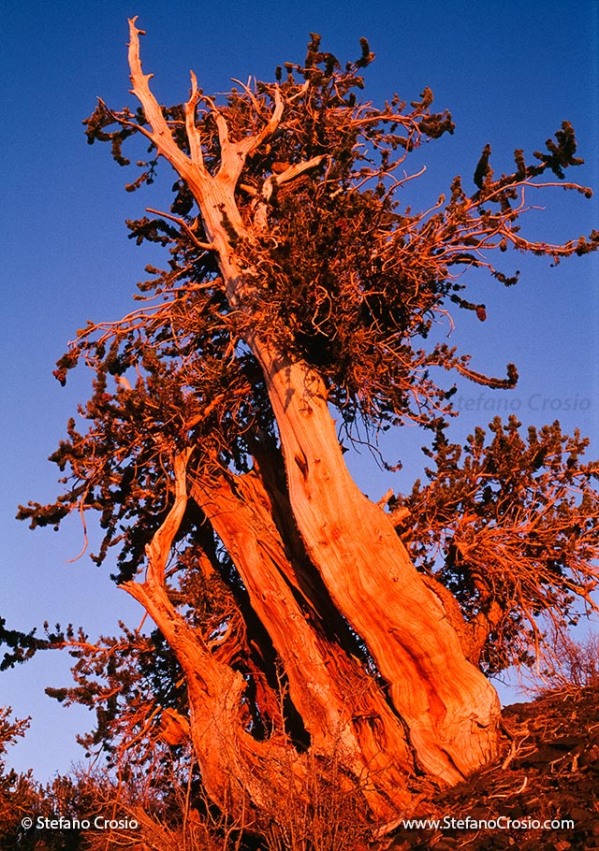
Great Basin Bristlecone Pine at Sunset

Great Basin Bristlecone Pine (Pinus longaeva) at sunset

This image is of a Great Basin Bristlecone Pine (Pinus longaeva) and it was made at sunset in the Inyo National Forest (CA): these trees can only be found in certain mountainous areas of California, Nevada and Utah and are really remarkable in that, with some of them being almost 5000 years old, they are the oldest living tree on earth.

Bristlecone pines have adapted to survive in extremely harsh and challenging environments. Typically, they live in high elevation habitats in areas with rocky soil, low rainfall and long winters.

They grow extremely slowly (a 40 year old bristlecone pine may not reach 6 inches!) and, at high elevations, they grow to 60 feet tall. Also, their needles can remain green for over 45 years. At low elevations, bristlecone pines grow straight, while at high elevations their trunks become twisted. Their root system is very shallow so as to allow maximum water uptake in arid environments.

For more information about these incredible trees, you may check out the relevant pages on the Websites of the National Wildlife Federation, the BBC, and the National Park Service.

If you would like to see more images of mine, feel free to browse my Galleries.

As per my copyright notice, please respect my work and do not download, reproduce or use the image above without first seeking my consent. Thank you :-)

Windows Arch and Turret Arch Before Dawn

Windows Arch and Turret Arch at twilight

Utah’s Arches National Park is a special place that rewards visitors with stunning red rock desert views and over 2000 natural sandstone arches and giant balanced rocks.

I captured the above image of Windows Arch, with Turret Arch in the background, at twilight, just before dawn, from a slightly elevated vantage point. Given the bright desert sunlight and the crowds that generally assemble around the most iconic features of the Park, photographing at the fringes of the day or at night are among the best options available to those who do not simply seek to bring home a snapshot from Arches.

Immediately before dawn, contrast is low and manageable but the sky is already lit and takes on delicate pastel tones that subtly complement the warm hues of the ubiquitous rocks and sand. Add a pleasing composition (especially if you are at one of those over photographed spots) et les jeux sont faits 🙂

Oh, and by the way, Happy Memorial Day! 🙂

If you would like to see more images of mine, feel free to browse my Galleries.

As per my copyright notice, please respect my work and do not download, reproduce or use the image above without first seeking my consent. Thank you :-)

Wine Review: Casa Sola, Chianti Classico Riserva 2007 DOCG

Disclaimer: this review is of a sample that I received from the producer, who also happens to be a friend of mine! My review of the wine has been conducted in compliance with my Samples Policy and the opinion I am going to share on the wine is my own.

Casa Sola, Chianti Classico Riserva DOCGToday I will review a bottle of Chianti Classico Riserva that I received as a sample from the producer, who happens to be a former schoolmate of mine and a friend. The wine that I am going to review is Casa SolaChianti Classico Riserva 2007 DOCG (\sim \!\,$35). As I said in my disclaimer, my review will not be tainted by my personal relationship with the producer and will be as objective as a wine review can be. 🙂

The Bottom Line

Overall, I found Casa Sola’s Chianti Classico Riserva to be a very pleasant Chianti, which could nicely complement a juicy steak or game dish.

Rating: Good to Very Good and Recommended Good to Very Good  – $$

(Explanation of our Rating and Pricing Systems)

Let’s now say a few words about Chianti in general.

About the Appellations

Chianti wine may be produced under two different Tuscan appellations: Chianti Classico DOCG or Chianti DOCG.

The Chianti Classico appellation encompasses that stretch of Tuscan territory where the grapes for making Chianti have traditionally been grown for centuries (the first document referring to Chianti dates back to 1398!): this means an area surrounding the cities of Florence and Siena, including such landmark towns as Greve in Chianti, Castellina in Chianti, Radda in Chianti and Gaiole in Chianti.

The Chianti Classico regulations require that the wine be made from 80% or more Sangiovese grapes, while the remaining maximum 20% may come from other permitted black-berried grapes (these include Canaiolo, Colorino or international varieties such as Cabernet Sauvignon or Merlot). The minimum aging required is (i) 12 months for the base version of “Chianti Classico” and (ii) 24 months, at least 3 of which must be in bottle, for “Chianti Classico Riserva“. Every bottle of Chianti Classico wine must bear the “black rooster”  logo on its neckband. Plenty of additional information may be found on the Website of the Chianti Classico Wine Consortium.

The Chianti appellation encompasses a significantly larger territory in the surroundings of the Tuscan towns of Arezzo, Firenze, Pistoia, Pisa, Prato and Siena. The Chianti regulations require that the wine be made from 70% or more Sangiovese grapes, while the remaining maximum 30% may come from other permitted grapes, provided that (a) the use of permitted white-berried grapes may not exceed 10% and (b) the use of Cabernet Sauvignon and/or Cabernet Franc grapes may not exceed 15%. The minimum aging required is (i) 6 months for the base version of “Chianti“; (ii) 12 months for the “Chianti Superiore” version, and (iii) 24 months for “Chianti Riserva“.

About the Grapes

Regarding Sangiovese, Chianti’s main grape variety, it is a variety that is indigenous to Central Italy and was first mentioned in writing in 1600 under the name Sangiogheto (which begs the question: if the first documented use of the word Chianti to identify the wine dates back to 1398, what did they call the wine’s main grape for those 200 and change years???).  In 2004, DNA parentage analysis showed that Sangiovese originated as a cross between Ciliegiolo (a Tuscan grape variety) and Calabrese di Montenuovo (a quite obscure variety from Calabria). Sangiovese is a vigorous and late ripening variety that is one of the most widely cultivated in Italy, especially in the regions of Toscana, Umbria and Emilia Romagna. Some is also grown in California and Washington State. (Note: information on the grape variety taken from Wine Grapes, by Robinson-Harding-Vouillamoz, Allen Lane 2012)

Sangiovese is one of the most renowned Italian grape varieties and is utilized for making several signature Italian wines, including (beside Chianti) Brunello di Montalcino, Vino Nobile di Montepulciano and Morellino di Scansano. Varietal wines made out of Sangiovese grapes tend to have fairly aggressive tannins when they are still “young” and are generally best enjoyed after a few years of aging, when time takes care of taming them. Given the massive quantities of Sangiovese that are produced, quality levels of the wines made out of such grape variety tend to be inconsistent and knowledge of the various appellations that allow its use and of the specific wineries is important to avoid unsatisfactory experiences.

Our Detailed Review

Now, on to the actual review of the wine I tasted, Casa Sola, Chianti Classico Riserva 2007 DOCG.

This Chianti Classico is a blend of 90% Sangiovese, 7% Cabernet Sauvignon and 3% Merlot grapes grown in the winery’s vineyards near the town of Barberino Val d’Elsa, in proximity to Florence. The wine has a muscular 14.5% ABV and was aged for 18 months in a mix of larger oak barrels and barrique casks plus 8 months of additional in-bottle aging. The Riserva retails in the US for about $35.

As usual, I will use a simplified version of the ISA wine tasting protocol that we described in a previous post: should you have doubts as to any of the terms used below please refer to that post for a refresher.

In the glass, the wine poured ruby red and thick.

On the nose, its bouquet was intense, quite complex and fine with aromas of cherry, strawberry, sweet tobacco, licorice and vanilla.

In the mouth, the wine was drywarmsmoothfreshtannic and quite tasty. It was a full-bodied, balanced wine and its mouth flavors were intense and fine, revolving mostly around fruity notes of cherry and strawberry. Its tannins were gentle and offered a pleasant counterpoint to the wine’s smoothness. It had a quite long finish and its evolutionary state was ready, meaning definitely enjoyable now but a few more years of in-bottle aging could make it evolve even more and add additional complexity.

Finally, beyond producing wine and olive oil, Casa Sola also offers guided tours of the vineyards and winery culminating in a wine tasting experience, cooking classes and in-house accommodation in 11 rustically-furnished apartments: for more information, please refer to Casa Sola’s Website.

A special wine tasting: Marchese Villadoria, Barbaresco Riserva Speciale 1969 DOC… and some cool facts about Nebbiolo

StefanoA few days ago we had a special night, with a few wine-aficionado friends coming over to our house for dinner, including fellow wine blogger Anatoli who authors the excellent blog Talk-A-Vino. Needless to say, several great bottles of wine were opened, some coming from our cellar and some that were graciously brought by our guests.

Today I would like to focus on a bottle that we opened that night and really was quite special: a 1969 Barbaresco! That’s right, as in 44 years old! More specifically, it was a bottle of Marchese VilladoriaBarbaresco Riserva Speciale 1969 DOC ($22 for current vintages).

The bottle had been given to me a while ago by my father, who had forgotten all about it and recently “re-discovered” it in his own cellar. Clearly, with all those years of aging, much could have gone wrong, like the cork could have gone bad (which would mean an oxidized wine) or simply it could have been corked. But still… worth a shot, right?

The Bottom Line

Overall, I very much enjoyed tasting such an evolved Barbaresco: it has been the longest-aged wine I have ever had and it has been a pleasure to the eye, the nose and the mouth. Regarding the quality of the wine itself, I cannot vouch for the contemporary vintages of Villadoria’s Barbaresco, as this was the first bottle I had from such producer, who is a little bit out of the limelight. But there is no doubt that that 1969 Barbaresco held his own: sure, the bouquet could ideally have been a little more complex, but hey – today you can buy a bottle for $22 (granted, I am not sure how much it went for back then): what more do you want for that kind of money? 😉

Rating: Very Good, considering the excellent QPR Very Good – $$

(Explanation of our Rating and Pricing Systems)

If you are interested, let’s now briefly talk about Barbaresco and the grape Barbaresco is made from, which is Nebbiolo.

About the Appellation

Barbaresco is a wine that is made in the northern Italian region of Piemonte in an appellation that earned DOC status in 1966 and was then “upgraded” to the top DOCG status in 1980. The appellation encompasses a small area in the vicinities of the town of Cuneo comprising three smaller towns (Barbaresco, Neive and Treiso) and a village named San Rocco Senodelvio. The regulations applicable to the  appellation require that Barbaresco be exclusively made from Nebbiolo grapes grown in that area and that the wine:

(i) be barrel-aged for a minimum of 26 months (at least 9 of which in wood barrels) plus an additional 10 months in bottle for “plain” Barbaresco wines; or

(ii) be barrel-aged for a minimum of 50 months (at least 9 of which in wood barrels) plus an additional 10 months in bottle for Barbaresco Riserva wines.

About the Grape

A few notions about Nebbiolo, without a doubt Piemonte’s most world-famous grape variety. Researchers have recently been able to trace back the origins of (or at least the first documented reference to) Nebbiolo to 1266, at which time the grape was called Nibiol. This makes Nebbiolo one of the oldest grape varieties in Piemonte. While Nebbiolo is definitely an Italian indigenous variety, doubts still remain as to whether it originated from Piemonte or Valtellina (a mountainous district in the neighboring region of Lombardia, where Nebbiolo is still grown nowadays and locally known as Chiavennasca).

The name Nebbiolo comes from the Italian word “nebbia” (fog) – some say because of the fog that in late Fall generally enshrines Piemonte’s hills where Nebbiolo is grown. Nowadays, three main different Nebbiolo clones have been identified: (i) Nebbiolo Lampia; (ii) Nebbiolo Michet; and (iii) Nebbiolo Rose’. Interestingly enough, however, DNA profiling has shown that, while Lampia and Michet have identical DNA profiles, Rose’ does not share the same profile, which has recently led to consider Nebbiolo Rose’ a different grape variety altogether rather than a clone of Nebbiolo.

Villadoria, Barbaresco Riserva Speciale 1969 DOC

Nebbiolo is a late-ripening, very finicky variety in terms of the terroir it requires to produce quality wine, which means that Nebbiolo successfully grows only in very few places on the entire earth – Piemonte and Valtellina sure being two of them, along with certain of California’s AVA’s. Nebbiolo grapes generally have robust tannins and high acidity, which make it a variety that is very suitable for long-term aging. In Italy, Nebbiolo’s best expressions are in varietal wines such as Barolo and Barbaresco in Piemonte or Valtellina Superiore and Sforzato della Valtellina in Lombardia’s Valtellina district (all of them being DOCG appellations).

(Note: information on the grape variety taken from Wine Grapes, by Robinson-Harding-Vouillamoz, Allen Lane 2012)

Our Detailed Review

Now on to the wine we had last week: it was a Marchese Villadoria, Barbaresco Riserva Speciale 1969 DOC (13.5% ABV). Current vintages of this wine retail in the US for about $22.

If you have read the preceding notions about the Barbaresco appellation, it will not come as a surprise to you that our bottle was designated “DOC” instead of the current DOCG designation which, back in 1969, did not exist yet.

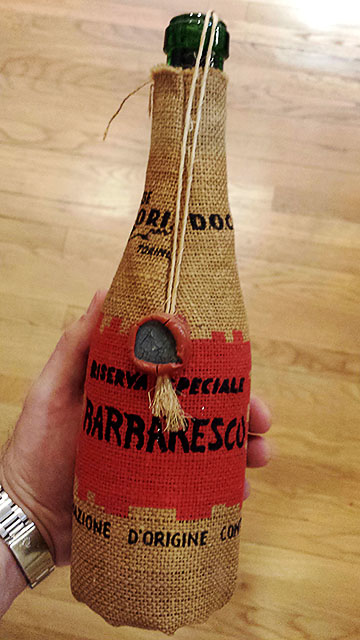
Two peculiar features of our bottle (that I had never observed in any other bottle before) were that it came completely wrapped in coarse cloth to which one end of a string had been affixed using sealing wax while the other end had been stapled to the cork! The two snapshots to the right should give you an idea of what I am talking about. While I can only offer conjectures as to why the producer went through the hassle of doing all that, I would imagine that the idea behind the cloth wrap was to protect the wine from light exposure (and therefore harmful UV rays) while the string connecting the cork to the cloth was maybe an anti-tampering device of sort?

I opened the bottle and decanted it about two and a half hours before the time we would likely taste it, following a proper handling and decanting procedure codified by the Italian Sommelier Association (I may write a post about it at some point). Fortunately, it looked like the cork had held up well throughout all those years, so that was a promising sign. Thanks to proper cellaring and handling, the wine poured clear into the decanter up to almost the end of the bottle, when unsurprisingly some sediment showed up.

Villadoria, Barbaresco Riserva Speciale 1969 DOCFast forward two and a half hours (during which we managed to keep ourselves busy with appetizers, a pasta course and plenty of other wine) and the time had come to pour the Barbaresco into our glasses and taste it!

As usual, I will use a simplified version of the ISA wine tasting protocol that we described in a previous post: should you have doubts as to any of the terms used below please refer to that post for a refresher.

In the glass, the wine was orange red in color, as expected after all those years of aging, and thick.

On the nose, it was intense, quite complex and fine, with aromas of spirited cherries, licorice, rose, vanilla and ethereal notes. The bouquet was not very broad, but it was elegant.

On the palate, our wine was dry, warm and smooth; quite fresh, quite tannic and quite tasty. If you are familiar with the ISA wine tasting protocol you might notice that our wine was a little shifted toward the “softness” side and therefore you might wonder whether it can still be classified as balanced. Well, considering that it is only natural that, after 44 years of aging, tannins and acidity recede a bit and that for a structured red wine being a little slanted toward the softness side is certainly not a “sin”, by all means I will go ahead and call it balanced. In terms of structure, our wine was between medium and full-bodied and its mouth-flavors were intense and fine, showing a pretty good correspondence with the wine bouquet: I picked up strawberries, cherries, vanilla and licorice. Finally, the finish of the wine was quite long and its evolutionary state was mature.

Ever Heard of a Sik-Sik?…

Arctic ground squirrel, or sik-sik (Spermophilus parryii)

Thought so. Quite honestly, neither had I – at least before I traveled to Canada’s arctic territory of Nunavut (I have published more photographs from that trip on thisthis and this previous posts). Up there, beyond Inuit, caribou, wolves, arctic hare, the occasional polar bear and billions of mosquitoes and black flies you can find… sik-siks, which is the kind of cute sounding way Inuit call arctic ground squirrels because of the sound they make.

Arctic ground squirrels (Spermophilus parryii) are the largest and northernest among North American ground squirrels. They seek shelter from the frigid tundra temperatures by building a maze of burrows in areas where the permafrost does not prevent digging.

Throughout the long acrtic winters sik-siks hibernate for 7 to 8 months a year. Now get ready for a super cool fact: “Researchers at the University of Alaska at Fairbanks have shown that during hibernation, arctic ground squirrels adopt the lowest body temperature ever measured in a mammal. [Their] body temperature […] drops below freezing, a condition referred to as supercooling. At intervals of two to three weeks, still in a state of sleep, hibernating squirrels shiver and shake for 12 to 15 hours to create heat that warms them back to a normal body temperature of about 98 degrees Fahrenheit [(about 36.5 degrees Celsius)]. When the shivering and shaking stops, body temperature drops back to the minimal temperature” (quoted from the Denali page of the National Park Service’s Web site).

By the way, I have uploaded a new gallery to my Web site with a selection of my images of rodents and lagomorphs (i.e., rabbits and hares – no pikas, sorry): feel free to go take a look if you feel like it!

If you would like to see more images of mine, feel free to browse my Galleries.

As per my copyright notice, please respect my work and do not download, reproduce or use the image above without first seeking my consent. Thank you :-)

WiNews: Elena Walch’s Pinot Noir “Ludwig” 2010 Wins XII Italian Domestic Pinot Noir Competition

StefanoJust a quick flash to alert you about a piece of news that an Italian producer that I am fond of has been kind enough to share with me.

The 2010 vintage of the “Ludwig” Pinot Noir made by Elena Walch (the Alto Adige winery whose Riesling Castel Ringberg we have recently reviewed) is the fresh winner of the XII Italian Domestic Pinot Noir Competition, which is really exciting news as well as a tangible recognition for Walch’s commitment to quality production.

I hope I will be able to lay my hands on a bottle of the 2010 Ludwig soon so I can publish a full review!

An Overview of the 2011 Vintage Port Tour, NYC, and the Basics About Port

Last week I felt inspired by reading Anatoli’s wonderful accounts of his recent trip to Portugal on his excellent wine blog, Talk-A-Vino. Beside telling us all about the restaurants he dined at, he of course shared plenty of information about the wines he tasted over there, including of course Portugal’s world-famous fortified wine, Porto. And finally, today by total coincidence, he published a wonderful, extremely thorough post on Port, with all you need to know about it – had I known in advance, I would have spared myself the work to research and write an overview of Port altogether (see below)! 🙂 However, since by the time Anatoli published his post my Port write-up was all done already, I am going to publish it nonetheless, and then if you want to dig deeper into Port, please refer to Anatoli’s post of today!

Anyway, in order to remotely taste my own share of Portugal, I enthusiastically accepted the invitation to participate in the 2011 Vintage Port Tour that was held in New York City last week to offer to the press and the trade a preview tasting of Vintage Port’s latest production from the prestigious collection of brands belonging to the Symington Family.

Quoting directly from the literature that was handed to participants at check in, “the Symingtons, of Scottish, English and Portuguese descent, have been Port producers for five generations since 1882”. The Symingtons own four historic Port brands: Graham’s, Cockburn’s, Dow’s and Warre’s, plus the other three brands Quinta do Vesuvio, Smith Woodhouse and Quinta de Roriz. All such seven brands were represented at the 2011 Vintage Port Tour.

According to the brochure we were provided, the brands controlled by the Symingtons account for over one third of all premium Port and, with 965 HA (2,385 acres) of vineyards, the family is the largest vineyard owner in the Douro Valley. Also, Dow’s 2007 Vintage Port is so far the only Port in the XXI century to have been awarded a perfect 100 point score by Wine Spectator.

Before getting to the chase and telling you which ones among the Ports that I tasted at the event impressed me most, let’s take a look at a few basic facts about Port.

As we said, Port is a fortified wine, which means a wine in which the regular alcoholic fermentation process gets interrupted about half way through the conversion of the grape sugars into alcohol, CO2 and heat by the addition of a neutral grape spirit (a grape brandy). Port is made from a blend of different grape varieties, that must be included in an official list of authorized grapes that was compiled by the Portuguese government in 1940.  The main grape varieties that are used in the making of red Port are: Touriga Nacional, Touriga Franca, Tinta Roriz, Tinta Barroca and Tinto Cão.

Although at some point I will publish a post that explains the wine production process more in detail, here suffice it to say that one of the inhibitors of the yeast fermenting action is the presence in the must of alcohol in excess of about 16/17% VOL, which is why adding a spirit to a fermenting must blocks the fermentation process. The result of this addition is two-fold: on the one hand, it quite obviously increases the ABV of the resulting wine (generally, to about 19% to 21% VOL; hence the name “fortified wine”); on the other hand, by interrupting the conversion of grape sugars into alcohol, it leaves a considerable amount of residual sugar in the wine, which therefore tastes sweeter.

After being fortified, Port is moved into steel vats and/or oak or other wood casks for aging: depending on the intended type of Port, the aging process can be relatively short or even extremely long, with some of the finest Ports aging up to a century! After aging in casks, the wine gets bottled for consumption or for more in-bottle aging.

There are many different styles of Port, including White Port that is made from different, white-berried varieties. However, speaking of “regular” Port made from black-berried grape varieties, there are three main styles that are worth mentioning:

(i) Ruby: this is the most basic, simple style – it is a blend of different vintages that have aged for a relatively short period of time (generally, 3 to 6 years) in steel vats and/or wood casks and are meant for immediate consumption;

(ii) Tawny: this is a more complex, developed style of Port – it gets to age in wood casks for a very long time (essentially, 4 years or longer, with some Tawnies called Age-Designated that bear on the label an indication of how long they aged, ranging from 10 to 40 years), thus acquiring complex tertiary aromas and turning tawny in color due to the oxidation process induced by the lengthy in-cask aging;

(iii) Vintage Port: this is the king of Ports, which is made exclusively from grapes from a single vintage and only in the best years. After a minimum aging of 2 years in steel vats and/or wood casks, they are bottled unfiltered (which means that they will likely develop sediment in the bottle) and are meant for decades of in-bottle aging before being enjoyed at their best.

With all of this said, let’s now talk about my experience at the 2011 Vintage Port Tour.

The event was compact and well organized, with one table for each brand and each brand (except only Quinta de Roriz, which only had the 2011 vintage) offering for tasting both their own 2011 Vintage Port and an older vintage for comparison. In the exclusive interest of adequately covering the event, I got to taste *all* of the exhibited Vintage Ports: I know, when the going gets tough, the tough get going! 😉 Broadly speaking, all the Ports that were showcased at the event were very good, although some of them had a different style than others, clearly also because of the different aging of the older vintages made available for tasting.

Here below I will point out those that were my own personal favorites (with their approximate retail prices in the US) among the 13 Vintage Ports that I tasted, along with my tasting notes for each of them:

(1) 2011 Vintage:

Quinta de Roriz (about $60): purple in color; intense and complex aromatic palette, with a bouquet of caramel, black cherry, rose, licorice, raspberry, black pepper and tobacco; sensuous in the mouth, with intense flavors of plum, raspberry, licorice, dark chocolate, fruit candy and vanilla; warm, smooth, well balanced and long. Rating: Spectacular, with Excellent QPR Spectacular

Graham’s (about $90): purple in color; fairly complex bouquet (it needs aging to develop) of blackberry, black cherry, licorice and tobacco; wonderful in the mouth: intense, with excellent flavor-scent correspondence, plus additional flavors of dark chocolate and vanilla; warm, smooth, well balanced and very long. Rating: Outstanding Outstanding

Dow’s (about $80): purple in color; fairly narrow aromatic palette (it needs aging to develop) with aromas of plum, blackberry and licorice; very good in the mouth, with flavors of licorice, dark chocolate and spirited black cherry; quite warm, super smooth, balanced and quite long. Rating: Good to Very Good Good to Very Good

Smith Woodhouse (about $55): purple in color; fairly narrow bouquet (it needs aging to develop) of fruit candy, licorice, ethereal notes; good corresponding mouth flavors; warm, smooth, balanced and long. Rating: Good Good

(2) Older Vintages:

Quinta do Vesuvio 1994 (about $90): garnet in color; with a not very broad and yet elegant aromatic palette of wild berries, wild strawberries, violet and chocolate; but the little bit that it lacked on the nose was more than compensated on the palate, with intense and outstanding mouth flavors of raspberry jam, licorice, tobacco and dark chocolate; warm, smooth, balanced and long. Rating: Outstanding Outstanding

Smith Woodhouse 2007 (about $55): purple in color; elegant and complex bouquet of black cherry, spirited wild cherry, raspberry, rose, tobacco, sandalwood and black pepper; wonderful in the mouth, with pleasing flavors of spirited wild cherry, dark chocolate, rhubarb, licorice and tobacco; warm, smooth and long. Rating: Outstanding, with Excellent QPR Outstanding

Dow’s 1985 (about $95): garnet in color; intense, unique and complex bouquet very focused on tertiary aromas with tobacco, gunpowder, black pepper, raisin and a hint of wild cherries; intense, luscious mouth flavors of spirited raspberry and wild cherry, Amarena Fabbri (if you guys know what I am talking about!), licorice and dark chocolate; warm, smooth, well balanced and long. Rating: Outstanding Outstanding

Graham’s 1980 (about $105): garnet in color with orange hints; to be honest, given its aging, I would have expected a broader aromatic palette: I picked up aromas of tobacco, black pepper, licorice, plum and wild cherry; very good and more expressive in the mouth, with flavors of raspberry candy, licorice, vanilla and spirited cherry; warm, smooth, balanced and long. Rating: Very Good Very Good

Cockburn’s 2000 (about $70): ruby in color with garnet hints; intense nose with a fairly narrow bouquet of cherry, strawberry, plum and licorice; in the mouth, sweeter than the others, with pleasing flavors of licorice, vanilla, cherry jam, dark chocolate and tobacco; warm, smooth, balanced and quite long. Rating: Very Good Very Good

That’s all for today. As always, let me know how you liked it in case you happened to enjoy one of the Ports that I reviewed!

Happy Mother’s Day!

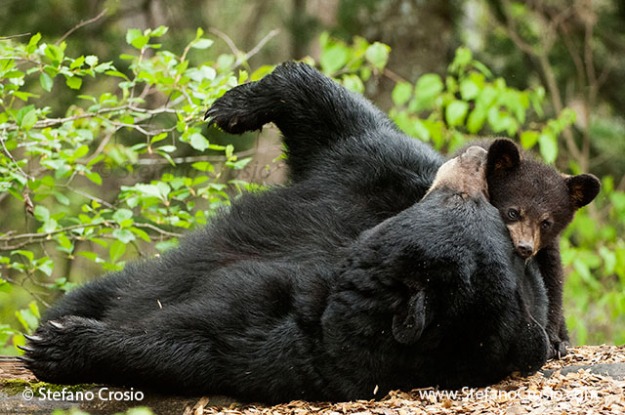
In a rare (at least for this blog!) multi-image post, here’s to all the Mothers who enjoy reading Clicks & Corks and to the Mothers of all of our readers!

Which of these mommies do you, or your Mom, relate more to?  😉

Happy Mother’s Day!

Snow monkey (Macaca fuscata) nursing her baby

Protective?

Coastal brown bear (Ursus arctos) sow with cub

Romantic?

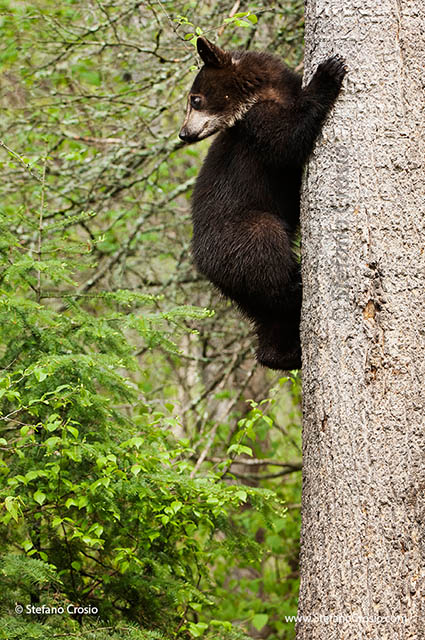
Black bear (Ursus americanus) sow play-fighting with cub

Playful?

Polar bear (Ursus maritimus) sow with cubs

Cuddly?

American Graffiti

Sego Canyon (UT) Pictographs and Century Old Graffiti

I took this image of ancient Native American petroglyphs in Utah’s Sego Canyon, not far from Thompson Springs. These petroglyphs were scratched on the rocks of Sego Canyon by Native Americans of the Fremont Culture, who lived in the area between 600 and 1250 of the Common Era. As you will notice, however, just by looking at the top left quarter of the image above, more recent graffiti were also scratched on those very same rocks, right by the Fremont petroglyphs.

When I was framing this image, I wanted to convey the juxtaposition of “ancient graffiti” like the Fremont petroglyphs with relatively speaking more modern graffitis that two different people, seemingly in 1884 and in 1902, felt the need to scratch right next to (if not directly on) those vestiges of the past.

Which begs the question: considering that those “younger” graffiti are by now more than a century old, does age make them more acceptable to us viewers? Do you see them as a “work of art in the work of art” or as the condemnable act of vandals who inexorably defaced that precious Native American rock art?

If you would like to see more images of mine, feel free to browse my Galleries.

As per my copyright notice, please respect my work and do not download, reproduce or use the image above without first seeking my consent. Thank you :-)

European Wine Wars: after Tocai, it is the time of Prosek… and Teran

The international press, Dr Vino and several other sources all reported yesterday that, as a result of Croatia’s imminent accession to the European Union at the end of a 10-year long process, Croatian wineries will be required to stop using the name “Prosek” to identify a traditional local sweet raisin wine that has been made for centuries mainly in the Dalmatia region from local grape varieties such as Bogdanuša, Maraština, Plavac mali and Pošip.

The reason for the requirement is that, according to EU officials, the name of the Croatian wine is too similar to Italy’s Prosecco and therefore it might be confusing to consumers. And this in spite of Prosek and Prosecco being two very different wines, made out of different grapes (Glera for Prosecco and the Croatian grape varieties mentioned above for Prosek) and in different styles (Prosecco is mostly sparkling and is not a sweet wine, while Prosek is a still, sweet raisin wine).

Unsurprisingly, the EU requirement has caused considerable commotion in the Croatian wine world and some producers indicated that the Croatian authorities are even considering initiating a legal dispute to challenge the EU requirement.

However, the chances that Croatia be allowed to retain its right to use the name “Prosek” for their wine after joining the EU are very slim, as the case is virtually identical to the one that a few years ago prevented Italian winemakers (mostly in Veneto and Friuli) from using the word “Tocai” to identify a local dry wine that had been made for centuries from the homonymous grape variety because the name was too similar to Hungary’s Tokaji, a famous local sweet raisin wine made from Furmint grapes (for more information about the Tokaji/Tocai dispute, please refer to my previous post over at Flora’s Table that dealt with it).

But, as the saying goes, bad news never comes alone, at least for Croatia, that is. Beside the Prosek debacle, Croatia has to face a claim made by neighboring Slovenia that Croatia should also be prevented from using the word “Teran” to identify a red wine that is made in Italy’s region of Friuli, in Slovenia and in Croatia from the grape variety known as Terrano or Teran in Croatia. Slovenia’s claim is based on the fact that the EU granted Slovenia a protected designation of origin for Terrano grapes grown in the Slovenian region of Kras. The European Commission very recently decided the Teran dispute in favor of Slovenia, with a decision that will likely also negatively affect Italian Terrano producers.

Even in this case, the decision gives rise to many doubts, as Terrano is a very ancient variety (the oldest references date back to 1340 in Slovenia) which originated from the Karst plateau, an area that is shared among Italy (Friuli), Slovenia and Croatia (Istria). DNA profiling has also proved that Terrano is identical to Refosco d’Istria (a Croatian variety) and Refosk in Slovenia (information on the Terrano grape variety, cit. Wine Grapes, by Robinson-Harding-Vouillamoz, HarperCollins 2012).

Given the above, which side of the fray are you on?

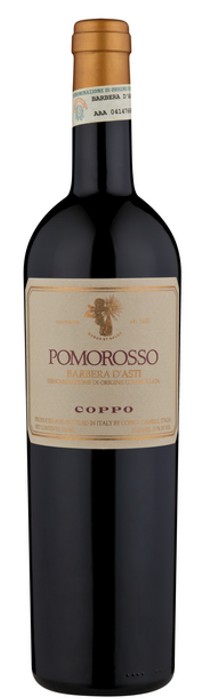
Wine Review: Coppo, Barbera d’Asti “Pomorosso” 2006 DOCG

Coppo, Barbera d'Asti "Pomorosso" DOCG

Today we are going to talk about Barbera, and more specifically about a bottle of Barbera that I recently had the opportunity to taste and that has definitely impressed me.

The Bottom Line

Overall, I found Coppo, Barbera d’Asti “Pomorosso” 2006 DOCG ($55) to be one of the best Barbera’s that I have had so far, a wine that is a pleasure to drink and savor sip after sip – a perfect companion for a red meat dinner.

Rating: Outstanding and definitely Recommended Outstanding – $$$

(Explanation of our Rating and Pricing Systems)

About the Grape and the Appellations

As you may know, Barbera is a grape variety that is indigenous to the Monferrato district in the north Italian region of Piemonte. The first written references to Barbera date back to the end of the XVIII century. Nowadays it is the most widespread grape variety in Piemonte, from which wines are made that display lively acidity and a deep ruby color. (Note: information on the grape variety taken from Wine Grapes, by Robinson-Harding-Vouillamoz, Allen Lane 2012)

In Piemonte, Barbera is the main grape of four different appellations:

  • Barbera d’Asti DOCG (encompassing an area surrounding the towns of Asti and Alessandria, and requiring the use of 90% or more of Barbera grapes and a minimum aging of 4 months for the base version or 14 months, of which at least 6 months in wood barrels for the “Superiore” version);
  • Barbera del Monferrato Superiore DOCG (encompassing the Monferrato district near Alessandria and an area near the town of Asti, requiring the use of 85% or more of Barbera grapes and a minimum aging of 14 months, of which at least 6 months in wood barrels)
  • Barbera d’Alba DOC (encompassing an area in the vicinities of the town of Cuneo and requiring the use of 85% or more of Barbera grapes)
  • Barbera del Monferrato DOC (encompassing the Monferrato district near Alessandria and an area near the town of Asti, requiring the use of 85% or more of Barbera grapes)

Given its wide distribution, Barbera is produced in a variety of styles, ranging from simpler, “younger” versions that are only aged in steel vats to more structured and evolved versions that are aged in oak barrels, including sometimes barrique casks.

Our Detailed Review

The wine that we are going to review today is Coppo, Barbera d’Asti “Pomorosso” 2006 DOCG.

It falls within the category of the more complex Barbera’s: it is made out of 100% Barbera grapes grown in the 56 HA Coppo estate near the town of Canelli, near Asti (Piemonte). It has 13.5% ABV and is aged for 14 months in barrique casks. In the U.S., it retails for about $55.

Let me say outright that the Pomorosso is a great, structured red wine, that is suitable for several years of aging (the 2006 vintage that I had was a symphony of aromas, flavors and balance).

But let’s go more in the specifics through a technical wine tasting. As usual, I will use a simplified version of the ISA wine tasting protocol that we described in a previous post: should you have doubts as to any of the terms used below please refer to that post for a refresher.

In the glass, the 2006 Pomorosso poured ruby red and thick.

On the nose, its bouquet was intense, complex and fine with a sequence of aromas of violet, plums, blueberries, cherries, tobacco and chocolate.

In the mouth, the Pomorosso was dry, warm, smooth; fresh, tannic and tasty. It was a full-bodied, perfectly balanced wine and its mouth flavors were intense and fine, showing good correspondence with its bouquet as well as a perfect integration of the oaky notes released by its barrique aging. Its tannins, although very discernible, were also equally gentle and supple, with their delicate astringency counterbalancing the wine’s lively acidity. The Pomorosso had a long finish, with its flavors pleasantly lingering in the mouth for a very long time. Its evolutionary state in my view was mature, meaning that, with 7 years of aging under its belt, it was at or approaching its peak in terms of quality, making me think that additional aging, while certainly possible, would not likely improve its quality any further.

As usual, if you have tasted Pomorosso before, let me know how you liked it!

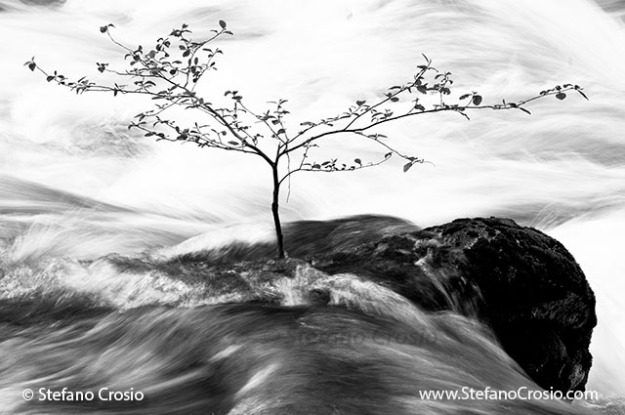
The River

Stubborn dogwood (Cornus nuttallii Audubon)

Readers who have been following this blog since the inception may recall that I very much like dogwood, of which I have already published a close-up of a blossom in a previous post.

This photograph of a small dogwood tree, stubbornly clinging to a rock in the middle of an impetuous river is another image that I hold dear because I think it clearly conveys a message of resilience and will to survive against all odds. Two very positive messages, if you ask me.

The black & white rendition simplifies the image to its graphic elements and amplifies the yin-yang contrast between the dark and the light portions of the image, that balance each other out nicely, as if divided by an imaginary diagonal line.

Oh yeah, the title for this post pays homage to my favorite Springsteen song 🙂

If you would like to see more images of mine, feel free to browse my Galleries.

As per my copyright notice, please respect my work and do not download, reproduce or use the image above without first seeking my consent. Thank you :-)

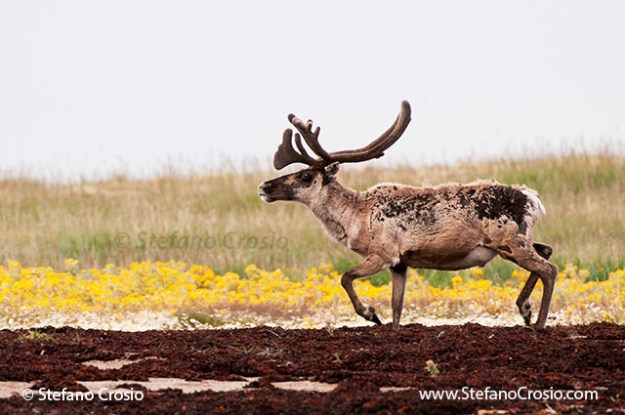
Barren-Ground Caribou Bull

Barren-ground caribou bull (Rangifer tarandus groenlandicus)

I took this image of a barren-ground caribou bull (Rangifer tarandus groenlandicus) during my trip to Canada’s arctic territory of Nunavut (by the way, I have published other photographs from that trip on this and this previous posts).

This bull was strutting on a Nunavut beach, stomping its hooves on a layer of dried sea weed that the high tide had left behind and in so doing the animal was making literally hundreds of black flies come out of those sea weed for the joy of both the caribou and… the photographer! Whenever the wind dies down in the tundra, black flies and mosquitoes fill the air and become a major nuisance. This image was taken in the summer, when caribou shed their winter fur and leave patches of skin exposed to mosquito or black fly bites.

Anyway, to me the key points in this image are the position of the caribou, with two raised legs to convey a sense of motion, and the graphic four-layer background, which appears to be interestingly divided into four bands of brown, yellow, green and cyan.

If you would like to see more images of mine, feel free to browse my Galleries.

As per my copyright notice, please respect my work and do not download, reproduce or use the image above without first seeking my consent. Thank you :-)

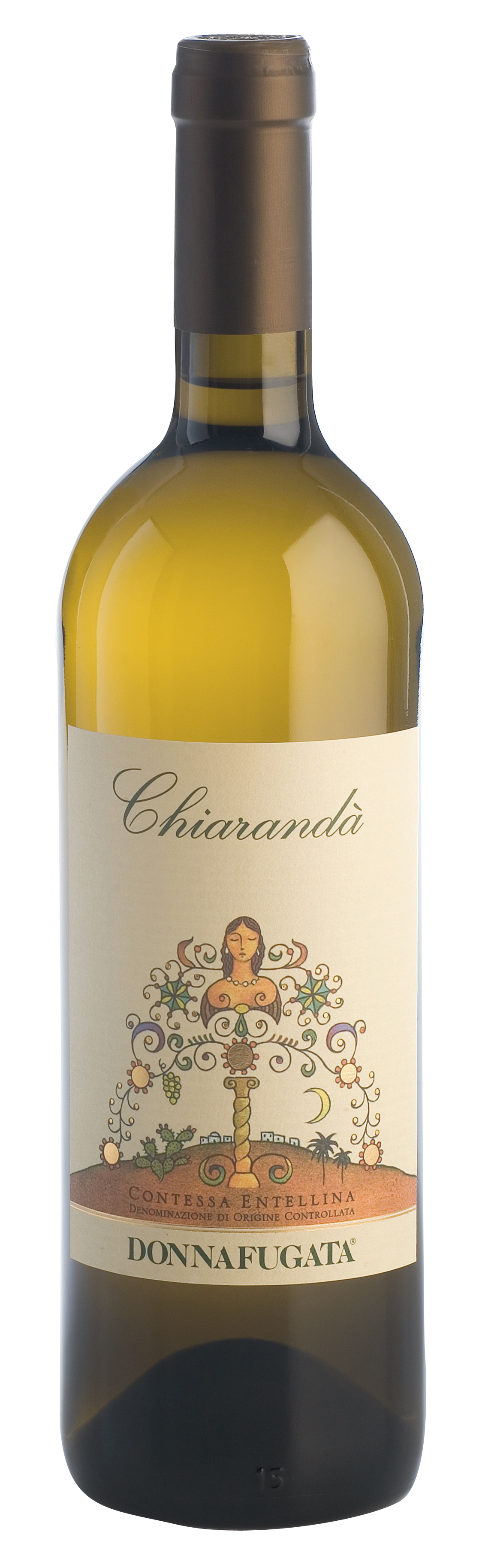
Wine Review: Donnafugat​a, Contessa Entellina Bianco “Chiarandà” 2009 DOC

Donnafugata, Contessa Entellina Bianco "Chiarandà" 2009 DOCOn a previous post over at Flora’s Table, we have talked about how Chardonnay is successfully grown in various regions throughout Italy, literally from Valle d’Aosta in the north to Sicily in the south, and how several Italian wineries make some excellent wines from such a widely cultivated international variety.

Very broadly speaking, I have to say I rather review and promote wines made out of Italian indigenous grape varieties, essentially because they differentiate themselves from the ubiquitous international varieties, because there are many excellent ones and because, by so doing, I think I am giving my small contribution to preserve biodiversity also in the vineyard (a wine world populated only by Chardonnays, Sauvignons, Pinots and Merlots would be a pretty boring one, if you ask me!) and to make certain Italian wines better known outside of Italy.

However, it is undeniable that certain international varieties have been successfully grown in Italy and that excellent, elegant wines are made out of such grapes which oftentimes are not very well known to the general public.

So today’s review is of a Sicilian Chardonnay that I very much like and that illustrates the point that Chardonnay is an extremely versatile variety that can give excellent results even in warmer climates like Sicily’s.

The wine I am talking about is Donnafugata‘s Contessa Entellina Bianco “Chiarandà” DOC 2009 ($35).

The Bottom Line

Overall, I very much enjoyed the Chiarandà, which I found to be a very elegant and “clean” Chardonnay, in which its oaky notes are not dominant but rather very well integrated such that they add to (instead of overwhelm) its pleasantly fruity and mineral flavor palette.

Rating: Very Good and definitely Recommended Very Good – $$

(Explanation of our Rating and Pricing Systems)

About the Producer and the Wine

Founded in 1983, Donnafugata is one of the top Sicilian wineries that contributed to the “Sicilian wine revolution” by contributing passion, investments and professionalism to raise the profile of Sicilian winemaking and produce top quality wines.

Their Chiarandà is a 100% Chardonnay wine made from the grapes grown in Donnafugata’s vineyards in a hilly region of the Contessa Entellina DOC appellation near the homonymous town (about halfway between Marsala and Palermo), in the western part of Sicily, at an altitude between 200 and 600 mt (650 to 1,950 ft) above sea level. The vineyards from which Chiarandà is made achieve an excellent density of 4,500 to 6,000 vines/HA and the vine training system used is spurred cordon.

The wine has 13% ABV and is fermented in stainless steel vats and then undergoes 6 months of aging on its lees in a mix of concrete and oak vessels of various sizes plus 24 additional months of in-bottle fining. Given its lively acidity (see, tasting notes below) it is a wine with great aging potential, in the 10 year range. In the US, the Chiarandà retails for about $35.

Our Detailed Review

Let’s now get down to the actual review of the 2009 Chiarandà that I had. As usual, I will use a simplified version of the ISA wine tasting protocol that we described in a previous post: should you have doubts as to any of the terms used below please refer to that post for a refresher.

In the glass, it is a beautiful golden yellow in color, and thick when swirled.

On the nose, its bouquet is intense, fine and definitely complex, with an array of enticing aromas of peach, tangerine, butter, vanilla, herbs (sage), mineral and iodine notes.

In the mouth, the wine is dry, warm, smooth; with lively acidity and pronounced minerality. It is medium to full-bodied with good structure and very balanced, with intense and fine mouth flavors reminiscent of its aromatic palette and a long finish, with those flavors pleasantly lingering in the mouth long after gulping down a sip. Its evolutionary state was ready (meaning, fine to drink now, but can take two or three more years of aging without compromising its qualities).

As usual, if you have tasted Chiarandà before, let me know how you liked it.

The Long and Winding Road

Cabin in the tundra

I took this image at sunset on a stormy day in Canada’s northern territory of Nunavut, in the Canadian Arctic. On that huge expanse of barren flatland, most houses are built on short stilts because of permafrost that makes it virtually impossible to dig deep enough to lay a proper foundation.

The vast majority of the about 31,000 people living in Nunavut are Inuit (about 26,000 or 85%). Inuit are one of the three groups of Aboriginal people who live in the Canadian Arctic (the other two groups being First Nations and Métis): Inuit speak a language called Inuktitut (Nunavut and Inuit are two Inuktitut words respectively meaning “our land” and “the people“) and some of them also speak English. If you venture out of the just 26 communities where most of Nunavut’s Inuit live in that immense territory of almost 2 million square kilometers (about 772,000 sqm), it is not unusual to see isolated cabins such as the one in the image above that Inuit use mostly as a base for hunting.

That day, when I realized that the setting sun was about to briefly peek out of the thick stormy cloud cover, I quickly set up my camera and tripod and framed that dramatic sunset using the winding dirt road created by the wheels of the there ubiquitous quads as an element of the composition leading to the cabin that I placed in one of the rule of thirds “power points” to add an element of interest to what would otherwise have been a flat, static composition.

This image brings to my mind the lyrics of the famous Beatles’ song:

The long and winding road that leads to your door
Will never disappear
I’ve seen that road before it always leads me here
Leads me to your door

If you would like to see more images of mine, feel free to browse my Galleries.

As per my copyright notice, please respect my work and do not download, reproduce or use the image above without first seeking my consent. Thank you :-)

Wine Review: Two Italian Dry Rieslings Made by Elena Walch and Abbazia di Novacella

I am writing this review with some trepidation as I know that most likely it will be read by fellow wine blogger and friend Oliver who authors the very enjoyable and educational blog The Winegetter (if you do not follow him already, I sure think you should!) and, most importantly, is definitely an authority when it comes to Rieslings! I think I know that his preference goes to German sweeter Rieslings, while the two wines that I am going to review today are both Italian dry Rieslings from the Alto Adige area of the Trentino Alto Adige region.

And now on to the reviews of the two wines that I tried. As usual, I will use a simplified version of the ISA wine tasting protocol that we described in a previous post: should you have doubts as to any of the terms used below please refer to that post for a refresher.

1. Elena Walch, Alto Adige Riesling “Castel Ringberg” 2010 DOC (12.5% ABV; ab. €15 in Italy)

Elena Walch, Alto Adige Riesling "Castel Ringberg" 2010 DOCElena Walch is one of my favorite producers of white wines from Alto Adige and, let me say it upfront, her Castel Ringberg did not disappoint me!

This is a single vineyard wine made of 100% Riesling grapes grown in the Castel Ringberg vineyard near the town of Caldaro. It was fermented and rested on its lees exclusively in stainless steel tanks. Unfortunately, although other Elena Walch’s wines are available in the US, this wine does not appear to be, which is a shame.

In the glass, the wine was straw yellow and quite thick.

On the nose, its bouquet was intense, complex and fine, with pleasant aromas of petrol (very discernible), followed by grapefruit, citrus, pear, minerals and herbs.

In the mouth, it was dry, quite warm, smooth; fresh and tasty, with medium body. The wine was balanced, with intense and fine mouth flavors that trailed the wine’s bouquet. It had a long finish and it was ready in terms of its evolutionary state.

Overall, a very pleasant, fresh dry Riesling with a captivating bouquet.

Rating: Very Good Very Good – €

(Explanation of our Rating and Pricing Systems)

2. Abbazia di Novacella, Alto Adige Valle Isarco Riesling “Praepositus” 2009 DOC (13% ABV; ab. $35 in the US)

Abbazia di Novacella, Alto Adige Valle Isarco Riesling "Praepositus" 2009 DOCThis wine is part of Abbazia di Novacella’s premium line “Praepositus”. It is made of 100% Riesling grapes, grown in vineyards with an outstanding density of 6,000 vines/HA and harvested for 2/3 in October and 1/3 in December (late harvest). It was fermented in stainless steel vats and aged in bottle for 9 months before being released to the market.

In the glass, the wine was straw yellow with greenish hints, quite thick.

On the nose, its bouquet was intense, quite complex and fine, with aromas of petroleum, grapefruit, lime and Granny Smith apple.

In the mouth, it was dry, quite warm, quite smooth; fresh and tasty, medium-bodied. The wine was balanced, with intense and fine mouth flavors. It had a long finish and was ready as to its evolutionary state.

Overall, another very pleasant dry Riesling, although it personally impressed me a touch less than the Castel Ringberg, especially due to its narrower bouquet.

Rating: Good to Very Good Good to Very Good – $$

(Explanation of our Rating and Pricing Systems)

At any rate, two Italian dry Rieslings that I would certainly recommend and that I am pretty sure would not disappoint you.

That’s all for today! As always, if you have tasted either one (or both!) of these wines, make sure to share your thoughts by leaving a comment below!

A Food Photography Primer

Over time, a few readers over at Flora’s Table who seem to have been enjoying the food images that I make and publish in that blog have been asking that I write a post with a few pointers about food photography: today is the day for that. Bear in mind that what follows is not intended to be a comprehensive course on food photography, but just a reflection on some basic rules of photography that play an important role in making a good food photograph.

There is no magic, food is just one of the subjects of studio photography and food photography is still photography, so the same basic principles apply. As such, there are three main guiding criteria that everyone with an interest in food photography should focus on:

1. Composition
2. Lighting
3. Post-Processing

Let’s take a closer look at each of them.

1. Composition

Composition is an element that can literally make or break a photograph. A successful image, including one of a food item, needs to have a strong, clean, balanced composition or it will look flat and boring at best. Here are a few pointers as to how to tackle this aspect:

  • Devise a plan before your shoot: pre-visualize how you would like your image to look like and figure out what you need to accomplish your vision (in terms of props, lighting, background and focal length of your lens)
  • Set up well ahead of time, when you have no time pressure: the shoot should be set up according to your plan and your vision, with everything in place except the food you are going to photograph. Take a few test shots in the same light that you would use for the real thing and see how your image looks like through the lens you chose. Use this opportunity to find out what does not work and to move things around or change camera/lighting settings until you achieve a pleasing composition that conveys your vision. Add the actual food item to be photographed only when you are all set and ready to go, so when you photograph it, it is going to be perfectly fresh, in top condition
  • Although composition is subjective and should convey your own vision, there are a few “rules” that will generally make your image a stronger one, including the following:
    • Less is more: keep your composition clean and simple;
    • Compose in such a way that the main subject of your image is immediately obvious to everyone;
    • Avoid blank space near the edges of your frame: make sure that your subject and other meaningful elements of your composition fill the frame in a balanced and pleasing way, making sure that you have a strong foreground, middle ground and background in your image;
    • Very rarely does a subject that is in the smack center of your image look good (unless you are going for an extreme close-up where your subject fills the entire frame): try to create some more dynamism by for instance resorting to the rule of thirds, that is placing your main subject off center, near one of the corners of your frame, or positioning important elements in the frame along an imaginary diagonal line;
    • Know your camera’s commands well and select a focal length and an aperture suitable for what you are trying to accomplish: do you want to achieve a compressed look with quite shallow a depth of field? Select a telephoto lens. Do you want to place a strong subject in the immediate foreground in the context of a wider scene with greater depth of field and a clearer sense of depth? Go for a wide angle lens. Do you want more depth of field? Select a smaller aperture (bigger f/stop number). Do you want only a narrow area in your image to be in sharp focus with the remainder being rendered as a soft blur? Pick a large aperture (smaller f/stop number). Every tool (i.e., your lenses) should be used for the purpose it is intended for and ultimately to realize your vision.

2. Lighting

Lighting is the essence of photography (the very word “photography” comes from Greek and means “writing with light“) and yet it is an often overlooked component in a photograph. Almost never will a photograph taken in bad light look good. Once again, here are a few things to bear in mind while you are planning for your shoot:

  • If you want to photograph using natural light, never set up in direct sunlight (you would end up with harsh, unattractive contrast) – prefer the light of an overcast day or light coming from a northern facing window or skylight, but be prepared to supplement it with some extra light source so as to avoid that the image looks too flat – also, be ready to use a tripod (especially if youintend to use a smaller aperture) as your shutter speed will likely be fairly slow, unless you crank up the ISO which however may end up in a noisy (as in, grainy) image
  • Stay away at all costs from your camera’s pop-up flash and never place a flash head directly onto your camera’s hot shoe as this arrangement would give you flat, unattractive front light: remember, photography (like painting) is the art of creating the illusion of a 3D object in a 2D medium, and the key to achieve that is creating visible, pleasing shadows in your image
  • In order to create visible shadows you need to ensure that your main light source (AKA your key light) is off axis with your camera: side lighting and backlighting are both effective ways to create shadows
  • Generally, in food photography you want to achieve soft shadows and stay away from harsh, unpleasant shadows. The way to do this is to use a large light source or, if you don’t have one, to make your light source as big as you can: remember, the bigger the light source, the softer the shadows it will cast. This is why photographing food (or making people portraits) in natural light on an overcast day is something appropriate: thanks to the cloud cover, the sky turns into a gigantic source of diffused, soft light. In the studio, soft light can be achieved in several ways: by using a light modifier, such as a soft box (essentially, a big diffuser) or an umbrella (a reflector) or (assuming you have white walls and ceiling) by bouncing the light of your flash head off a wall or the ceiling
  • If you need to open up a bit the shadows that you have created, so as to reduce the contrast and provide more detail in the parts of your image that are in the shadow, you should use a fill light, which is another light source coming from a different direction and with a lesser intensity than your key light (you don’t want to obliterate your shadows altogether, you only want to make them lighter): a second flash head at a weaker setting or a reflector that bounces some of the light coming from your key light back into the scene are both good solutions to achieve this (tip: some aluminum kitchen foil crumbled and then flattened out works fairly well as an improvised silver reflector)

3. Post-Processing

Neither in the “good ol’ days” of film-based photography nor in nowadays digital photography world will a great image come straight out of the camera. While the old GIGO rule still applies (Garbage In, Garbage Out – meaning, if you start out with a bad image, it will be very difficult that you may turn it into a good one in post-processing alone), even a very solid image out of the camera will require some extent of post processing to become a great photograph. A few tips:

  • Shoot RAW, not Jpeg: by shooting RAW you will retain the maximum flexibility on your files and will not have to live with choices irreversibly made by the camera – the possibility of changing your white balance into whatever light temperature you desire is by itself totally worth the choice of shooting RAW instead of Jpeg
  • Learn how to use at least the basic features of Photoshop (or whatever other image editing software of your choice): at a minimum, learn how to crop your image (should you need to); how to work with levels and curves and with the dodge/burn tool to control contrast and exposure; how to use the saturation and color balance commands to control color; how to effectively sharpen an image; and finally how to work with layers so every change you make can be reversed at a later time if need be
  • Generally, be subtle with your changes and only aim them at optimizing your image so as to extract all of its potential from that digital file and turn a good image into a great one.

That’s it! I hope the above may be of help or inspiration to some of you to push the envelope a little bit and try to apply all or some of the above tips to your own food photography and see what comes out of it. And especially, have fun in the process and experiment!

If you are interested in seeing more of my food images, feel free to check out my photography Web site.

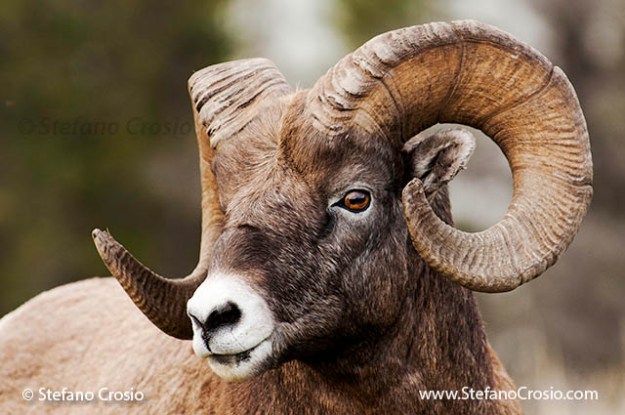
Bighorn Sheep Portrait

Bighorn sheep (Ovis canadensis)

I have uploaded a new gallery to my Web site with a selection of my bighorn sheep (Ovis canadensis) images taken in Canada’s Jasper National Park: feel free to go take a look if you feel like it.

The image above is a sample from that gallery: a few hours “invested” following a herd of bighorn sheep during their grazing rewarded me with a few photographs that I am happy with. This one is a head shot of a beautiful individual who let me approach at a safe but relatively close distance. I am fond of this image because I think it shows the character of these animals, highlighting their most distinctive feature: those majestic, weathered, curled horns in a graphic way, while the soft, diffused light of an overcast day limits contrast and allows viewers to see every detail of the subject’s face.

The gallery contains a collection of different images, some of which will be the subjects of future posts because they are interesting behavioral shots of these animals.

if you have the opportunity to check them out, let me know what your favorite ones are!

If you would like to see more images of mine, feel free to browse my Galleries.

As per my copyright notice, please respect my work and do not download, reproduce or use the image above without first seeking my consent. Thank you :-)

Wine Review: Tenuta San Guido, Bolgheri Sassicaia 1995 DOC… and the History of “Super Tuscans”

Tenuta San Guido, Bolgheri Sassicaia DOCLast month, a friend of mine invited me and a common friend to dinner at his place. At the time of the main course, he showed us what he had decided to share with us: not only was it a bottle of Sassicaia, but it was a 1995 vintage!

The Bottom Line

Tenuta San GuidoBolgheri Sassicaia “Sassicaia” 1995 DOC ($150): let me say it right from the outset – WOW! Although I had had Sassicaia before, having the opportunity to taste a bottle having 18 years of in-bottle aging under the belt was beyond fantastic.

Rating for this excellent wine: Spectacular Spectacular – $$$$$

(Explanation of our Rating and Pricing Systems)

Before we get into the details of that almost mystic 🙂 experience, let’s take a closer look at the notion of “Super Tuscans” and let’s delve into some history about the archetype of all Super Tuscans, that is in fact Sassicaia.

History of the “Super Tuscans”

If you pardon my quoting my own Wine Glossary, the term “Super Tuscans” indicates certain Bordeaux-style red wines that have been made in Tuscany, since the early Seventies by winemakers who wanted to experiment and veer off traditional Tuscan winemaking styles, often utilizing international grape varieties (such as Cabernet Sauvignon, Merlot and Syrah) as opposed to traditional local ones (such as Sangiovese). In order to enjoy such freedom to experiment, those winemakers produced their Super Tuscans outside the strict rules of the most prestigious Italian appellations (DOC and, more recently, DOCG), which resulted in those premium wines to be initially labeled as “table wines” and more recently as IGT wines (a more loosely regulated Italian appellation) in spite of their quality and substantial price tags. The “grandfather” of the Super Tuscans is Sassicaia, whose notoriety and quality led to the creation in 1994 of the DOC Bolgheri which includes a Sassicaia sub-zone, thus making Sassicaia the first Super Tuscan to enjoy DOC appellation status.

Although it appears that nobody knows for sure who coined the incredibly successful moniker “Super Tuscans“, some believe that it was created by Burton Anderson, a wine reviewer who covered Italy for Wine Spectator in the 1980s. What is certain though is that it very quickly became the name by which that kind of wines were internationally identified.

As we said, the wine that started the Super Tuscans phenomenon was Sassicaia. This fabled wine was created by the Marquis Mario Incisa della Rocchetta, who first completed his agrarian studies in Pisa in the Twenties and then, thanks to his being a family friend of the Baron de Rothschild (the owner of Chateau Lafite Rothschild, one of Bordeaux’s Premier Crus), he had an opportunity to visit the famous estate and study the terroir where the grape vines that produced one of the world’s finest reds grew. Incisa then went on to acquire a few rootings of 50-year-old Cabernet Sauvignon and Cabernet Franc vines from an estate near Pisa owned by the Dukes Salviati to transplant them in 1942 at the family’s San Guido estate in Bolgheri, Tuscany.

His decision to transplant those vines in an area of Tuscany that up until then had never known any serious viticulture was due to the resemblance of the soil of that area (“Sassicaia” alludes to the Italian word “sasso” meaning stone, and seems to refer to a pebbled terrain) with that of the Graves (which in French means gravel) on the Left Bank of the Garonne river near Bordeaux, where another Premier Cru, Chateau Haut-Brion, is located.

At first, Sassicaia had not enthused the Marquis (nor his employees working the vineyards, who supposedly called the wine, with typical Tuscan coarseness, “good only for the pigs“): this convinced Incisa to keep the first “experimental” vintages of the wine for personal consumption only. However, Incisa soon realized that, after a few years of aging, that same wine that had not convinced him initially would turn into a much better wine.

This realization gave him the incentive to keep at it, making several improvements, including being the first one to import small barrique oak barrels into Italy for aging Sassicaia and cutting a deal with wine producer Antinori (Piero Antinori was Incisa’s nephew) for the future distribution of Sassicaia, as a result of which arrangements Antinori sent their well-known enologist Giacomo Tachis to the San Guido estate to work on Sassicaia. Tachis refined the blend, the wine making process and the cellaring of the wine until, in 1968, the first “official” vintage of Sassicaia hit the market with just 3,000 bottles and initially it did not really rock the wine world…

The turning point was 1974, when Luigi Veronelli, a famous Italian food and wine writer, published a rave review of the 1968 Sassicaia. International acclaim for Sassicaia came not long after that, in 1978, when during a worldwide blind tasting of 33 Cabernet Sauvignon-based wines organized in London by Decanter Magazine, the 1975 Sassicaia took the top spot, ahead of all the prestigious Bordeaux reds, thus marking the beginning of the Sassicaia success story. Later, Robert Parker awarded Sassicaia’s 1985 vintage (universally considered the best yet) a perfect 100 point score and James Suckling of Wine Spectator even compared it to the 1985 Mouton-Rothschild, admitting Sassicaia into the Olympus of the world’s best wines.

(Credits for most of the information that I researched as a basis for this Sassicaia history: Decanter; L’Acqua Buona; Sassicaia.it; and Sassicaia.com)

About the Estate, the Appellation and the Producer

For detailed information about Tenuta San Guido and the “Bolgheri Sassicaia” appellation, please refer to this post.

I would definitely recommend that you also check out this other post featuring an interesting interview with the owner of Tenuta San Guido, Marchese Nicolo’ Incisa della Rocchetta.

Our Detailed Review

Now, on to my tasting notes for the Sassicaia 1995 that I had the pleasure of drinking! Considering the high profile of this wine, I am going to follow all of the steps of the ISA wine tasting protocol in my review (for more information, see my previous post about such protocol and its various steps).

Tenuta San Guido, Bolgheri Sassicaia “Sassicaia” 1995 DOC is a blend of 85% Cabernet Sauvignon and 15% Cabernet Franc, with just 12% ABV. It underwent between 14 and 18 days of maceration and malolactic fermentation. It aged 24 months in barrique casks, part new and part previously utilized. The Sassicaia 1995 vintage retails in the US at about $150.

For more information about the grape varieties Sassicaia is made from, please refer to our Grape Variety Archive.

In the glass it was clear, ruby red with garnet hints, thick.

The bouquet was intense, complex and fine, with aromas of black cherry, blackberry, sweet tobacco, cocoa, vanilla, soil and a graphite hint.

In the mouth it was dry, warm, silky smooth; quite fresh, gently tannic, quite mineral; medium-bodied, perfectly balanced, intense in its mouth flavors (with very good correlation to the bouquet), with a long finish, of excellent quality; mature and definitely harmonious.

Clicks & Corks is Foodista’s Featured Drink Blog of the Day!


Foodista

Looks like the Easter Bunny came one day early here – something happened today that I found pretty cool and that I want to share with all of you: a couple of hours ago I received an email from an editor of Foodista – the cooking encyclopedia and food news source informing me that Clicks & Corks has been picked as Foodista’s Featured Drink Blog of the Day!

My post An Overview of the ISA Wine Pairing Criteria will be featured on the Foodista home page today (on the sidebar on the right) and will be included in their Drink Blog of the Day Archive.

I am excited and honored that this new blog has been picked by Foodista’s editors and featured on the Web site of that thriving food lovers’ community.

If you are interested, go check them out at www.foodista.com

Happy Easter everyone!

Foodista Drink Blog of the Day Badge

Portrait of a Red Fox

Red fox (Vulpes vulpes)

I like foxes: I took this photograph of a red fox (Vulpes vulpes) in Manitoba, Canada, not far from where I photographed the arctic fox that I posted about a while ago. This red fox stuck around for a little while, looking at me and my tripod with some curiosity, before moving on in search of prey in those barren, wintry grounds. I love how it really looks in its prime, with that wonderful fur and tail, in the soft, diffused light of a nice overcast day, just perfect for a portrait!

If you would like to see more images of mine, feel free to browse my Galleries.

As per my copyright notice, please respect my work and do not download, reproduce or use the image above without first seeking my consent. Thank you :-)

Black Bear Cub Climbing a Tree

Black bear (Ursus americanus) cub climbing a tree

Black bears (Ursus americanus) are proficient climbers. They use their curved claws to cling to the bark and quickly climb high into trees. Generally, they do it to escape danger (it is common behavior for cubs), to eat the nuts or fruit in the tree, or to rest or sleep at the juncture between branches and trunk. In this image, a young black bear is descending a tree after an excursion to the canopy. It is amazing to see how even little bears will climb quickly and with dexterity all the way to the top branches of tall trees and perch there for a nap, with no fear of heights.

By contrast, grizzlies have longer claws that are not as well suited for climbing, which makes them not as effective a tree climber as black bears. This does not mean, however, that grizzly bears cannot or will not climb a tree. They certainly can, they are only clumsier than black bears (given also their heavier structure) so to climb a tree they often resort to hugging the tree and pulling themselves up, using branches as if they were the steps of a ladder.

Anyway, should you experience a close encounter with a bear in the wild, follow sensible bear safety procedures and avoid climbing a tree because chances are that either species of bears will climb it at the very least as well as you can!

Some useful online resources about bears and their behavior can be found at:  

Bear Aware

Bear Country USA

Denali National Park and Preserve

National Geographic Magazine

North American Bear Center

If you would like to see more images of mine, feel free to browse my Galleries.

As per my copyright notice, please respect my work and do not download, reproduce or use the image above without first seeking my consent. Thank you :-)